
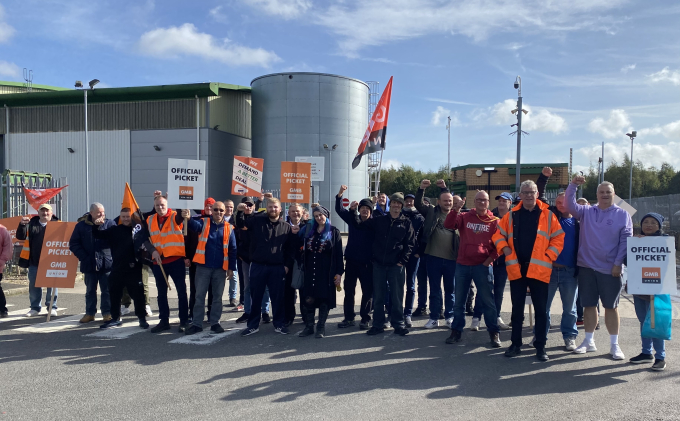
Over 50 members of the GMB union at three plants of the multinational Veolia in Notts began a strike for pay rises on Monday 25 September. Despite a half-yearly turnover of £23 billion and huge profits, the company has paid most workers only the national minimum wage over the 13 years of its operation so far.
Notts County Council manages a contract involving Veolia and several district and borough councils to process recyclable waste from local authorities in its area.
The strikers are picketing in the way it should be done: challenging every lorry that tries to gain entry, successfully turning back sympathetic local government refuse workers and others that could not or would not cross the line.
The local Ukraine Solidarity Campaign organised a support demonstration outside the Mansfield plant on Friday 29 September.
Veolia has used every legal threat they can. They have threatened the GMB workers with disciplinaries if they are seen on pickets at Veolia plants other than their own or are seen supporting Ukraine during the picket. They have implied legal action against the Ukraine Solidarity Campaign for drawing public attention to their Russian activities and the GMB’s opposition to them.
The company clearly fears publicity and the dispute spreading. Many Veolia workers across the country will suffer from similar exploitation. The Tory council hides from accounting for its inaction. But the GMB workers and the Ukraine Solidarity Campaign will need to continue their strike and solidarity challenges.
Veolia and boycotting Russia
By Dan Katz
The GMB union is campaigning in Nottinghamshire against low wages being paid by the waste and recycling company, Veolia. GMB organiser Mick Coppin says: “[Veolia] expect local workers to do dangerous, difficult and smelly work for the minimum wage. Our members can no longer afford to heat their homes.”
The workers are striking for better pay. All socialists and trade unionists should actively back them.
The Ukraine Solidarity Campaign (USC) has supported the workers but added a demand that Veolia, a multinational, end its operations in Russia.
The USC points out that GMB members have a record of backing Ukraine. Indeed, the GMB has played an important role in the labour movement in advocating for backing Ukraine.
However, the USC demand that Veolia should pull out of Russia is mistaken. If Veolia did pull out of Russia it would make no difference at all to Putin’s war. The blanket sanctions policy against Russia has not worked, and will not work.
Veolia is providing services that have no bearing on Putin’s ability to wage war on Ukraine. Veolia does not sell weapons to Russia.
Not all damage done to the Russian economy is positive, or helpful to our international struggle.
It is not the job of socialists to try to unpick the world economy. Attempts to do so, if successful, would take us backwards towards tightly defined political-trading blocs, and, inevitably, make the world an even more unstable and fractious place.
Break Veolia ’s Russian links
By Ralph Peters
One of the countries Veolia operates in is Russia and local Ukrainian campaigners are demanding they end their collaboration with the Russian regime.
At the last Notts County Council meeting, Labour councillor Mike Pringle called for the council to demand Veolia’s withdrawal from Russia and take action to resolve the dispute.
The Tory council leader, Ben Bradley who is also the MP for Mansfield, claimed dishonestly that there was nothing that the council could do about the dispute, and claimed to know nothing of the Veolia Russian connection. However, eight months ago the Tories had been told that the contract with Veolia could be terminated if it brought the council “into disrepute” as the Russian connection does.
In January, Veolia used the excuse that its activities in Russia are not in support of the war. This time Veolia UK claims that it has “no legal, financial or operational” ties with the Russian Veolia despite being both parts of the Veolia Group.