
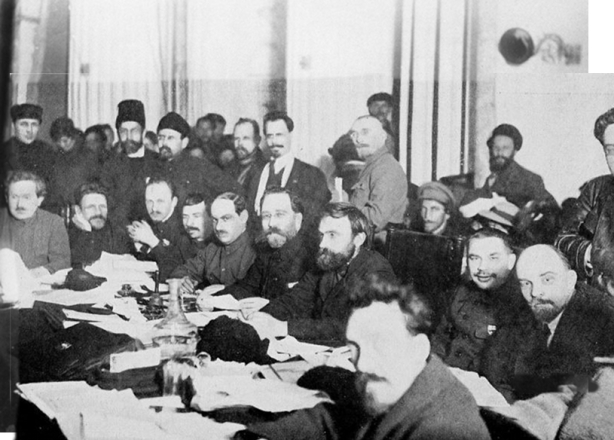
There is much to be gained from reading Eric Blanc’s Revolutionary Social Democracy: Working-Class Politics Across the Russian Empire (1882–1917). But within the valuable information and explanation of what some lesser-studied parties were doing is an argument in favour of what Blanc refers to as “orthodox Marxism” which doesn’t hold.
Blanc’s central thesis is simple: up to 1914, there was a classical Marxism of the Second International, exemplified by Karl Kautsky, its most able theorist. At the end of the war, the Russian Revolution provided a “Bolshevik” model, then promoted by the Comintern, which was of use only in autocratic conditions like those of Tsarist Russia, and which has hindered socialist parties ever since.
Blanc’s argument may have value against versions of “Bolshevism” which model themselves on the “Bolshevisation” of 1924-5 (taking Bolshevik civil-war improvisations as a universal model) and in stressing the huge democratic dimension of socialist revolution (against those on the left who effectively agree with the right-wing description of October 1917 as a “coup”, only approve of that). But his attempt to rehabilitate the “orthodoxy” of the pre-1914 socialists fails.
Blanc cites the Finnish Social Democratic Party (SDP) and the “Finnish Revolution” of 1918 as proof that “orthodox Marxist” parties can be revolutionary in parliamentary states. The facts he presents about Finland do not bear that out. In the ramshackle Tsarist empire, Finland had unusual autonomy. After 1905 it gained its own elected parliament, with votes for men and women over 24. It was the first country in Europe to win votes for women. The Finnish SDP became the biggest socialist party in the world in proportion to population, and in 1917, with 84,000 members, was larger than the Bolsheviks. The SDP won a majority in parliamentary elections in 1916. The Tsarist regime stopped the parliament from meeting. After the February revolution, the parliament met. But the SDP, a broad party with a strong right wing and centre, flouted its previous rule against coalitions with bourgeois parties, and formed a coalition.
In July the SDP pushed through the Finnish parliament a law for autonomy in all but foreign and military affairs. Confident after the “July Days” in St Petersburg, the Provisional Government dissolved the parliament and called new elections on 1-2 October which gave the SDP only 45-46% of the vote and parliamentary seats.
Bourgeois parties formed a coalition government. It set about reconstructing a state machine, suppressing the popular militias which had grown since February and affirming a bourgeois Civil Guard. It accelerated its efforts after the Bolshevik revolution in Russia recognised Finland as independent. In January 1918 the left pushed the SDP into an uprising to save the popular militias and resist the Civil Guard. Because of German and Swedish intervention, and the difficulty for the Bolshevik government in St Petersburg to give aid, the right had won the civil war by April, with much bloodshed.
Even in January, the SDP stated its aim as a socialist democratic parliamentary republic. But the “parliamentary road” did not work in Finland. And the SDP’s eventual tactic was more “insurrectional” than the Bolsheviks’ in late October in Russia. (Finland: uprising against a government claiming a base in an elected parliament. Russia: dispersal of the unelected Provisional Government so an elected assembly could take power).
Blanc accepts that the Russian Revolution was successful. (It later degenerated; but the Bolsheviks always said it would degenerate unless it spread to other countries). And, as John Marot has commented, wryly, in his review for Tempest: “Only Lenin’s partisans and those willing to follow their lead proved to be truly revolutionary, dedicated to achieving victory, at all times and everywhere. Those who did not, the social democratic parties that remained faithful to pre-1914 Kautskyist orthodoxy, turned out to be counter-revolutionary. Blanc shows this to be the case everywhere in the land of the tsars. It is the signal merit of his contribution. His book deserves the widest audience for that reason alone.”
Kautskyists
Kautsky would baulk at the idea that he was the architect of the Russian revolution, but Blanc twists his thought to fit the mould, claiming that the Bolsheviks were Kautskyists until, after their revolution, they rationalised local expedients into a false universal model.
As other reviewers have noted, Blanc makes a habit of referring to the “democratic revolution” to encompass both the bourgeois-democratic revolution and socialist revolution. He portrays Lenin as the loyal disciple of Kautsky, but sees the non-Stalinist revolutionary left as stuck trying to follow the post-1919 Comintern down a dead-end of “Bolshevik re-enactment”.
Kautsky wrote much of value, and was on the left of the German Social Democrats (SPD) and generally an ally of Rosa Luxemburg until about 1910-12. But he then shifted to the “centre” of the SPD. Blanc doesn’t deny the shifts, but makes little mention of debates with the SPD before 1914. Blanc mentions Luxemburg little and does not cover Luxemburg’s 1910-11 critique of Kautsky’s attitude to mass strikes and of his proclaimed “strategy of attrition”.
The pioneer Russian Marxist George Plekhanov and later Kautsky outlined the basics of what Blanc terms the “democratic revolution”, but it was not a one-size-fits-all. In Russia, the democratic revolution was seen as anti-feudal, while in the West, it was anti-capitalist. Russia had no parliament until the feeble and undemocratic, indeed token, Duma after 1906, and it had nothing like the “civil society” that existed in Britain or even semi-demi-autocratic Germany.
The “democratic revolution” in Germany was understood on all sides to be a socialist revolution of a particular type. Kautsky often let it be assumed that a democratic revolution in Germany — sweeping away the Kaiser and three-class voting, giving full powers to the only-consultative elected assembly, etc. was necessarily socialist. In Russia, Plekhanov and others were clear that it meant establishing a bourgeois democratic republic. As Lenin put it, an “American” rather than a “Prussian” bourgeois development.
Kautsky, the “Pope of Marxism” in the heyday of the Second International, presented the German SPD’s electoral advances as showing that the existing capitalist state, particularly its legislative bodies, could be used to achieve socialism. He hinted that this might not be smooth and peaceful, and that a doomed bourgeoisie would lash out in its last days, but the conclusion for now was almost always to continue moderate tactics in the expectation that conditions would surely get better. The successes of the German party could be extended across Europe.
Blanc fails to register the clear difference between the Bolshevik party by the time of the 1917 revolution and its social democratic counterparts, in particular the effects of the split among the socialists over World War One and the subsequent reconsideration by the internationalists like Lenin of their previous acceptance of Kautsky (after and before 1910) as an authority. (Kautsky had a “centrist” position on the war).
Blanc has to argue that the Bolsheviks were fighting for a “democratic revolution”, not socialism, in 1917. Blanc follows the argument of Lars T Lih about a continuity between the Bolsheviks before and after Lenin’s return in April 1917: that the Bolsheviks in 1917 neither broke from their previous positions nor intended, by “all power to the soviets”, anything different from the previous “democratic revolution” perspective. Blanc argues, unconvincingly, that the Russian Revolution was really all about seeking a permanent democratic form of government in place of autocracy, and so there is limited scope for it as a model in countries which have existing democratic institutions, though imperfect.
Duncan Hart, in his review, counters Blanc with quotes from Lenin and Trotsky. In September 1917, Trotsky wrote in Pravda:
“[T]hose who are of like mind with Comrade Martov, in opposition to us, deny the social-revolutionary character of the political task. Russia, they declare in their platform, is not yet ready for socialism, and our function is necessarily limited to the founding of a democratic bourgeois republic. The whole attitude is based on a complete rejection of the international problems of the proletariat. If Russia were alone in the world, Martov’s reasoning would be correct. But we are engaged in carrying out a world revolution, in a struggle with world imperialism, with the tasks of the world proletariat, which includes the Russian proletariat.”
Catastrophe
InThe Impending Catastrophe and How to Combat It (October 1917), Lenin wrote:
“Either we have to be revolutionary democrats in fact, in which case we must not fear to take steps towards socialism. Or we fear to take steps towards socialism, condemn them in the Plekhanov, Dan or Chernov way, by arguing that our revolution is a bourgeois revolution, that socialism cannot be ‘introduced’, etc., in which case we inevitably sink to the level of Kerensky, Milyukov and Kornilov, i.e., we in a reactionary-bureaucratic way suppress the ‘revolutionary-democratic’ aspirations of the workers and peasants.”
Blanc elides the experience of the war for not just the Russian proletariat but the international workers’ movement. The Russian Revolution itself would then have an even more significant impact on the consciousness of the most advanced sections of social democrats.
The exponents of “All power to the Soviets” argued for a government of workers and peasants, with the bourgeoisie shut out. The Bolsheviks — Lenin, for example, in State and Revolution, written in summer 1917 — concluded that this amounted to a new type of state, a workers’ state, a temporary institution on the road to communism. Blanc essentially ignores this last argument. The early Third International’s political views constituted a theoretical advance beyond those of the pre-1917 Bolsheviks and other revolutionary social democrats. It was based on the experience of the 1917-21 working-class revolutions, defeated and successful. Kautsky, by contrast, came to chair the Commission of Socialisation formed by the German SPD during the German Revolution of 1918-9, essentially as a ploy to counsel workers to wait until the experts reported to the scheduled National Assembly on when and what to socialise.
Third International
Contrariwise, parties that, in Blanc’s opinion, adhered to Kautskyist revolutionary social democracy during the 1917 revolution joined the Third International as founding members: the Latvians, the Polish Socialist Party (Left), the SDKPIL, and the Finns. (Blanc scarcely mentions the Bulgarian “Narrow” SDP, later Communist Party, which was probably closer to the Bolsheviks than any other party until its eclipse in the mid-1920s. Bulgaria was not in the Tsarist empire, but had many links with Russia). To make the case that 1917 was not a validation of “Leninism”, but rather of a wider revolutionary social democracy, Blanc emphasises the plurality of revolutionary groups in the Tsarist empire during the upheavals around 1917. Yet he attributes no similar agency to those very same parties in creating the Comintern, whose ideologies he attributes solely to “Leninism”.
As a result, Blanc’s defence of Kautskyism is unconvincing because his main goal is to discredit revolutionary socialists in the Bolshevik tradition and reject the political conclusions drawn after 1917 by the same people he is researching (the Latvian, Polish, Finnish etc. revolutionary socialists).