
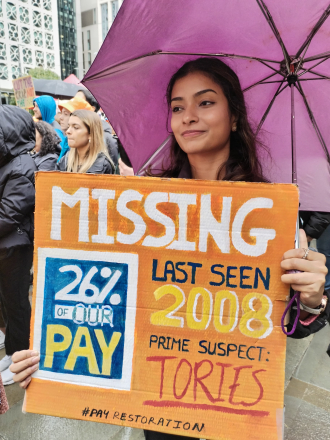
Two thousand mainly young doctors and other health workers rallied in Manchester on 3 October, during Tory party conference.
Striking junior doctors and consultants, members of the British Medical Association (BMA), were joined by members of the Society of Radiographers, also on strike on 3 October.
“Full pay restoration” is a much better use of the White Stripes’ “Seven Nation Army” than “Oh Jeremy Corbyn”. It sounds impressive shouted across St Peter’s Square. The BMA is fighting for a clear timetable for restoration of real-terms pay to 2008 levels.
Speakers at the protest put emphasis on the shift of the BMA from a professional association to a trade union, and to the growth of grassroots activity.
The BMA and its members have put up far more fight against the Tories than any other union. The question is what it will take to push the government further.
Coordination between junior doctors, consultants and now radiographers is progress. What other possibilities are there for coordination, and can action be significantly escalated?
How do we renew and expand wider labour movement support for the BMA, which does seem to have faded as the dispute drags on? There were striking university support workers from Unison at the Manchester rally, but few others.
And on the political field, how to budge the Labour Party, whose leadership is steadfastly refusing to back the doctors?
Socialists in the BMA and elsewhere need to seriously discuss these questions, while building the strongest possible support for the strikes and picket lines.