
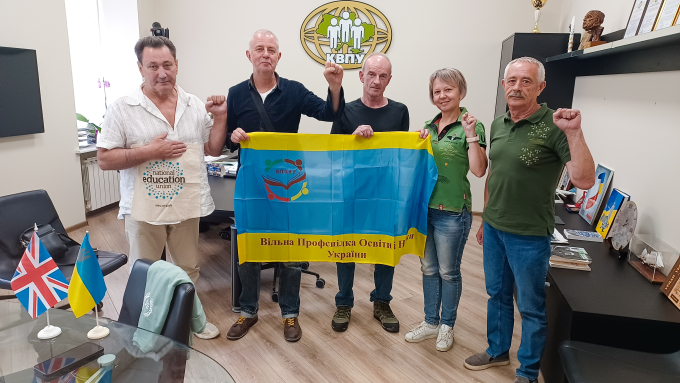
Mark Osborn, a teacher from south London, recently met activists from Ukraine’s Free Trade Union of Education and Science Workers (VPONU), an affiliate of the Confederation of Free Trade Unions (KVPU), in Lviv and Kyiv.
On 22 August, in western Ukraine, I met the Lviv Committee of VPONU. Nataliia Babych told me that Ukrainian education workers needed solidarity from British unions: “We want to survive. We want to be free and live in an independent Ukraine. We want to live in a democratic state.”
Nataliia told me that educators face increased workload and low wages. Despite the fact that teachers are exempt from conscription into the army, many have joined up and are now fighting at the front, including several elected union officials from the Lviv area.
During the course of our discussion, we were interrupted three times. Once by the sirens announcing a possible missile attack. Twice by sirens from convoys of trucks and ambulances ferrying wounded Ukrainian troops to a military hospital. In the basement of the building there was a bomb shelter, with sandbags piled up on the street outside.
The union activists were almost entirely taken up with the question of defending Ukraine against the Russian invasion. That question dominates everything else. The day after I met Lviv VPONU a Russian drone strike hit a school in Romny, Sumy Oblast, northeast Ukraine. Students are not back in school until the beginning of September, but some staff were on site.
The Principal, Tetyana Prokopenko, her Deputy Principal, School Secretary and Librarian were all killed.
In Kharkiv, Ukraine’s second biggest city and close to the border with Russia, 60 classrooms have been built in underground Metro stations. 1,000 students will be taught underground.
On Independence Day in Ukraine, Thursday 24 August, I met leaders of the KVPU and Tatiana Zuivra, an English teacher and VPONU rep at a secondary school. At the KVPU office in the capital, Kyiv, we discussed the issues Ukrainian teachers face.
The union activists proudly showed me photographs of relatives serving in the armed forces. Again, these union leaders asked for solidarity from British trade unions. Tatiana said that the wage of a Ukrainian teacher is the equivalent of around £140 per month, before tax.
Volodymyr Fundovnyi, National Chair of KVPU, explained how, during the 1990s and the transition in Ukraine from a Soviet-style economy to free market capitalism, the union had fought for wages that had been unpaid for many months.
The KVPU is the smaller but more radical of the trade union centres in Ukraine. Strikes have been banned under Martial Law. And Zelenskyy’s capitalist government is deregulating the economy. Unemployment stands at least 20%.
A new report from Unicef states that 1,300 schools in Ukrainian held territory have been destroyed since Russia’s full-scale invasion in February 2022. Only about one-third of Ukrainian school-age children are attending classes fully, in person.
Some schools have been destroyed as a result of missile hits, others have closed as a precaution.
Deputy Education Minister Andriy Stashkiv states, “Out of 13,000 schools in Ukraine, 6,500 will work as usual [when schools open in September], 3,800 will work in mixed format and 2,500 secondary institutions will work entirely online [this school year]” (29 August, Ukrinform). Stashkiv also reported that 70,000 internally displaced Ukrainian children have moved from Russian occupied areas into government-controlled areas.
Ukraine believes that up to 80,000 students will log on to Ukrainian schooling from Russian-occupied areas. This is dangerous for the students and their parents. If the Russian occupying authorities find out, the children and their parents’ lives could be at risk.
Following Covid, this is the fourth consecutive year Ukrainian children have had their education disrupted and the war means many are distressed, worried, and without safe spaces to learn. Regina De Dominicis, Unicef’s regional director says, “Not only has this left Ukraine’s children struggling to progress in their education, but they are also struggling to retain what they learned when their schools were fully functioning.”
Unicef also report that more than half the children who have fled the country are not enrolled in a school in their new home.
Ukraine has opened 3,200 criminal cases into the treatment of Ukrainian children under Russian occupation. Yulia Usenko, Head of Child Protection in the Office of Ukraine’s Prosecutor General, says the allegations include, “murders, mutilations, abduction… deportation and sexual violence.” Usenko states that Ukraine has evidence of torture used against 75 Ukrainian children and 13 cases of sexual violence.
In March 2023 the International Criminal Court issued an arrest warrant for Russian President Vladimir Putin for the deportation of Ukrainian children to Russia. Ukrainian President Volodymyr Zelenskyy states: “371 children have been returned to Ukraine from deportation… we know for sure that at least 19,505 children … are still with the enemy. And we must return them all.” A report in February 2023 by Conflict Observatory claims that Russia puts Ukrainian children in camps where they are subjected to “political re-education”.
UN official Rosemary DeCarlo states that 545 Ukrainian children have died, and 17,000 have been injured since the full-scale invasion began in February 2022. DeCarlo accepts that the actual numbers are almost certainly much higher. Ukraine believes 1,165 children are also missing.