
In mid-September of 1941 German troops occupied Kyiv. On 26th September a decree ordered all “Yids” (sic) resident in the city to assemble three days later at the junction of Melnikova Street and Dokterivskaya Street, on what was then the north-western edge of the city.
From there the Jews were marched to the nearby Babyn Yar ravine, where they were stripped of their possessions and clothing and then systematically massacred. 22,000 were killed that day. Another 12,000 the following day.
By November, according to the report of an SS commander responsible for the mass murder, some 75,000 Jews had been killed in the ravine.
But that was not the end of the slaughter. By the time of the Nazi retreat from Kyiv in November of 1943, over 100,000 people had been massacred in Babyn Yar – mainly Jews but also Roma, Ukrainian nationalists, the mentally ill, clergymen, Communists, and Ukrainian and Russian prisoners of war.
In the post-war years Ukraine’s Stalinist rulers wrote this chapter of the Holocaust out of history.
In the late 1940s Nikita Khrushchev, the then head of the Ukrainian Communist Party, rejected calls for a monument to be erected to the victims of Babyn Yar. So too did his successor, Mykola Podhorny.
Instead, in order to erase the very existence of the ravine, Podhorny ordered it to be filled in with earth. A dam the height of a six-story building was erected at its northern end, and for three years slurry from a local brickworks was pumped into the ravine.
But in 1961 the dam wall broke, flooding the adjacent Kurenivka district. Estimates of those killed as a result vary widely, but the minimum figure is 145.
The same year Yevgeny Yevtushenko published his poem “Babi Yar”, initially in the underground press and then in Literaturnaya Gazeta, in protest at the ongoing refusal of the authorities to acknowledge Babyn Yar as a site of the Holocaust.
Yevtushenko was immediately denounced in state media for supposedly attaching more importance to the sufferings of Jews than the sufferings of the Russian people. According to Khrushchev, by this time General Secretary of the Soviet Communist Party, the poem portrayed Bayn Yar “as if only Jews were the victims.”
Jewish activists who did not enjoy Yevtushenko’s prestige faced harsher treatment in their attempts to commemorate the massacre of September 1941. They were detained at railway stations to prevent them from travelling to Kyiv, sacked from their jobs, and, in some cases, imprisoned.
In 1965 the authorities ran a competition for the design of a memorial in memory of those killed at Babyn Yar. They rejected all entries. None of them corresponded to the Stalinist mythology of the Great Patriotic War.
In 1972 27 Jews were arrested and sentenced to fifteen days imprisonment for laying flowers at Babyn Yar on the anniversary of the massacre of September 1941. The following year five Jews were arrested for unlawful assembly in attempting to commemorate the massacre.
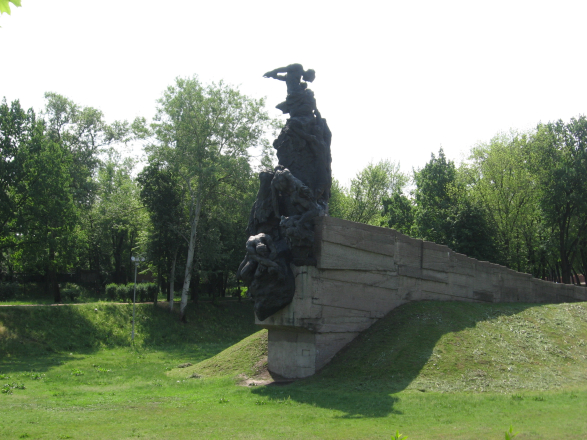
In 1976 a grotesque memorial was erected by the authorities at Babyn Yar. The central figure in the monument is a Soviet soldier. The monument’s inscription makes no mention of the Jews who had been the primary victims of the successive slaughters at the site:
“Here, between 1941 and 1943, over 100,000 citizens of the city of Kyiv and prisoners of war were shot by the German fascist predators.”
Subsequent plans to build a sports stadium on the site were abandoned, but not the construction of a television tower (targeted in a Russian missile attack in the second week of the war), a multi-lane dual carriage, and apartment blocks.
Work on these building projects constantly uncovered corpses from the slaughter of 1941. The work also involved digging up graves and destroying headstones in the old Jewish cemetery of Lukianovka, immediately adjacent to the ravine.
Only after the demise of Stalinist rule did it cease to be a crime to acknowledge and commemorate Babyn Yar as the site of a chapter of the Holocaust. Annual commemorations became not just legal but also officially supported by municipal and state authorities.
In 2016 work began on transforming the site into a Memorial Centre, one in which the mass murder of Jews was no longer written out of history. A plaque at the entrance to the sprawling site invokes the memory of:
“Those tens of thousands of inhabitants of Kyiv who were killed here on 29th/30th September 1941 only because they were Jews. But let us also honour the tens of thousands of Ukrainains, Jews, Romani and representatives of other ethnic groups whose lives were taken away here by the Hitlerite regime during the Nazi occupation in 1941-43.”
A Road of Sorrow leads from the entrance into the centre of the site. Triggered by the body movements of anyone walking along the path, 36 overhead microphones quietly play extracts from Jewish prayers and the names of some of the victims.
The ceiling of an eleven-metre-tall symbolic synagogue designed in the shape of a book, assembled from wood gathered from derelict buildings across Ukraine, shows the positions of the stars in the Northern Sky in the night of 29 September 1941.
A Crystal Wall of Crying, made of anthracite and rock quartz crystals, stands as a symbolic extension of the Wailing Wall in Jerusalem. The Crystal Wall is positioned, within ten metres of accuracy, where a straight line drawn as an extension of the Wailing Wall would pass through the site.
A tall monument of bricks, topped by a tank of slurry water, recalls the deaths in the Kurenivka district in the man-made disaster of 1961. The bricks are taken from derelict buildings throughout Ukraine, including the local Zejcev brickworks.
(One employee of the brickworks had been Mendel Beylis, charged with ritual murder in the infamous Beylis Trial of 1913.)
Another monument is dedicated to the poet and head of the Ukrainian Writers Guild Olina Tehila, one of the 600 or so members of the OUN (Organisation of Ukrainian Nationalists) killed at Babyn Yar.
An Alley of the Righteous is dedicated to the Ukrainians who saved the lives of Jews during the Nazi Holocaust. Over 2,500 Ukrainians have been awarded the title of “Righteous Among the Nations of the World.”
Other monuments and memorials are dedicated to the memory of other victims of the massacres committed at Babyn Yar – Roma, clergymen, Ukrainian nationalists, and children – and to all those who fell victim to Nazism.
The Memorial Centre is not yet complete. The planned museum at the entrance to the site is still under construction (or renovation). So too is a massive pyramid-shaped kurgan dedicated to the victims of the 1961 disaster. The task of adding to the collections of archival material is also ongoing.
But there is a contradiction between the aim of the Memorial Centre (“to prevent the resurgence of totalitarianism and the spread of xenophobia, including antisemitism, Romaphobia and Ukrainephobia”) and versions of Ukrainian history which uncritically glorify the role of the OUN during the war.
Both wings of the OUN – the OUN-M led by Andriy Melnik, and the OUN-B led by Stepan Bandera – collaborated with the Nazis in the Holocaust. At Babyn Yar itself both factions were members of the Ukrainian Auxiliary Police which assisted in the massacres.
But Kyiv’s Prospect Stepana Bandery is, literally, just five minutes walk to the north of the Memorial Centre. Legal challenges to prevent the renaming of the boulevard, previously Moskovsky Avenue, were initially successful but subsequently overturned on appeal.
Rescuing the Holocaust from the silence of Stalinism is a positive. But it should not be at the expense of being silent about those who shared the antisemitism of the Nazis and collaborated with the latter in carrying out the Holocaust.