
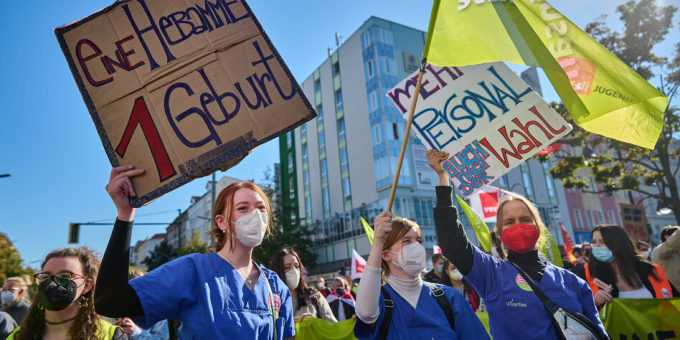
In September 2021 thousands of healthworkers launched an indefinite strike at Charité and Vivantes, two of Berlin’s large municipal hospitals. So began the Krankenhausbewegung - Berlin’s Hospital Movement. After a month, they won.
A year later, nurses in the UK underwent their own industrial awakening, as the Royal College of Nursing balloted for nationwide strike action over pay. The differences between the disputes could not have been more stark, as a series of obstacles — some erected by anti-union laws, others by their own union — combined to defeat the UK nurses, despite overwhelming public support.
Women’s Fightback interviewed Stella Merendino, an Emergency Department nurse working in Vivantes hospitals, who went on to play a leading role in the movement.
ROOTS OF THE DISPUTE
The roots of the Hospital Movement will be familiar to British readers: rightwing reforms to the healthcare system and the challenges posed by the Covid-19 pandemic. In the early 2000s, Germany introduced a system, already in use in the US and UK, in which hospitals receive a set fee for a procedure or course of treatment, regardless of how much it actually costs to deliver (the system is known as Diagnosis Related Groups, or DRGs).
Unsurprisingly, hospital managements have sought to exploit the system — if they can drive down the costs of treatment, they can pocket the difference. To rightwing politicians and lazy journalists, this can be chalked up as “efficiency”; anyone who works in healthcare will know that it is a recipe for poor quality care. In particular, DRGs have created an incentive to drastically cut the number of nursing jobs. Simultaneously, many hospitals have outsourced many of their non-medical roles in an attempt to drive down wages.
When the pandemic hit in 2020, the German healthcare system was in much better shape than the NHS, but things were still very bad for those on the ground. “Everyone was at the end of their strength”, says Merendino. Towards the end of 2020, organisers for Verdi, the public sector union, began to campaign around better staff-to-patient ratios and working conditions, and Merendino was quickly recruited: “I was on fire from the first moment because I knew what it meant for our patients. Short staffing kills people.” She immediately got to work moblising her colleagues: “It only took two weeks to get the whole Emergency Department organised,” she says, “which was pretty crazy, but shows you just how bad the conditions were.”
OVERCOMING DIVIDES
The Berlin Hospital Movement and the UK nurses’ strikes share a common backdrop, but that is where the similarities end. In the UK, the dispute was led by the Royal College of Nursing, which is strictly limited to nursing staff and only recently admitted healthcare assistants. It is one of a patchwork of (sometimes competing) unions in the health sector. Verdi, on the other hand, represents workers across the public sector, including all grades of hospital workers. Activists immediately sought to build alliances with waste disposal, cleaning and other workers, whose jobs had been outsourced in an attempt to reduce costs.
An NHS-wide strike could have been possible in the UK if Unison, the biggest health union representing non-medical staff, had managed to win their strike ballot. As it happened, they lost — a story for another article, perhaps — and spent the subsequent months instructing their members, nurses included, to cross picket lines.
“After I organised my Emergency Department, I started to help out with different hospitals, in different units to help others get organised within the union,” says Merendino. Whereas traditional trade unions focus on recruitment as a first step, in this case “you didn’t need to be a union member to get involved in this fight for better working conditions. I think this was quite a big thing, because no one felt pressured to get into the union — even if they did join in the end.”
In the UK, the RCN leadership pursued a sectional and apolitical strategy. It stayed out of politics — even going so far as to order members not to bring anti-Tory placards to picket lines — in an attempt to maintain a respectable image. While in talks with the government, the RCN openly declared its support for a separate pay scale for nurses, which would allow its members to negotiate separate pay deals while leaving lower-paid NHS workers on the old contracts.
The Hospital Movement, on the other hand, sought to overcome divides in the workplace and actively sought to exploit the backdrop of the 2021 federal election. “I spoke to the press a lot”, says Merendino, “and we invited politicians to our Emergency Department to show them how bad the conditions were. It was very interesting how politicians talk to people just prior to elections: ‘everything will get better when we are in power’ blah blah blah.” Ultimately, she adds, “they needed to back us because if they didn’t it would endanger their election prospects.”
For many nurses, the Hospital Movement was a way into a wider political world. “As a union you always have a political standing,” she says, “and you should use that to stay on the good side. We're definitely on the left and we’re very proud of it. We have many connections with queer organisations, feminists, homeless projects, anti-racist and anti-fascist movements, and so on. We keep each other informed about demonstrations. Our fight is not just within the health system but against all injustice and discrimination.”
DEMANDING
Rather than being initiated and controlled by a trade union bureaucracy, the Berlin strikes were based on organising in the workplace, with months of painstaking work and an attempt to organise meetings in every unit of the hospitals. Demands were formulated at the lowest possible level, rather than being distilled by supposed experts at Verdi's headquarters. Eventually, they came up with four demands: better nurse-patient ratios; a clear means for enforcing these ratios; better conditions for those in training; and a pay rise for outsourced workers.
As the mood of the struggle built, organisers put on rallies and engaged in other demonstrations of collective strength. It all culminated in the handing-in of what amounted to an ultimatum, signed by more than eight thousand health workers: either reach a settlement within a hundred days, or face an all-out indefinite strike.
When, by September 2021, no deal was forthcoming, the strikes went ahead and the struggle went from being hard work to being all-consuming. “I don’t know how I survived it really,” says Merendino. “You always had your head in the negotiations, or in talks with politicians, or with the press. You tried to have some sort of private life — but if I’m honest, my private life wasn’t a priority because there was so much at stake.”
WORKER EXPERTS
The engine of the Hospital Movement was its democracy. Workers took control of the strike, with delegates elected from every unit in the hospitals taking a direct part in decision-making and in the negotiations. As Merendino explains, this was a major shift for Verdi. “In negotiations, our union usually works with a lead negotiator. There are usually just a few people in the room. But we didn’t want just anyone negotiating our nurse-patient ratio, because union negotiators don’t work in those departments or units. We are the experts on our units.”
The union bureaucracy was blown along by the intensity of the dispute. “Because we organised so many people into the union in such a short period of time, they were forced to do it our way,” Merendino says. “We had a system of delegates, so that each unit had 2-4 delegates, and every decision that was made during negotiations was being run past the delegates. Delegates would have time to discuss with their teams also.” They had a negotiating team of about twenty, including Merendino, who took their orders from a mass meeting of delegates in a nearby room throughout the negotiations.
The high level of agency for activists served to keep spirits high even as exhaustion set in. “The whole length of it was brutal”, Merendino says. “You would sit there until 4 or 5 o’clock in the morning. But we were there with co-workers, who all wanted the same thing — you would make great friends. In the end, all those efforts and all those sleepless nights did something for us.”
In any healthcare strike, the issue of whether and how to provide cover (or “derogations” in union jargon) is always a heated debate. In the end, both the RCN in the UK and Verdi in Berlin sent nurses to work during the strike to cover life-preserving services. But again, the manner in which this was organised could not have been more different. The RCN’s derogations were decided by centrally appointed ‘strike committees’, which could be overruled (and in many cases were overruled) by unelected bureaucrats in union HQ. In the Hospital Movement strikes, workers in hospital units decided themselves how many people should work. In the Emergency Department, they chose the same number as the most under-staffed shift in the previous six weeks.
But how did all of this bottom-up democracy sit with a massive, institutional machine like Verdi? “I think that the union weren’t very happy about it at first,” Merendino says. “They didn’t expect to have 2,000 people getting organised in just a few months, but it happened. Those 2,000 people were very motivated and they wanted change. So Verdi were forced into giving us a voice. In the end, they could see the benefit. Before, we would have people sitting there who had never even worked in the hospital — or in whatever workplace, depending on what strike it was. Now they have a network of worker-experts that they can rely on. It has lasted in Berlin, and has been adopted in other cities.”
WINNING AND SPREADING
The standard way to run (and lose) an industrial dispute in the UK at the moment is to call short, disconnected spasms of strike action over a marathon-length period of time, in the hope that the employer will somehow become tired and give up. Not in Berlin. The Hospital Movement walked out for an indefinite period. Crucial to their ability to keep going was decent strike pay from Verdi — 80 percent pay for the nurses, and (after some crowdfunding) more than that for outsourced workers. By the beginning of October, after just one month of all-out strike, they had been offered a raft of concessions and ended the dispute.
They didn’t get everything. They won improved nurse-to-patient ratios (though not ones as good as they had initially demanded), and a means of enforcing them: nurses are now paid extra for working on understaffed shifts and get paid time off as compensation. Outsourced workers will get a pay rise, though will still not be on the same contracts as public sector workers, and are still outsourced. “The next step will be to take on outsourcing,” Merendino says.
In the aftermath of the Hospital Movement strikes, other health workers have begun to organise across Germany, using the same demands. A year later, an eleven week Verdi strike in North Rhine-Westphalia (which includes the cities of Aachen, Bonn, Düsseldorf, Essen, Cologne and Münster) ended with a similar set of concessions from hospital managers. “We can’t change the whole union movement in Germany in just one year or two,” Merendino says, “but it is happening gradually and it is a really good change.”
GIVE US WHAT WE WANT
In the UK, the nurses strikes were the backbone of the largest wave of strike action so far this century. They garnered a small increase in pay as a result of their action, but the majority were disappointed as it didn't come close to what they had demanded. So what lessons are there to learn? The RCN dispute was tightly controlled by the union bureaucracy. Unelected officials ordered members around, determined the strategy of the dispute and hand-picked the strike committees; later the minimal power that the strike committees had was taken away from them.
The leadership of the union ran a respectable, politically neutral campaign consisting of short strikes. Its supposedly clever, expert negotiators caved and recommended a terrible deal. Eventually the dispute collapsed out of alienation and fatigue. The situation had looked promising — RCN members turned over their leadership in their internal consultation and rejected the government’s offer — but trust and confidence in the dispute crumbled. The reballot was lost. In Berlin, nurses won — and they did so by running a democratic, worker-led campaign that was the opposite of the model deployed by many traditional unions. Trust was maintained throughout, especially during the crucial period of negotiations, because the workers were at the helm every step of the way.
The rising militancy of health workers presents a huge opportunity, not just for the left but for the cause of feminism. This is a sector dominated by women. Nurses and care workers have historically been reluctant to strike, susceptible to the mythology of ‘vocation’, and stigmatised when they take action. Across the world, millions of healthcare workers are coming to understand the reality of the work they do, and the leverage they have. “There is one option,” Merendino says, “and that is to give us what we want.”