
While the horror film genre exploits the female body as a site of terror, women artists can weaponise the same theme as a powerful creative source. Here, Liliana Pavier examines fine art objects through the lens of the horror film genre.
WANGECHI MUTU: MYTHMAKING
Wangechi Mutu is a self-proclaimed “irresponsible anthropologist and irrational scientist” and uses the canonically exploited black, female body as her point of departure. She fragments and distorts with collage and mixed media, splicing cuttings from magazines with medical diagrams.
Mutu’s collages merge monstrous mythology with the female body, tinged with violent eroticism, in a manner reminiscent of the conflation of female sexuality with supernatural terror in the horror film Carrie (1976, originally a novel by Stephen King). The mythical "curse" of womanhood pulses through both Mutu’s art and Brian De Palma’s film.
Mutu’s collage Your Story My Curse (2006) presents a scene with three sexless figures against a bruise-mottled background. Mutu’s cultural references and symbolic choices represent a dark and mystical femininity, both cursed and capable of cursing.
Carrie ’s opening scene initiates the title character’s pubescence and foreshadows her deadly supernatural powers: her ‘Curse of Blood’ arrives as she showers at school. Ignorant of menstruation, Carrie believes herself to be injured and screams in terror, whilst her peers pelt her with tampons, urging her to “plug it up” and jeering her.
The scene associates female sexuality with danger and mystical power, just as Mutu mythologises her female figures as both sensual and malignant.
Mutu’s The Original Nine Daughters (2012) includes figures with fantastical features such as claws, feathers, wings or antennae, wearing heels and stilts, or with long fingernails, or with pins in their bodies, a reference to the racism of anthropology toward black female bodies.
Both Mutu and De Palma explore womanhood as fearful, grotesque and erotic. De Palma employs the mystification of nascent female sexuality to understand societal fear of female bodily functions. Mutu reveals a history of fear and fetishisation of black female bodies, while creating a mythology of powerful black women who envision a future of liberation.
MIRE LEE: INSIDE OUT
In her kinetic sculptures, South Korean artist Mire Lee weds the wet horror of bodily function with pulsing desire. This combination is well represented in the horror film genre. Julia Ducournau’s film Raw (2016) and Ridley Scott’s Alien (1979) both use the visual language of abjection to conceive a powerful womanhood.
In Raw (2016), vegetarian veterinary student Justine comes of age with an appetite for human flesh. As she enters womanhood, she transforms into a cannibalistic monster. Both Ducournau and Lee strip the body down to raw, animal function, forcing the viewer to face a grotesque aspect of humanity they’d rather avoid.
Lee’s exhibition I’m a fountain of filth raving mad with love (2022) displays cement mixers, suspended sculptures and ceramic works along with two films, making “a show that gives you a feeling of going into the body of a huge animal”.
In Alien , the astronauts explore the “gigantic, cavernous, malevolent womb of the mother [alien]”. One astronaut, Kane, experiences a phallic oral rape from which the monstrous creature is hatched.
Lee strongly features motherhood in her exhibition. Its title, and the text written on the walls in concrete, are taken from Korean poet Kim Eon Hee, who has a set of poems on motherhood and frequently uses imagery of excrement and the body. Lee presents a film of her own mother sleeping, observing that “people immediately become like meat when they fall asleep”.
The exhibition explores Lee’s fascination with the fetishes of vorarephilia and scatology, both related to the fusion of filth with desire and therefore pain with pleasure, the mode in which the horror genre operates. This also connects strongly to Raw (2016), in which Justine’s appetite for flesh is figured as sexual desire.
TRACEY EMIN: THE BAD VICTIM SEEKING REVENGE
Tracey Emin has met similar criticism to that levelled at rape revenge horror films such as I Spit on Your Grave (1978), which was dismissed as “tasteless, irresponsible, and disturbing” by critics.
Emin’s iconic tent Everyone I Have Ever Slept With (1963-1995) was her “way of getting back at [then-boyfriend] Carl Freedman”. Motivated by self-defence, Emin regains her power from her literal and figurative rapists by exposing them in her work. Emin is the “all-powerful, all-destructive, deadly femme castrice”, like the heroines of rape-revenge films such as I Spit and Teeth (2007), who literally castrate their rapists.
In I Spit , Jennifer is subjected to a series of rapes and becomes a “catatonic, silent obsessive” who ritualistically executes her revenge, seducing and castrating each of her rapists. Critics Martin and Porter call this “one of the most appalling moments in cinema history”, implying that it is more disturbing than the rape. Similarly, Emin is characterised as almost more “distasteful” for discussing her history of abuse than the abuse itself.
In Teeth (2007), Dawn discovers that she possesses a "vagina dentata" after being assaulted. When Tobey overpowers and begins to rape her, Dawn’s vagina castrates him. Dawn discovers that when she is consenting, her vagina’s teeth ‘withdraw’ so that she may have sex safely. Dawn weaponises her vagina to castrate first a schoolmate who has sex with her for a bet and later her stepbrother as revenge for his negligence at her mother’s death. In the final scene, the audience perceives that Dawn has now embraced her monstrosity. Both Jennifer and Dawn transform from victim to deadly seductress.
Emin was assaulted by her mother’s lover at the age of ten, and at eleven by a stranger whom she met on Margate beach. In her poem and video, Why I never became a dancer (1995), Emin narrates her attempt as a teenager to win a disco-dancing competition in Margate, where she was humiliated and heckled by her audience of local boys (many of whom she had slept with), while dancing and calling out her sexual abusers’ names. The video represents her liberation from humiliation and shame. The slut-shaming she had once endured is transformed into a work of art in which Emin has the power of success and celebrity.
Emin’s ambiguous recount of abuse makes her, like Dawn and Jennifer, the imperfect rape victim. Because of claims that somehow they “liked it really”, they are failed by the justice system and must avenge themselves.
LOUISE BOURGEOIS: MOTHER ALIEN
Louise Bourgeois’ portrayal of the “shadowy figure” of the archaic mother resonates with the fearsome mothers of horror, particularly Mother Alien.
Emin collaborated with Bourgeois on a series of drawings, Do Not Abandon Me (2009-10), exploring the maternal body. Emin and Bourgeois’ symbolism of the womb as a void connects directly to the archaic mother figure that Ridley Scott represents in Alien . The representation of the womb as an abyss is also akin to the isolated and terrifying space of Scott’s iconic tagline: “In space no one can hear you scream”.
The spiral motif appears repeatedly in Bourgeois’ art, notably in the suite of oil-based, woodcut prints entitled Spirals (2005) and in her twisting, bronze sculpture, Labyrinthine Tower (1962). For Bourgeois, the spiral describes an infinite maternal cycle of birth, death and rebirth.
In Spider (1997), Bourgeois unites several of her concerns and motifs. The spider’s sculpted body and legs sprout threateningly around and over the cell. The spider’s body is, significantly, impregnated with glass eggs.
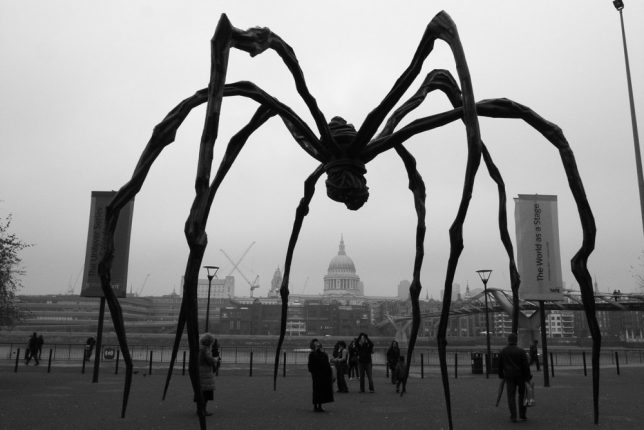
The largest of Bourgeois’ arachnid sculptures is Maman (2000), the iteration of Bourgeois’ mother as inescapable and malevolent. The steel installation towers over the viewer, terrifying in her disproportionate size and with a visible mesh egg sac.
Maman and the threatening mothers of Alien have reproductive functions inescapably linked to their destructive, fearsome capabilities. The power of the maternal for both Bourgeois and Scott is not simply threatening but ultimately protective.
FEMALE MONSTROSITY
The parallels between cinema and the works of these artists reveal the construction of female monstrosity by the patriarchal systems of order. The male gaze toward works of art, the audience’s exploitative voyeurism, and the camera’s phallic invasion of the female body, are all complicit in this.
Each artist represents a different face of the fearful and vilified woman: the racially stereotyped and hypersexualised black woman depicted by Mutu; the abject interior and tabooed sex of the female body by Mire Lee; the promiscuous victim of rape by Emin; the neurotic, phallic motherhood by Bourgeois.
These artists’ comprehension of the deep-rooted fear of their subjects enables their liberation. They describe what is perceived as inherently grotesque or unacceptable about womanhood without shame or censorship, and this is where both their criticism and success lie. These artists embrace their perceived monstrosity and in doing so, envision a new future for themselves, free from the limitations and expectations of the patriarchy, to express the nuance of their womanhood in full force and power.