
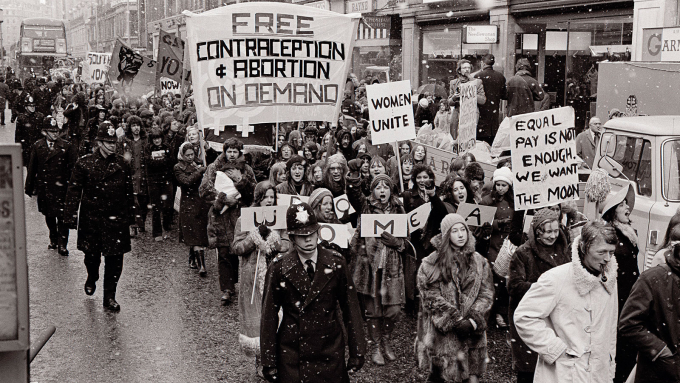
The campaigns in the 1970s and 1980s which defeated a series of attacks on the 1967 Abortion Act offer a model that we can learn from.
In 1975, the National Abortion Campaign (NAC) was set up to campaign against the White Bill, the first in a series of Private Members’ Bills in the 1970s and 80s which sought to reduce term limits. The NAC was made up of activists from the Women’s Liberation Movement, the socialist left and the labour movement, and it had two aims: to defend the Abortion Act and win real reproductive freedom. The NAC was clear that abortion was a class issue; they knew that to win, they needed to build a mass movement that was based in the organised working class.
That same year, the NAC held a trade union conference on abortion. NAC activists argued in their workplaces and in their union meetings that abortion rights were something that trade unions should fight for. They were operating in a labour movement that had considerably more conservative ideas about gender roles, family and abortion than today. Many unions were actively anti-abortion. There were many men who saw it as a private, personal matter, and “not their issue”. But persistent work by rank-and-file activists meant that those ideas started to change.
The 1975 Trades Union Congress voted for free abortion on request. Then, in 1979, the TUC organised a 60,000-strong demonstration in defence of abortion rights — quite remarkable when you think that today's TUC hasn’t even organised a demonstration on pay, in the midst of the biggest strike wave in decades! This was the first time the union movement in the UK organised a demonstration on women’s issues, but it didn’t happen by chance. Branch after branch, followed by a number of national union conferences, had called for it to happen.
There was a clear difference between the TUC’s purely defensive slogan, ‘Keep it safe, keep it legal’, and the NAC’s more radical, bodily autonomy-focused ‘Free abortion on demand, for a woman’s right to choose’. Activists in the NAC understood the importance of building the broadest possible campaign, while also continuing to raise more radical demands and build support for them in the movement.
The NAC organised in the Labour Party too, and in 1975 and 1977 conference voted for free abortion on demand in the NHS. Some Labour MPs ignored the conference decision — not much has changed there! — and voted for greater restrictions on abortion in Parliament. NAC activists pushed for votes on abortion in Parliament to no longer be taken as a free vote for MPs, arguing it should be voted on along class lines and not on the basis of individual conscience. This was defeated, with major unions voting against it.
In 1976, protestors occupied Westminster Cathedral and let off stink bombs in the House of Commons in opposition to the Benyon Bill, which sought to reduce the legal term limit from 24 to 20-weeks. In 1987, 20 years after the passing of the Abortion Act, the Alton Bill was submitted, seeking to reduce the legal term limit, this time from 24-weeks to 18. Once again, the NAC mobilised, creating the Fight Alton Bill campaign. FAB had local groups in almost every town and city, and co-ordinated another TUC-sponsored national demonstration. In both cases, they successfully fended off the Bills.
In 2003, the NAC merged with the Abortion Law Reform Association (ALRA) to form Abortion Rights UK.
Now, our rights are again under attack. As we mobilise to defend ourselves, we should remember that, to some extent, we've been here before and won. And we should remember the lessons: mass working class mobilisation will be crucial in the battle ahead.