
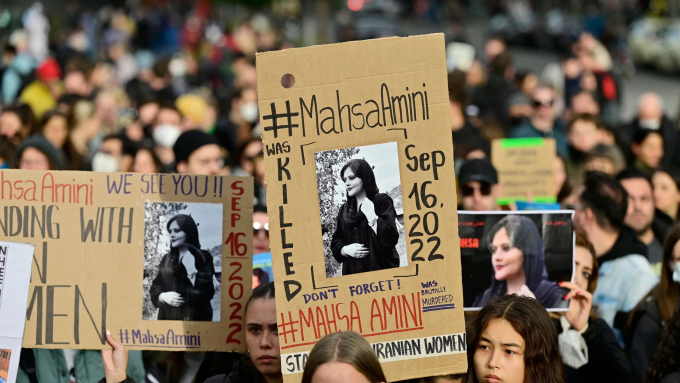
September marks one year since the murder of Jina Mahsa Amini, a young Iranian-Kurdish woman who was killed in detention following her arrest for allegedly violating Iran ’s compulsory hijab law. Her murder sparked the most significant protests against the Iranian regime since the 1980s and the strength of the uprising prompted the Iranian regime to take the notorious morality police off the streets.
CRACKDOWN
It has been confirmed that more than twenty thousand people have been arrested and hundreds killed in the subsequent crackdown, with the real number expected to be much higher. Sentences have been extremely harsh. At the time of writing, Iran Human Rights reports 464 executions so far in 2023, a sharp increase on previous years as the regime attempts to instill fear in political dissidents. Protestors have been taken through Iran’s Revolutionary Courts, in trials blighted by gross miscarriages of justice, including confessions being extracted under torture. Many individuals remain in detention, charged with offences carrying the death penalty.
Women political prisoners report being raped by interrogators, attacked by fellow prisoners, and being denied medical treatment. Many have been moved to prisons outside of the capital city. It is believed that the regime may be looking to close down Evin prison in Tehran and then claim that Iran no longer detains political prisoners.
The Iranian regime is one of the worst in the world for freedom of the press, and since the beginning of the uprising dozens of journalists have been detained. Niloofar Hamedi and Elaheh Mohammed were the first two reporters to be arrested in September 2022. They were charged with “conspiracy and rebellion against national security” and “anti-state propaganda” — charges once again carrying a possible death penalty. Their trials took place in the Tehran Revolutionary Court in July, behind closed doors, and they were both denied access to legal representation. Other journalists report being beaten in custody, recieving death threats, being followed, and recieving threats that their close family members will be raped or killed. At the time of writing, 26 journalists are detained in Iranian prisons.
Thousands of schoolgirls have been hospitalised following reports of mass poisonings. The first cases came from the city of Qom, in November, at the height of the wave of street protests. Ali Pourtabatabaei, who reported on the Qom poisonings, is one of the journalists that remains in detention. The poisonings are widely believed to be a punishment for the women and girl-led uprising, committed either by the government or by far right groups in Iran.
Despite this brutal crackdown, a lasting legacy of the protests has been continued defiance from Iranian women and girls, especially when it comes to wearing the hijab. Images and footage of women removing their headscarves feature regularly on social media, as well as on the streets of Tehran, and it’s estimated that 10 percent of Iranian women do not cover their hair.
At the time of writing, the anniversary of Jina Mahsa Amini is drawing closer, and the regime is pre-emptively arresting large numbers of women's rights activists in an attempt to stall a new wave of protests.
SEPIDEH GHOLIAN
Sepideh Gholian is a prominent 28-year old workers’ rights activist and a political prisoner in Iran. She was jailed in 2018 for supporting the Workers’ Union of Haft Tappeh sugar cane workers’ strike.
She was originally arrested along with more than a dozen other activists, union organisers and workers. They reported being beaten, whipped, and threatened with sexual assault whilst being held. Most were released after a short period, but Sepideh was only let go after a full month in detention.
Her freedom was short-lived. Iranian state television aired footage which seemed to show Sepideh confessing to taking part in a Western-backed campaign to overthrow the government. She countered these accusations on social media, declaring that she had been beaten and forced to make a false confession. She was imprisoned for a further four years.
On 15 March she was released again, and in an incredibly courageous act of resistance, she immediately staged a powerful one-woman protest outside the prison gates. Hair uncovered, carrying a bunch of flowers, smiling, she was recorded shouting “Khamenei [Ali Khamenei, Iran’s so-called Supreme Leader], the tyrant, we’ll drag you into the ground!” and demanding the release of other political prisoners.
Sepideh was rearrested that same day, and now faces a further two years in prison. In July, she was removed from court during a public session of her trial because she refused to wear a “chador”, a full-body cloak that reveals only the face. Her trial has been suspended.
RESISTANCE
The protests rumble on in Iran in fits and bursts. The strength of the uprising last year initially forced authorities to capitulate to the pressure of the protestors, at least in practice. For 10 months the morality police stopped patrolling the streets.
This year has also seen a wave of strikes. Inflation in Iran has been running at approximately 50% for several years now. Widespread anti-regime sentiment and a collapsing economy prompted workers from energy, steel, petrochemical and other industries to strike. Workers in more than 80 companies joined the action, striking against poor working conditions, job insecurity, low wages, and rising living costs.
The hijab remains the symbol of the uprising; the pinnacle of decades of oppression under a clerical-fascist regime. But the protests have always been about more than just reforming the compulsory hijab law — the Iranian people are demanding the overthrow of the Islamic Republic. An opinion survey of 158,000 Iranians conducted in late December 2022 showed that 81% rejected the Islamic state. Of these, 40% believe it should be replaced by a democratic republic and 22% by a constitutional monarchy.
In February a number of leftist, feminist and student organisations and worker unions joined together to issue a statement against the regime. Among their demands was the call for: the immediate release of all political prisoners and abolition of the death penalty; for a free press and freedom of assembly; for free trade unions; for full equality for women and the abolition of law that discriminates against women and LGBTQ+ people; for a secular state and an end to discrimination based on religion or ethnicity; for an immediate increase in wages and improvement in working conditions; and the expropiation of wealth in order to fund education and other public services. The statement shows the potential for a new, democratic society that can be built if the Iranian people succeed in overthrowing the Islamic Republic. We stand with them every step of the way.
• Follow the Solidarity with the Iranian Workers’ Movement Committee:
www.swiw.org
The aims of the Committee are to mobilise union and labour groups in support of the uprising and workers’ protests in Iran and in opposition to the human rights violations and executions. The Committee is chaired by John McDonnell MP and consists of Iranian women's rights activists and delegates from trade unions and Iranian and Kurdish groups. Workers' Liberty also sends a delegate.
• Pass our motion in your Labour or trade union branch, calling for the release of Sepideh Gholian and all political prisoners in Iran:
bit.ly/freesepideh-motion