
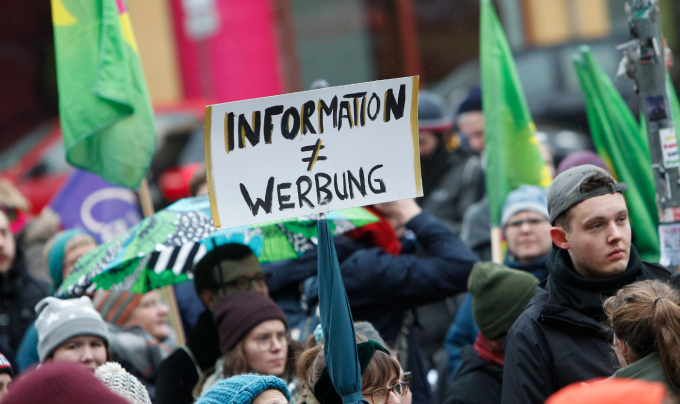
In Germany, abortion is covered by section 218 of the criminal code. It stands as an “offence against life”, alongside murder and manslaughter. It is only exempt if it is carried out during the first 12 weeks of pregnancy and if the woman has received counselling from an authorised advisor and has waited three days before the procedure. Until July 2022 a significant legal obstacle to abortion was section 219a of the criminal code. This law prohibited publicly offering, announcing, or advertising abortions.
In practice this meant that doctors were prevented by law from informing patients that they were providing abortions or what kinds of procedures they were able to offer in any other form other than verbally and in person. Both the prohibition of abortion as such and the prohibition of “advertisement for abortion” are based on laws implemented in 1933, in the early stages of Nazi rule.
The practical result of section 219a was that people seeking medical professionals qualified to conduct abortions, for example through a Google search, were unable to find factual information. Instead, they would usually find lists of doctors providing abortion exclusively through websites of anti-abortionists, who were looking to shame and doxx the doctors. Those seeking abortion would be subjected to a string of anti-abortion propaganda before they could even find a doctor qualified to conduct the procedure.
In 2017 Dr Kristina Hänel, a GP from Hesse was found to have violated paragraph 219a by including information on abortion on her website. She was sentenced to a €6.000 fine. There was huge public backlash and all political parties — except the governing CDU/CSU and the far right AFD — pledged to repeal the law. At the time, parties backing abortion reform held a majority of Bundestag seats, but the 2017 federal elections changed the situation overnight. The CDU and SPD formed a coalition, and in and amongst the horse-trading, the SPD dropped its pledge to get rid of section 219a.
Dr. Hänel appealed the court decision and was sentenced again in 2018 and, following another appeal, again in 2019. The case sparked outrage among the general population and Dr. Hänel received widespread support, including petitions with hundreds of thousands of signatories and nationwide protests.
As a result, the government decided on changes to section 219a, easing rather than ending the law. These changes were widely deemed inadequate and medical professionals continued to be investigated and sentenced for providing information. Doctors were still sentenced under the “new” 219a for including information about various possible procedures.
After sustained pressure, however, in 2022 the new government finally abolished paragraph 219a. Dr. Hänel and other medical practitioners sentenced under the old law have been exonerated.