
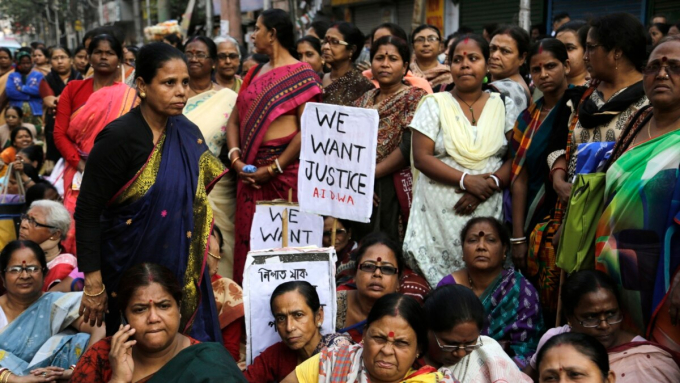
In May this year, two women were stripped naked and dragged through the streets of Imphal, the capital of Manipur state, before being gang raped by a mob of men. The backdrop to this incident is the ongoing ethnic violence between the Meitei people, who are the majority in Manipur, and the Kuki-Zo tribe, a minority. So far, over 130 people have died in the conflict and more than 35,000 have been displaced from their homes. It was Meitei men who raped two Kuki women.
Rape is the fourth most common crime against women in India, the weapon of choice for some men. Women and girls from Adivasi (indigenous Indians) and Dalit communities (once known as the ‘untouchables’) are almost twice as likely to be the victims of rape and violence. According to Dr Suraj Yengde, author of Caste Matters (2019), “The Dalit female… is a victim of the cultures, structures and institutions of oppression, both externally and internally. This manifests in perpetual violence against Dalit women."
The National Crime Records Bureau’s latest data shows there was a 45% increase in reported rapes of Dalit women between 2015 and 2021. Official statistics record that four Dalit women and girls are raped every day in India, though real numbers are thought to be much higher. Research carried out by the Dalit-led women’s group, the Swabhiman Society, says that 10 Dalit women were raped every day in India in 2021.
Rape is a weapon used against Dalit women and girls to keep the Dalit community in its place. And there are, of course, patriarchal structures and attitudes within the Dalit community itself. The rape of Dalit women and girls will often be "settled" outside of the judicial system, as perpetrators apply economic and social pressure on victims and their families.
According to Deepa Narayan, author of Chup: Breaking the Silence of India’s Women (2018), the oppression of Indian women “starts innocuously: it occurs in private life, within families, with girls being locked up in their own homes. This everyday violence is the product of a culture that bestows all power on men, and that does not even want women to exist.”
Kidnapping and abduction is the most common crime against women in India, followed by domestic violence from a husband and his relatives. Also shockingly common are "dowry deaths". 6,975 women were killed in India in 2022 because their dowry was regarded as insufficient by the husband and his family, this despite the fact that dowries have been illegal in India for more than sixty years.
Incidents of rape, murder and sexual violence regularly spark mass protets. The International Dalit Solidarity Network points out that “Dalit women activists are increasingly standing up for their rights. Numerous campaign groups organise protest marches, document and publicise atrocities, and offer their support to Dalit women. Such activities are not without risk as the response from dominant castes against Dalits fighting for their human rights can be brutal”.
For many Dalit feminist activists, frustration is common. Manisha Mashaal, from the Swabhimaan Society, says: “Forget getting justice, so many cases of violence against us are not even acknowledged. It makes my blood boil to see how we still have to fight for these basic rights”.
Deepa Narayan’s book, on the other hand, is a call to women in her own class — in her own words, the middle and upper classes — to stir themselves into action and break their silence on sexual violence and rape. “We need to talk about ourselves,” she writes, “and not just ‘them’, those poor, uneducated women out there”.
But large-scale, rapid change will only come about when women in fields and factories are stirred into action, when their voices are raised and their oppressors forced to listen.
• Further reading: Chup: Breaking the Silence about India's Women , by Deepa Narayan (2018); Caste Matters , by Suraj Yende (2019)