
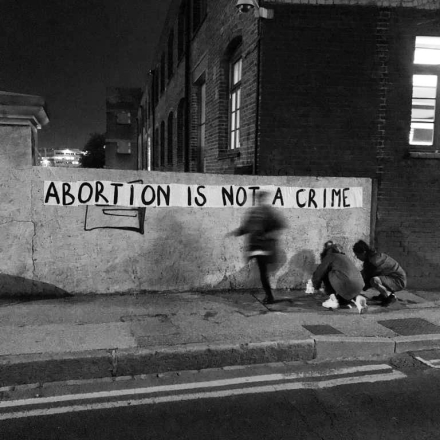
In June this year, Carla Foster was sentenced to two years in prison for having an abortion after the legal term limit of 24 weeks. The case highlighted just how limited and fragile our abortion rights are. She was sentenced under the 1861 Offences Against the Person Act. This law is still the foundation of abortion law in Britain: it criminalises all abortions and carries the maximum penalty of life imprisonment.
The 1967 Abortion Act legalised abortion under certain conditions, with an authorised provider. But as it didn’t repeal the 1861 Act, abortion remains illegal unless certain conditions are met. An abortion must secure the approval of two doctors, who must agree that continuing with the pregnancy would endanger the mental or physical health of the woman or pregnant person, and the termination must take place before the legal term limit of 24 weeks, except in the case of risk to the mother’s life or ‘severe disability’.
Carla Foster won her appeal, has had her sentence reduced (note: not overturned) and has been released from prison. But only a few weeks later, another woman was charged. 22-year-old Bethany Cox faces trial in January next year. She is the fourth woman to be prosecuted for allegedly carrying out an illegal abortion in eight months.
Both the British Pregnancy Advisory Service and the Royal College of Obstetricians and Gynaecologists say police investigations following later-term miscarriages and stillbirths are on the rise. In 2021, a 15-year old girl who had an unexplained early stillbirth was subjected to a year-long criminal investigation that involved having her phone and laptop searched. In 2022, a woman was kept in a prison cell for 36 hours after a stillbirth, due to suspicions she had an abortion after the 24-week limit.
DEMANDS
Not one more woman should face criminal investigation for having an abortion, and to that end we must demand the full decriminalisation of abortion now.
But decriminalisation will not be enough on its own. We need to remove all barriers to abortion access. That means:
• The abolition of term limits. Even with decriminalisation, term limits will mean that women like Carla Foster would still be forced into riskier, medically-unsupervised methods. We need access to safe and legal abortion as early as possible and as late as necessary.
• Abortion on demand. We must abolish the two-doctor rule and the requirement to prove that continuing with the pregnancy would involve greater risk to our mental or physical health. Simply not wanting to be pregnant should be reason enough. These constraints put pressure on women and pregnant people to question their reasons, as well as enabling anti-abortion doctors to undermine and obstruct access to abortion.
• Not just in law, but in practice too. We also need to win abortion on demand in practice. Although abortion is now decriminalised in Northern Ireland, it is still not available to most women due to a lack of services. In the rest of the UK, there is chronic underfunding, under-provision and under-resourcing of abortion services. Access to abortion is a postcode lottery, where in some areas, women are travelling hundreds of miles or waiting weeks to be seen.
Nearly three-quarters of abortions are carried out by private providers, funded by the NHS. According to a 2022 report by the Royal College of Obstetricians and Gynaecologists’ abortion taskforce, the quality of abortion provision is poorer, less safe and less consistent across the UK due to historic variation in funding and the exclusion of NHS Trusts from many contracts. Abortion care also fails to meet NICE (National Institute of Health and Care Excellence) guidelines, which require abortion procedures to be available within one week of assessment.
NHS underfunding and under-resourcing are also limiting the choice of abortion methods available. The two methods are surgical abortion and medical abortion. Surgical abortions take place in a clinic or hospital, under sedation or anaesthetic, and require a couple of hours' stay. Medical abortions involve taking two pills to induce abortion at home, which takes a few days.
Medical abortions are now by far the most common method before 12 weeks. They are favoured by NHS and private providers because they are much cheaper and easier to provide. Medical abortion will be many women and pregnant people’s first choice because they can stay home, and pills can now be ordered online via a Telemedicine consultation. But it won’t be everyone’s preference. Medical abortions mean days of very heavy bleeding, intense cramps and fever. This isn’t something that can be easily hidden from others in the home, such as parents or an abusive partner. It is also not safe for those with a variety of medical histories. Women who need or prefer a surgical abortion are often forced to wait weeks for an appointment or travel far from home to the nearest suitable clinic.
There is very little provision through NHS Trusts for abortions above 14 weeks. At later gestations, only a few NHS Trusts in England provide abortions, and in Scotland, Wales and Northern Ireland there is no provision at all.
We need to fight for access to a full and free choice of procedure, available locally for all, and as close to home as possible. Abortion services should be fully integrated into NHS sexual and reproductive health services. Trained nurses and midwives should be allowed to carry out abortions and prescribe abortion medication. At present, although nurses can carry out vacuum aspiration procedures for patients that have had a miscarriage, only doctors can perform the same procedure in a surgical abortion.
The fight for a huge expansion of abortion and contraception services means campaigning to rebuild the NHS. This includes demanding a huge increase in funding, paid for by taxing the rich, abolishing financial charges for migrants, and relaunching NHS workers’ fight for a real pay rise, so we can begin to solve the recruitment crisis.
The morning after pill should be free for all, available in all pharmacies, and we must abolish the mandatory counselling by pharmacists that is both shaming and unnecessary.
We need improved sex and relationships education in schools and we must defend SRE from attacks from the religious right.
We must defend the Gillick competency when it is attacked by transphobes and link the struggle for trans rights with the struggle for reproductive freedom. Those who want to restrict trans children and young people’s right to consent to gender affirming healthcare, such as puberty blockers, also threaten under-16s’ access to abortion and contraception.
Reproductive freedom is also about being able to decide to have a child, if and when we choose to do so. Winning reproductive freedom means fighting the wider inequalities that stand in the way of our right to choose, such as housing, pay, benefits (including the two-child benefit cap), childcare, migrants’ rights, disability rights and social care.
• Workers’ Liberty activists are currently discussing how we can shape the fight to defend and extend our reproductive freedom, bringing our campaigning into the unions and pushing for the labour movement to join the fight. Get involved by emailing: