
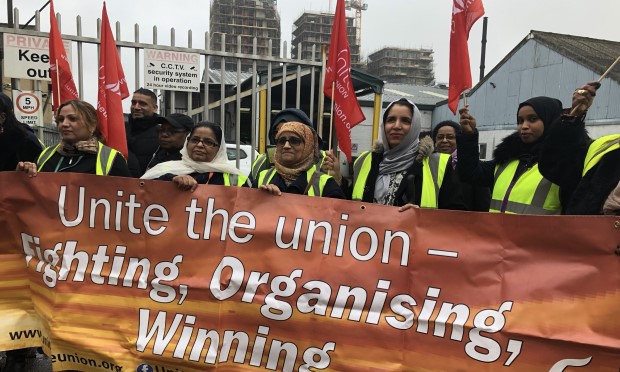
The working-class movement is on an uphill journey. The latest official (Certification Officer) statistics on union membership, published 6 July, are thankfully out of date, but sobering.
Between December 2019 and December 2020, union membership rose a bit. Between December 2020 and December 2021, it fell a bit, despite lockdowns and work-from-home beginning to fade.
The figures depend on unions compiling returns at their year-ends (mostly December 2021, a few as late as September 2022) and sending them in. Even now, the result is incomplete because Unite the Union has done no report since December 2020, but it’s unlikely that Unite increased membership in 2020-1.
Union membership has improved since then, at least in some unions. The National Education Union reported 34,000 new members in early 2023 after it returned a vote to strike, and reports hundreds of new workplace reps. The civil service union PCS reported a 5% upturn in 2022, and activists say more have joined this year.
Unite will surely have recruited from the good pay battles it has organised among bus workers, dockers, and others this year. GMB will have recruited from its efforts in Amazon warehouses.
The BMA and RCN, professional associations now becoming more like unions, have started setting up workplace branches and workplace reps.
Workers’ Liberty meets on 13-16 July for our annual summer school, Ideas for Freedom. The current strike wave started shortly before last year’s Ideas for Freedom, and is still rolling on.
There are gains from that strike wave. Relatively good pay deals have been won in some private-sector areas, improved pay offers (even if still real-wage cuts) have been gained and sometimes accepted in many areas, and the higher-stakes battles, involving jobs, conditions, and pensions, are still live in rail and on the Tube.
That has been much less than the potential. We argued from the start against the “marathon, not a sprint” philosophy of most union leaders. That has meant a dribble of one day’s strike here, a few days there, spread over months, and with workers told each time to “wait and see” for the next action. We have argued for unions to coordinate strike schedules to achieve the maximum joint impact, on a much larger scale than 1 February and 15 March.
If that argument had prevailed — which is partly another way of saying, if union organisation had been less faded before high inflation jolted unions into action, and if the socialists promoting the arguments had been more numerous, more coherent, more energetic — then we would have seen more victories by now.
And we could see the beginnings of the translation of the section-by-section industrial remobilisation into working-class-wide social and political mobilisation which we so far lack. The Enough is Enough campaign, launched in August 2022 as a sort of strike-solidarity movement, held several well-attended rallies and then shrivelled, without generating continuous week-to-week activity.
Workers’ Liberty has campaigned to get Trades Councils to act as ongoing centres of solidarity, but our success there has been patchy.
The Tories, despite everything, remain fierce and coordinated in their drive to use the economic turmoil to tilt the balance of class forces against us. The working-class resistance remains patchy and sectional, and weak on whole-class issues like the NHS.
Stubborn
The Tories stand more stubborn against public-sector pay demands than private capitalists (or the Scottish and Welsh governments). They are driving through the Minimum Service anti-strike bill, the Illegal Migration Bill, and the Public Order Act. They sit on the NHS’s runaway waiting lists and staff shortages.
They are likely soon to approve a huge new oilfield development. The government’s own official watchdog, the Climate Change Committee, reports “inaction”, “continuing support for further unnecessary investment in fossil fuels”, “progress not made”, “off-track”, or at best “worryingly slow”.
Despite the Tories’ unpopularity, their version of “financial responsibility” — no tax rises, squeeze wages and public services, assuage “the markets” — continues to hegemonise Keir Starmer’s Labour leadership, keen to show it is “pro-business”.
Unite conference on 10 July heavily voted down moves to disaffiliate the union from Labour. General secretary Sharon Graham said:
“This is the moment of maximum leverage for the union where we can hold Labour to account. Now cannot be the time to walk away. We would be weakening our own arm.
“It would be the worst time to leave the Labour Party when they are in touching distance of power, if we leave we wouldn’t influence that power.
“Labour must be Labour and the union must push them to into that position we must make them take different choices...”
She did not, however, suggest what the union will do at the National Policy Forum in Nottingham in late July, or at the Labour conference in Liverpool, 8-11 July. The unions have great weight at those events. At the 2022 conference they chose to give Starmer an easy ride, presumably relying instead on backroom haggling.
The US academic Eitan Hersh, a conservative Democrat but an acute observer of much of the US left, in or out of the Democrats’ orbit, has noted: “Many of us think we’re politically active — but in fact, we’re doing little more than signalling”.
Fail
That is true of union general secretaries if they fail to help members organise politically, openly, week by week. It is also true of individuals who lack weekly activity through workplace “singlejack” agitation, regular meetings, street-stalls, demonstrations, picket-lines, etc., and instead are left-wing via social media.
Wilhelm Liebknecht summed up the tasks of socialists as: “study, propagandise, organise”. Individual backroom work (reading, social-media and web activity) is part of it. The pivot must be coordinated out-in-the-world, in-person activity, drawing people “round” socialist ideas in workplaces, on the streets, and in regular labour-movement and other meetings weekly or monthly.
And round comprehensive socialist ideas, not just this or that militant or activist proposition on this or that issue.
We cannot foresee or dictate the large-scale ebbs and flows of working-class confidence and combativity. We can’t answer tactical questions in advance. Yet even in the most adverse times, we can build up a coherent network of activists, reliable each week in the workplace, in meetings, and on the streets, who educate each other in the principles of working-class solidarity, both as the guide in immediate struggles and as the foundation for reshaping society. Thus we can generate a collective capacity, a collective body of opinion able to answer those questions and organise for the answers.
If we had had more of that a year ago, we’d be further up the hill now. If we can do more now, we’ll get further up in the hill in the next year.
We produce our paper Solidarity as an instrument in building the network we need.
Historically, when trade-union movements, even, were most vigorous — let alone socialist political movements — writing, circulating, discussing regular newspapers was central to them.
Activists of the Industrial Workers of the World in its heroic period before 1914 probably spent more of their energies on the streets, circulating Industrial Worker and Solidarity (their paper the same name as ours) and waging free-speech fights, than in strictly-workplace activity. The life of the French CGT in its great days of the early 20th century centred round its paper Vie Ouvrière and other journals. Even the less-revolutionary United Auto Workers of the USA, in its heyday of the 1930s and 1940s, had a lively eight or twelve page newspaper, the United Automobile Worker. The archives include a local UAW paper for the West Side of Detroit, in which a column would advertise several union meetings every day, of different branches, committees, etc. in that area’s UAW hall.
Websites and social media are important. They cannot substitute for printed papers and meetings in drawing together and energising an activist collective. The printed paper comes with a person (to discuss, to propose activities, to make connections). The person, the socialist activist, comes with a paper, a rich and wide-ranging offer of ideas and visible evidence that the person is part of a collective effort.
Vladimir Lenin described the socialist newspaper as “the collective organiser”. Antonio Gramsci wrote that it might seem absurd to say that socialist activism is an “intellectual” effort; but it must in fact be “directive and organisational, i.e. educative, i.e. intellectual”.
We cannot hope to, and do not aspire to, coordinate working-class struggle by clambering into “official” positions and then issuing administrative directives.
We hope and aspire to advance working-class confidence, combativity, and solidarity, by discussion, self-education, education. This paper exists to serve that effort.