
On 21-22 June 2023, an "official" Ukraine Recovery Conference will be taking place in London. The conference will see banks, corporations and a parade of bourgeois economists announce that Ukraine’s post-war reconstruction has been solved: the Zelensky government will deregulate all industries, investment will come flooding in to the nation, and Ukraine will enter a new era as a beacon for Western democracy.
But there are some holes in this narrative. Western corporations are unlikely to invest in a country that is currently an active war zone. Zelenskyy’s government has restricted labour rights and civil freedoms in a worrying way throughout the war, which Ukrainian socialists have tried to sound the alarm on. The Recovery Conference will see little to no input from the Ukrainian left, trade union movement and civil society – all forces that will be vital if the country is to recover in any way possible. Otherwise, Ukraine looks to be headed for a repeat of Eastern European "shock therapy" in the 1990s – a series of policies that hit the Ukrainian economy and Ukrainian society more generally more heavily than a number of its former Soviet neighbours.
As a way of trying to advocate a left alternative to post-war reconstruction, the one-day conference "Another Ukraine is Possible" was held on Saturday 17 June, organised by the Ukraine Solidarity Campaign. Speakers from British and Ukrainian trade unions, Ukrainian socialist activists, left-wing economists and a number of other academics from various disciplines outlined the current social and economic effect of the Russian invasion, and how we might go about planning for a future where the Ukrainian working class are not left out of the picture.
Across all four of the panels, the message was clear: Ukraine’s future must not be decided by neoliberal economic policies, and with such a complex and wide-ranging series of problems and damage that has to be covered by "reconstruction", the only viable solution is to follow the lead of Ukrainian workers and activists who are doing the work on the ground, and know best what support is needed where. In order to shape this conversation, the British trade union and socialist movement must step up to the task, building active solidarity and networks within our unions to work alongside their Ukrainian counterparts. This can build pressure on both our own and the Ukrainian governments, as the social divisions within Ukraine come to bear greater and greater pressure on the wartime effort.
Although reconstruction is an ongoing process, that began long before the war will end, there was one other message that went without saying: the sooner Russian troops are stopped from destroying Ukrainian lives, the less there will be to "reconstruct". Reconstruction and the Ukrainian war effort are closely linked. Anyone who supports a just reconstruction for Ukraine should be just as strongly in favour of providing Ukraine with the immediate support – arms above all else – that is needed to win the war.
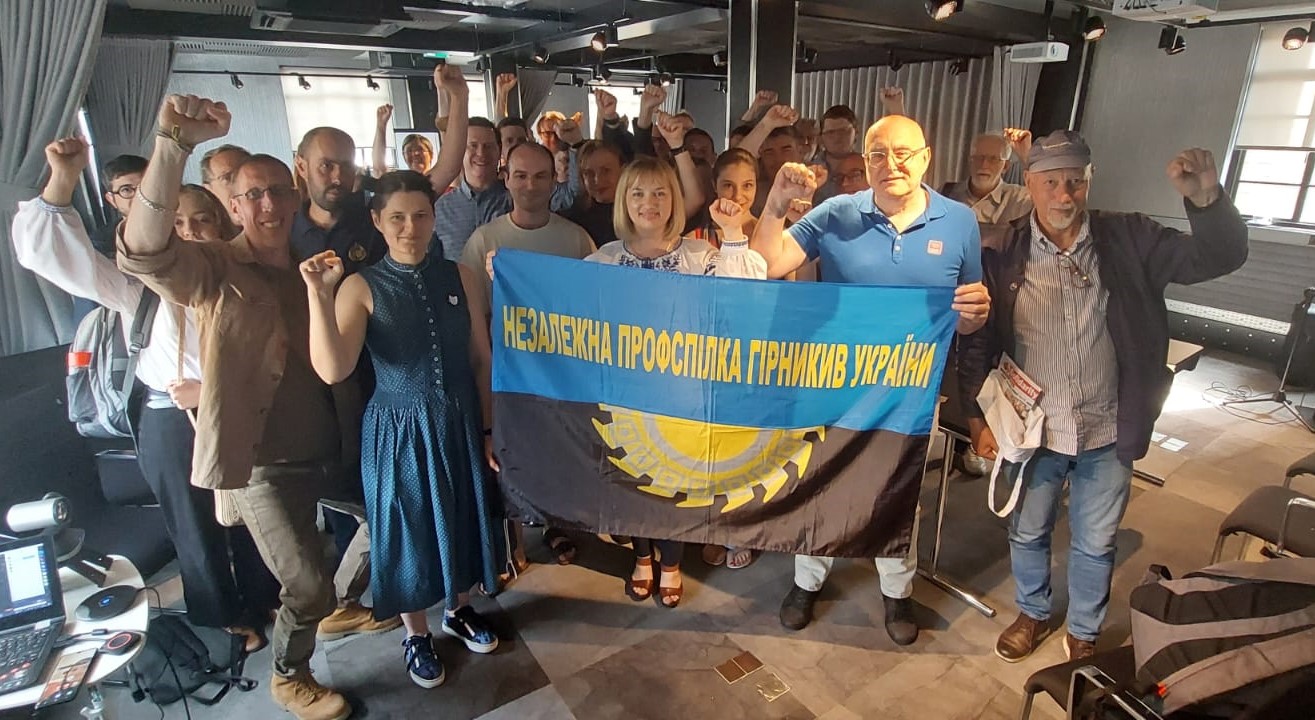
Solidarity photo at end of the event, with flag of Ukrainian miners' union NGPU. Centre: Oksana Holota of the Confederation of Free Trade Unions of Ukraine