
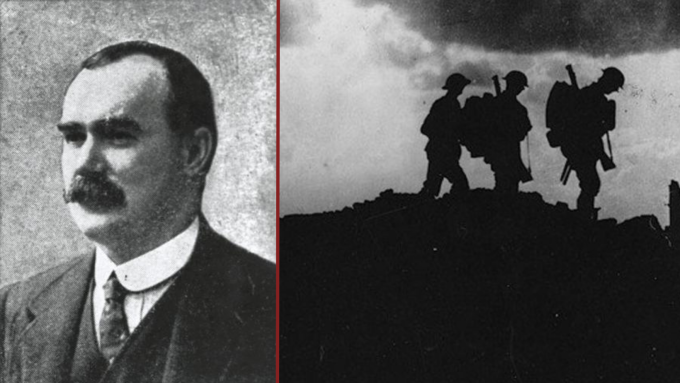
Workers' Liberty 3/71, on James Connolly and World War One. Click here for the whole printed version as pdf. The text online here is slightly expanded and amended from the printed version.
- Introduction
- War!
- The Basle Manifesto
- Connolly's first position
- Connolly's second position
- Connolly on Belgium and Serbia
- The Citizen Army songs and Connolly's third position
- The German majority socialists and Liebnknecht
- The consequences of 1914
- Moving to the IRB tradition
- Republicanism and socialism in Connolly
- A new picture of Germany
- Anti-Englandism as absolute
- In retrospect after Easter 1916
- A justification?
- Sorts of internationalism
- The pick-and-mix Connolly
- The evolving Connolly
- The constructions of Connollyism
"For us both Francophiles and Germanophiles are one and the same... patriots, bourgeois or their lackeys, and not socialists. The Bundists, for example, are for the most part Germanophils and glad of the defeat of Russia. But in what way are they any better than Plekhanov? Both are opportunists, social-chauvinists, only of different colours"
— Vladimir Lenin, Letter to Shlyapnikov
11 February 1915 [1]
"Connolly is most dishonest in his methods. In public he says the war is a war forced on Germany by the Allies. In private he says that the Germans are as bad as the British"
— Patrick Pearse, Christmas 1915,
quoted by Liam McNulty, James Connolly, p.291
"For... years now his fate has not been that of a prophet outcast — but of the prophet embalmed. In Ireland Connolly is the icon of all and therefore the prophet of none. Hypocritical adulation on the Left — bowdlerisation on the Right. It is sometimes hard to see Connolly as he was"
— Workers' Fight 6, May 1968 [2]
Introduction
James Connolly is one of the most admirable and admired Irish leaders in the last two hundred years. But Connolly, as he really was, is not the Connolly of most of his biographers and historians, notably Desmond Greaves, an Englishman assigned by the Communist Party to Irish work 80 years ago, whose biography was published in 1961, remains in print, and has been in continuous circulation since. More recently, more critical accounts have emerged, including Liam McNulty's new book.
Connolly was as he was. Here I try to reverse some of the misinformation from Greaves and others. I come to harsher conclusions than Liam does in his book.
War!
War! The Great War. World War One.
On 4 August 1914 Europe entered World War One. It had been moving to war, inexorably as it must now appear, after "Sarajevo", where, on 28 June, Archduke Ferdinand and his wife Sophie, of the Austrian Royal House, had been killed by Gavrilo Princip, a member of a Serbian nationalist secret society. Austria responded with an ultimatum designed to be impossible for Serbia to accept. All the powers were tied together by treaties, some hidden from view, secret treaties, and they followed, one after the other, into the cataclysm of the Great War. Soon it was military impasse, and that also expressed the impasse which capitalist society throughout the world had reached.
The Socialist International had foreseen this war and in its Basle Manifesto of 1912 had prepared for it.
The Basle Manifesto
"The International, at its Congresses at Stuttgart and Copenhagen, laid down the following principle for the war against war: In case of war being imminent, the working classes and their Parliamentary representatives in the countries concerned shall be bound, with the assistance of the International Socialist Bureau, to do all they can to prevent the breaking out of war...
"In case war should break out notwithstanding, they shall be bound to intervene for its being brought to a speedy end, and to employ all their forces for utilising the economical and political crisis created by the war, in order to rouse the masses of the people and to hasten the downfall of the predominance of the capitalist class..."
It identified the war, the expected war. The war that came.
"The recurring threats of war are getting more and more critical. The nations of Europe are always on the point of being driven at each other without the slightest reason of real people's interests for such attempts on reason and humanity...
"The most important task of the International falls on the working class of Germany, France, and Great Britain to demand from their Governments an undertaking to refuse all support to either Austria or Russia, and… in every respect to observe a strict neutrality...
"The greatest danger to European peace is the artificially fostered animosity between Great Britain and Germany… The best means of removing friction would be an understanding between Germany and Great Britain concerning the arrest of the increase of their respective fleets, and the suppression of the right of capture at sea.
"[This would] make impossible an attack on Serbia by Austria, and would finally secure peace to the world. To this end, above all, the efforts of the international movement must be directed.
"Congress… urges the workers of all lands to oppose to capitalist imperialism the international solidarity of the proletariat. It warns the ruling classes of all states against intensifying by warlike expeditions the widespread misery caused by the capitalist method of production, and emphatically demands peace".
In its 1912 words:
"Let the Governments not forget that in the present condition of Europe and the state of mind of the working class they cannot let loose a war without danger to themselves. It must be remembered that the Franco-German War resulted in the revolutionary movement of the Commune, that the Russo-Japanese War put into motion the revolutionary movement in Russia, that the competition in naval and military armaments has in England and on the Continent increased class conflicts and caused enormous strikes. It would be madness if the Governments did not comprehend that the mere notion of a world-wide war will call forth strong indignation and protest among the workers, who consider it a crime to shoot each other down in the interest and for the profit of capitalism, and for the sake of dynastic ambition and of diplomatic secret treaties..."
Immemorial words:
"The proletariat is conscious of being at this moment the bearer of the whole future of humanity.
"In order to prevent the destruction of the flower of all peoples, which is threatened by all the horrors of wholesale slaughter, famine and pestilence, the proletariat will put forth its whole energy...
"Oppose thus to the capitalistic world of exploitation and wholesale slaughter the proletarian world of peace and the brotherhood of the peoples!"
This text was criticised at the time and after war broke out for being perfunctory and for being vague on what the national parties would do, but there can be no question that the manifesto clearly foresaw the coming war, and that it called on the working class parties to oppose and resist all the imperialist powers. This was indeed, a case of the socialist International being "the bearer of the whole future of humanity".
Connolly's first position
James Connolly acted at the beginning of the war on the Basle Manifesto: against imperialism — all the imperialisms — and against all their wars.
"What should be the attitude to the working-class democracy of Ireland in face of the present crisis? I wish to emphasise the fact that the question is addressed to the 'working-class democracy' because I believe that it would be worse than foolish — it would be a crime against all our hopes and aspirations — to take counsel in this matter from any other source….
"In the first place, then, we ought to clear our minds of all the political cant which would tell us that we have either 'natural enemies' or 'natural allies' in any of the powers now warring…" (Our Duty in This Crisis,Irish Worker, 8/8/14).
Connolly was concerned with the prospect of a famine or high food prices in Ireland. That never became an issue during the war. On the contrary, "separation money" for the families of the 200,000 Irish soldiers in the British army eased the poverty.
"We must consider at once whether it will not be our duty to refuse to allow agricultural produce to leave Ireland until provision is made for the Irish working class.
"Let us not shrink from the consequences. This may mean more than a transport strike, it may mean armed battling in the streets to keep in this country the food for our people. But whatever it may mean it must not be shrunk from…
"If Ireland will starve, that the British army and navy and jingoes may be fed. Remember, the Irish farmer like all other farmers will benefit by the high prices of the war, but these high prices will mean starvation to the labourers in the towns. But without these labourers the farmers' produce cannot leave Ireland without the help of a garrison that England cannot now spare. It is the immediately feasible policy of the working-class democracy, the answer to all the weaklings who in this crisis of our country's history stand helpless and bewildered crying for guidance, when they are not hastening to betray her.
"Starting thus, Ireland may yet set the torch to a European conflagration that will not burn out until the last throne and the last capitalist bond and debenture will be shrivelled on the funeral pyre of the last war lord."
Connolly was murderously critical of the politics of the Irish Republican Brotherhood, whom he mockingly called The Advanced Nationalists. He specifically opposed and mocked their support for ''the German warlord", a stance on the coming war which they had taken well before 1914.
"The advanced Nationalists have neither a policy nor a leader. During the Russian Revolution [of 1905, following the Russo-Japanese war of 1904-5] such of their Press as existed in and out of Ireland, as well as their spokesmen, orators and writers, vied with each other in laudation of Russia and vilification of all the Russian enemies of Czardom". (Japan was an ally of Britain).
"It was freely asserted that Russia was the natural enemy of England; that the heroic [Russian] revolutionists were in the pay of the English Government and that every true Irish patriot ought to pray for the success of the armies of the Czar..."
He saw support for Germany in the war now beginning as more of the same.
"Surely the childish intellects that conceived of the pro-Russian campaign of nine years ago cannot give us light and leading in any campaign for freedom from the British allies of Russia today? It is well to remember also that in this connection since 1909 the enthusiasm for the Russians was replaced in the same quarter by as blatant a propaganda in favour of the German War Lord. .. The manhood of Ireland was pledged to armed warfare against the very power [i.e. Russia] our advanced Nationalist friends have wasted so much good ink in acclaiming…"
From the beginning, though, there was a contrast, if not a full contradiction. Connolly's articles in both the Irish Worker and in the Glasgow paper Forward were for Basle, but the Forward ones were more general, more international and more whole-hearted against the war, and the Irish articles were particularly Irish and more tender towards Germany.
There was not much for the Irish to do except not to follow the Home Rule party advice and join the British army, and to prepare to resist the export of food from an Ireland Connolly expected to be threatened with famine. And in the Irish Worker: "Should a German army land in Ireland tomorrow we should be perfectly justified in joining it if by doing so we could rid this country once and for all from its connection with the Brigand Empire that drags us unwillingly into this war."
The argument was presented an illustration of the idea that Irish people had no natural allegiance to Britain, but it worked by asserting the preferability of an allegiance to the rival imperialism, Germany.
Connolly's second position
At the start of the war Connolly was full of praise for the internationalist rebel member of the German Reichstag and anti-war activist Karl Liebknecht. In response to a mistaken report that Liebknecht had died resisting conscription into the war, he hailed Liebknecht as "our continental comrade" who had stood against "a world of imperial and financial brigands and cowardly trimmers and compromisers".
Having stood against the whole imperialist world system and with the Basle Manifesto; having dismissed the automatic taking of sides against British imperialism; having mocked at the physical force Republican Party, the IRB, for siding with Britain's reactionary friend Russia during the Russo-Japanese War of 1904-5 and for propaganda in favour of Germany "since 1909", on 29 August 1914 Connolly came out for the German state, the German autocracy. [3]
In a few weeks he went from Basle and Karl Liebknecht to the pro-war majority of the Reichstag Socialist Party.
On 29 August 1914, in the Irish Worker, paper of the Transport Workers' Union, he published The War Upon The German Nation, which sided explicitly in the war with one imperial camp, the German-Austrian, against the camp led by Britain and France. Connolly's new pro-German policy, from 29 August 1914 onwards, was already the line of the quasi-secret society and underground revolutionary party, the Irish Republican Brotherhood.
The baseline IRB position was to consider none but Irish interests and therefore to side with Germany simply because it was the power at war with Ireland's overlord Britain. Now new pro-German arguments were thought up, for example that developed by Sir Roger Casement, an Antrim man raised as a Protestant and knighted for services to the British Empire — that it was better to have German imperialism destroy British imperialism's position as the great power of the seas, which it had been since the Battle of Trafalgar in 1805 at least. Germany — so Casement and others thought — was challenging British monopoly in favour of freedom of the seas and of everybody else. In fact, the idea that Germany would not displace Britain in the imperialist hierarchy, but instead bring an age of world naval benevolence, was a fantasy of self-aggrandisement by the German government and of pious Irish-nationalist wishes and hopes projected on to the real imperialist Germany that was fighting the war.
InThe War Upon The German Nation Connolly adopted Casement's view that progress lay in the choice of one imperialism over the other — in the victory of the German Empire over the British. Connolly shifted to positive and active support for German imperialism.
This was not a modification or adjustment, or a mere acknowledgment that Basle was being supported by the socialists of only half a dozen countries. It was a straight reversal (though not a clean one, as we'll see). You can't, except in empty words, be both for the Reichstag anti-war member Karl Liebknecht and for the German minority, Rosa Luxemburg, Franz Mehring, Clara Zektkin, and others; and at the same time for the war and the pro-war majority of Reichstag deputies of the SPD (who would eventually kill Liebknecht and Luxemburg and their comrade Leo Jogiches).
The banner on the Irish Transport Union's Liberty Hall said "We Serve Neither King Not Kaiser But Ireland"; but the operative word was "serve". Connolly "served", he thought, Ireland, not the Kaiser. But serving Ireland came to mean to Connolly and his comrades helping Germany. They adopted the long-held position of the Irish Republican Brotherhood: helping England's enemy would serve Ireland.
Connolly had called all imperialism, including German imperialism by name, international brigandage. In his period as a propaganda skirmisher for German imperialism, he pointed to British imperialist hypocrisy in denouncing the imperialist misdeeds of its enemy, yet he supported the Germans in theirs, if sometimes evasively and mealy-mouthedly.
What had Connolly believed about the coming war? He believed in the view of the French socialist Gustave Hervé that the workers should call a general strike to stop the war. In the years before the war, Vladimir Lenin and Rosa Luxemburg said you would not get a general strike in the enthusiasm surrounding the start of war. They said that the “general strike to stop war” policy was unreal. It wouldn’t happen.
It did not happen. Then, probably, Connolly’s previous position pushed him towards believing there would be no workers’ action against the war, and to support for Germany.
Connolly on Belgium and Serbia
Austria shelled Belgrade on 28 July and the war started on a larger scale with Germany invading Belgium on 4 August.
Later James Connolly would rewrite the invasion of Belgium as it might have been... but for the misdeeds of Belgians, France, and Britain. It could have been a quiet, non-killing, non-destructive episode in which the Belgians had peacefully made way and let the Germans through Belgium to get at France.
The real invasion of Belgium was the destructive slaughter of many Belgians. In Louvain, a city of 48,000 people with a medieval University, in a few days in August 1914, the German occupiers killed 248 people, some of them hostages; deported 1,500 to Germany; destroyed one fifth of about 11,000 houses in Louvain; looted gold, silver, jewels and liquor, and deliberately burned the university's medieval library to the ground.
That was not normal for the time even in warfare. On the other side, it was not ridiculously compared to a typical incident of the early 17th century Thirty Years War, which had left much of Germany in ruins for two or three generations.
The Irish Home Rule Party, with which Connolly had competed through the Labour Party and in the Labour War, and which the IRB denounced as not nationalist enough, was much exercised by "little Catholic Belgium" and its parallel to Ireland. The Germans were understood to be acting deliberately on the military theory that to subdue a country they had to make the civilians, too, feel thoroughly defeated. And as a relatively young imperialism, they believed they should demonstrate their imperialist earnestness and ruthlessness, so that the others would take them seriously.
Yet Connolly defended this occupation and what went with it in, for example, Louvain. Connolly told a preposterous story to explain Louvain, that French soldiers (Belgium's allies) were in a chapel, and fired on the Germans. (Some Perverted Battle Lines, Irish Worker, 26 September 1914). As an explanation of what happened in Louvain when the Germans took over, that is not true. If anything like the incident described by Connolly happened at all, it was falsely dragged in so that Connolly could rehearse the story of earlier French government anti-clericalism. In other words, Connolly replied to the true accounts of Germany's invasion of Belgium by denouncing a France now at war with Germany.
"For a generation the French Government has made war upon the secular power of the Catholic Church in France... exercised its power with such relentlessness that many religious orders abandoned the country and removed themselves and all their belongings to Ireland, America, Belgium and other countries". Moreover, once-revolutionary France had been corrupted, and took part in the war only because of its "money-lenders... that they might not lose the money they lent to the Tsar" (Notes on the Front, Workers' Republic, 23 October 1915).
Connolly was repeating or inventing German propaganda. No one who knew the realiities of imperialism, as Connolly did, and had concern for the truth, would have said what he wrote about German imperialism, British imperialism, or the inter-imperialist war.
Belgian Catholic refugees were publicised and visible in Britain and in Catholic Ireland. In Allied propaganda much was made of them and of the history of German anti-Catholicism; nothing was made of the recent, early 20th century, conflicts between the French state and the Catholic church.
Then again he blamed Belgian civilians. "When we are told of the horrors of [the Belgian city of] Louvain, when the only damage... was the result of civilians firing upon German troops from buildings which those troops had in consequence to attack, I remember that in South Africa Lord Roberts issued an order that whenever there was an attack upon the railways in his line of communication every Boer house and farmstead within a radius of ten square miles had to be destroyed..." (The Friends of Small Nationalities, Irish Worker, 12 September 1914). This was untrue about Louvain, though the Louvain horrors happened before Connolly changed position for Germany. And it was an exercise in explaining away one imperialism by another, implying that Germany was justified. The same logic would imply justifying, by the misdeeds of others, British imperialism in South Africa or even in Ireland.
It was as strange for an Irish nationalist as for an anti-imperialist to justify Louvain, and the suppression of Belgium, a small nation, by its larger German neighbour. If you took sides in the war just according to the immediate issues, ignoring the broader world framework which the socialists had described in advance in the Basle Manifesto, then you would side against Austria with its drive to destroy the independence of Serbia, and against its enabler, Germany, which had invaded and occupied Belgium and a part of France.
Yet Connolly explicitly justified the occupation of Belgium and the killing of Belgian civilians who resisted.
Who was to blame? Not the invading German army, but the "stupid" Belgian ruling class who resisted. Or "England". Or the French. The Germans were entitled by the rules of war to do what they did in Belgium.
Appealing to the Irish not to resist a German invasion of Ireland and instead to do as he said the Belgians should have done, Connolly wrote: "Will Ireland allow her sons to be sacrificed by the same unscrupulous power that English capitalism may rise by garrotting the civilisation and commerce of Europe? No, a thousand times no!... No man to whom Ireland and Ireland's interests are dear will ever draw a sword or fire a shot in any quarrel of England's making..." (How England Sacrificed Belgium, Irish Worker, 17 October 1914).
In this argument Connolly was not against either war or Germany. He was appealing to Basle — but only against one side in the war.
Here capitalism was one-sidedly identified with England, while Germany was equated instead with "civilisation" and "commerce". In his articles in the war, as far as I know, Connolly never referred to the German ruling class as distinct from Germany as a whole. He sketched a largely nonsensical economic history of Europe in which Germany was on the defensive, fighting with guns to stop "England" strangling its industry, largely by economic means. Connolly had made a radical shift since the outbreak of war in his expectations and ideas of German imperialism.
Belgium had been left in the lurch, he wrote, because the UK had inveigled Belgium into its war to crush German industry, and then didn't send British soldiers, or didn't send enough of them. (How England sacrificed Belgium).
But then the UK shouldn't have sent sufficient troops anyway, because neither Britain nor Belgium (England's pawn) should have fought Germany, which was right, and only defending its industry and its industry's right to grow against "England".
Connolly remained determined, as Marxists always are, that there will be no talk of a "humane" war; but he fended off criticisms of what Germany was doing. He was full of pity for soldiers caught up in the terrors and horror of war; but you notice that he was writing only of Irish soldiers and giving them reasons why they shouldn't join "the war against the German nation".
In fact there was serious fighting between the Belgians and the German army. But Belgium's rulers, Connolly wrote, should have peacefully allowed German soldiers through Belgium to attack France. Then Belgium would have had neither slaughter nor destruction. That is, Belgium should have aligned with Germany in its war on France, and had only the Belgian "ruling class" to blame for the German invasion and occupation.
A more "pleasant, humane", unreal fantasy of war is hard to imagine, but it took the blame off Germany. It gives those who want it an imaginary alternative to what had actually happened: the horrible conquest and occupation of Belgium.
It evaded the issues of what would come of Belgium should Germany win the war: German Chancellor Bethmann-Hollweg's "September Programme" of 1914 foresaw Belgium becoming a permanent vassal state.
All Connolly's comments were couched as much as possible in the old socialist and humane anti-war terms, but it was all one-sided, either directly or indirectly pro-German. It was another version of old wine in new bottles.
In blunt English, Connolly's politics on the war were two-face, hypocritical, or Jesuitical. His opposition to the war was what would later be called "fake left". Short of being a native German chauvinist, he was as much for German imperialism no matter what as he could be. As much as the right-wing German Social Democrats were. And in Connolly's case because he imagined an Ireland freed after Germany's victory.
While lamenting the horrors of war for Irish people fighting for "England", he said nothing I can find against what the Austro-Hungarian Empire had done to Serbia with its ultimatum and its invasion leading to war in which one adult man in four in Serbia was killed. On the contrary, Connolly insisted ridiculously that only "two Empires... in Europe", England and Russia, stood "alone in the unenviable position of suppressing national existences and insisting upon small nations conforming to the mould in which these empires would cast them" (Some Perverted Battle Lines, Irish Worker, 26 September 1914). That, like much that Connolly said after 29 August 1914, was, I think, culpably mistaken.
In a speech on 30 August Connolly set out what he thought John Redmond, the leader of the Home Rule party, should have said in Parliament. He "might have risen and said: 'I and my colleagues will go to Ireland and consult the Irish Nation.' Then would Ireland be a nation in reality. 'We have waited and now Germany has come, and we will start our own Parliament. Stop us if you can.' Help would have come from all sides. Why the Royal Irish Constabulary would have acted as a guard of honour!" (Irish Worker, 5 September 1914).
The Citizen Army songs and Connolly's third position
Sustaining the Irish Citizen Army, formed during the Irish Transport Union's great Labour War with the Dublin employers, was now one of Connolly's main concerns. The union itself had dwindled to a tiny membership, though it would revive in the later part of World War One, after Connolly's death.
The songs sung by the Citizen Army, reported in Margaret Skinnider's 1917 book, Doing my bit for Ireland (pp. 221-3, 230, 237), sided clearly with German imperialism against British.
"'Tis the Germans they're out to destroy, me boys,
Whose prosperity did so annoy, me boys…
The great German nation has sworn their damnation,
And we'll echo the curse with a will, me boys…"
"Good old Britain, rule the waves
And gobble up all the land,
Bring out the blacks and Indian braves
To jigger the German band…"
"When the Germans come to free us, we will lend a helping hand,
For we believe they're just as good as any in the land…"
In his Irish papers, Connolly became a vulgar pro-German propagandist: that was his second position on the war. In more international (or anyway non-Irish) papers such as the Scottish Forward, which appealed in practice to British men not to fight Germans, Connolly still had something of the internationalist. That was his third position.
The German majority socialists and Liebknecht
TheWorkers' Republic would report favourably on the views of right-wing German Social Democrats, but not on left-wing, anti-war Social Democrats. On 4 December 1915 (Kaiser and Socialists), for example, it printed without comment the opinion of the ultra pro-war German socialist Anton Fendrich praising "the sincerity of the Kaiser's love for peace. I am convinced now more firmly than ever that he tried to avert the war up to the last minute... Nobody can expect that the views of the Kaiser are those of a radical or socialist, but there is no doubt that he understands the aims of the radical left in parliament far better and has more sympathies for them than the world knows".
It was necessary to counter the British demonisation of the Kaiser? Not with such lies and nonsense about the Kaiser and the German state! And Connolly did not, after his early praise for Karl Liebknecht (22/8/14, though again 16/1/15), report the stance of German socialist opponents of Germany's war.
In 1915 he approvingly reported the internationalist Zimmerwald conference (Workers' Republic, 25 December 1915): but Zimmerwald had been against all the imperialisms, and Connolly reported only the French delegates' stance. He did not even let readers know that German delegates attended, that there was German socialist opposition to the war. The manifesto of Zimmerwald and other details had been promptly available, three months earlier, in the Independent Labour Party'sLabour Leader and even in the British Socialist Party's (still pro-war) Justice, but Connolly did not report them.
The consequences of 1914
What happened in 1914 was of tremendous importance then and after. It shaped world history for the next hundred years and more.
If the Socialist International had been guided by its vow in the Basle Manifesto to oppose and fight all imperialisms and their Great War that began in August 1914, then history would have been perhaps radically different. In fact the German Social Democracy reneged; and, after that, and partly in consequence, socialists in almost all the warring countries reneged. (But not, it should be said, the Serbian socialists. They stood by Basle even though they could reasonably calculate that Serbia, considered alone, would do better out of a British-French victory.)
If the socialists had stood firm, then the socialist movement would not have split into Communists and Social Democrats as in fact it did. The socialist revolution would not have been limited, as it was, to Russia, a backward country, radically behind advanced capitalism and therefore, though ripe for workers' revolution, radically unripe for socialism. The hope of immediate socialist revolution in an advanced capitalist country like Germany would not have been defeated. Totalitarian Stalinism would not have triumphed as it did in the backward Russia of the 1917 revolution. Stalinism would not have taken control of the Communist International in the early 1920s. What socialism meant (to the mass of socialists) would not have been radically redefined as it was, going from Marx's conception of socialism as necessarily the product of the level of production in advanced capitalist society to "socialism in one country", the development of very backward Russia towards the levels attained by advanced capitalism. It would not have gone from "scientific socialism" to "developmentalism", to "socialism" as the development of backward areas of the world, as Stalinism of varying sorts.
Mussolini's and Hitler's fascists would not have taken their states.
The Stalinist Great-Russian empire in the USSR, and after the end of World War 2 in eastern and central Europe, would not have been conquered and consolidated. The atomic era would not have come upon a humankind still bogged down in the terrible contradictions of class society.
Capitalism would not have consolidated in the advanced west as it did after 1945. Nor as it would do further, on a world scale, 50 years later, with the fall of European Stalinism. We would not have socialism obliged to win its way once again from near the level of its beginning, and having to unlearn much that it had learned in the decades of Stalinism. What happened in 1914 was of tremendous importance. It shaped world history for more than 100 years after.
Moving to the IRB tradition
Connolly moved to the tradition of the Irish Republican Brotherhood, the underground "physical-force" "advanced nationalist" party which had existed since 1858 and had revived in the years before 1914. That corresponded to no Marxist tradition that Connolly had ever had anything to do with (though something like it came briefly into existence in parts of the Communist International in the early 1920s, and four decades later in Guevarism; it was of course itself rooted in the pre-Marxist radical tradition of Auguste Blanqui).
The IRB's was a tradition which saw revolution as a matter of insurrection as soon as the armed forces for it could be mustered. Connolly had previously repudiated that tradition. He saw it as a disease that "Ireland occupies a position among the nations of the earth unique in a great variety of its aspects, but in no one particular is this singularity more marked than in the possession of what is known as a 'physical force party'" (Physical Force in Irish Politics, Workers' Republic, 22 July 1899). Yet it was that party which Connolly would join, in spirit early in the war, formally from January 1916.
The Marxists in Connolly's time were essentially the evolutionists, the people for which history had to be ready, ripe, and fructified, for socialist transformation to be possible. In Labour in Irish History Connolly had drawn "the vital truth that successful revolutions are not the product of our brains, but of ripe material conditions". And in 1908, in America, in his verse on The Dying Socialist to his Son: "Wait and watch through galling years the ripening of time / Yet deem to strike before that hour were worse than folly — crime".
Perhaps at that time Connolly was being restrained, against some of his Irish nationalist instincts, by Marxist truths. Until about 1908 Connolly had in general been restrained by Marxist ideas, in a way he would thereafter progressively learn to do without.
The British Marxists, with whom James Connolly had spent his political youth, had been pro-Irish, but no absolutists of the fullest separation. They advocated what Marx had advocated: "legislative independence for Ireland — in short, the affair of 1782, only democratised".
What part did Connolly's Irish Republicanism, which he may have picked up from his British soldiering days in Ireland, and from Maud Gonne, play in his overall politics before he turned towards the IRB's version of Republicanism: positive support for all enemies of Britain, and, once Britain was at war with those enemies, insurrection as soon as the forces could be mustered?
Pre-1914 Republicanism was a radical anti-monarchism and a fierce anti-British stance in the Boer War. It tended to make an absolute, a self-to-itself absolute, ultimately an above-all-else absolute, of Irish nationalism, but it had no central practical meaning before the war gave nationalism, republicanism — by definition, of the Catholic, nationalist people — a new meaning.
Connolly had a number of successive attitudes or policies on the war, sometimes flatly contradicting each other. But there was no amalgamation, no equal combination, between Connolly's previous Basle socialist politics and the IRB attitudes he moved to. What resulted was a form of politics in which IRB nationalism took over socialism and pushed it aside.
Republicanism and socialism in Connolly
How James Connolly's Republicanism and socialism had fitted together had never been clear.
In 1896-1903 Connolly had talked about socialism in Ireland and the development of the Irish economy. Since his return from seven years in America to Ireland in 1910, Connolly had advocated and practised "Home Rule Reformism", a focus on developing an Irish Labour Party which would press for reforms through the new Irish parliament.
The strength of the divisions in Ireland over Home Rule, the backtracking of the Liberals and the Home Rule party, and the prospect of Partition, threw that perspective into question, in fact refuted and nullified it. Connolly's first alternative in mid-1914 was British coercion of the anti-Home-Rule north east, which implied a large continuing role in Ireland for Britain. Connolly before August 1914 was no absolutist of Irish nationalism: if the British would not prevent partition by coercing the north-east, then he was for no Home Rule at all rather than Home Rule with partition.
"I am not speaking without due knowledge of the sentiments of the organised Labour movement in Ireland when I say that we would much rather see the Home Rule Bill defeated than see it carried with Ulster or any part of Ulster left out". (The Exclusion of Ulster, Forward 11 April 1914).
What did Connolly expect in Ireland if Germany defeated Britain? The Liberal government, backed by the Home Rule Party, reneged on coercing the Irish Unionists into a united Home Rule Ireland. But what better would Germany have wanted to do, or tried to do, or been able to do, short of Belgium-level repression in the north-east, to prevent partition?
Germany could have given Ireland more than the British version of Home Rule did? Maybe, but to how much of Ireland? Coercion, German or British, did not go with an independent Ireland.
Whatever role is seen as Britain's in the Home Rule crisis, the fundamental opposition to Home Rule was from a part of the Irish people, a big part, and one defined away by James Connolly. The attempt to transfer from the British Empire to the German was questionable in purpose, full of German and Irish nationalist fantasy and wishful thinking. A German victory might have produced worse for Ireland than 1914 Britain would have, without war.
A new picture of Germany
Connolly said whatever needed to be said or not said for the IRB's championing of Germany, which he made his own.
His new picture of German imperialism owed most to its not being British imperialism, to its being at war with Britain. He became a narrowly anti-British, and because of that pro-German, agitator, and he was not at all scrupulous: what he wrote was not a true picture of what he knew of Germany. Germany was Ireland's "opportunity" to strike against Britain. By virtue of being the chief imperialist antagonist to the British Empire it was cast first by the IRB, then by Roger Casement, and then by Connolly, in a role it did not play in life.
The central idea that the German empire could destroy the British empire on the high seas and bring a benevolent freedom of the seas was a fantasy of a non-imperialist imperialism defeating British imperialism. It was not an idea of eliminating imperialism for something better and higher, but a foolish small-bourgeois and small-nation thought of rolling the film of capitalist development back to an earlier, now irrevocably past, stage.
Germany was to be the vehicle for this fantasy self-renewal. For anyone in 1914, it was a fantasy. For a Marxist, it was a shift from working-class internationalism to a small-bourgeois and nationalist outlook, projected onto Germany as the fantasy protagonist.
Even if Germany had played the role for Ireland ascribed to it by the IRB, then Casement, and then Connolly, that would inevitably have been at the expense of other countries. There could be no real anti-imperialism that was not against all the empires. That had been the point of the Basle Manifesto's (and Connolly's previous) opposition to all imperialism, and not just to one imperialism.
But now Connolly even in retrospect sided with Germany over Agadir, where it almost came to war in 1911. (Diplomacy,Workers' Republic 6 November 1915. At the time, he definitely had not sided with Germany.) The plain truth is that Connolly on World War One was a demagogue, playing on feelings and emotions to obscure the realities around him.
Anti-Englandism as absolute
The absolute all-overshadowing hostility to Britain ("England") made as little sense as the illusions in imperial Germany. Or perhaps religious, Catholic, and historical sense, but not current political sense.
Ireland's history at the hands of different Englands way back to the French-speaking Norman-Anglo Angevin Empire in the middle of the 12th century which began the lasting conquest of Ireland was a terrible one; but it was history. Unless to store a timeless Irish Catholic chauvinism, all that could be done with it was learn from it and try to undo some of its consequences. In fact many of its consequences had been undone in the era of the reforms Britain had been pushed into since 1869.
Connolly himself had recently summed up the socialist case against a narrow nationalist response:
"We are told that the English people contributed their help to our enslavement. It is true. It is also true that the Irish people contributed soldiers to crush every democratic movement of the English people... Slaves themselves, the English helped to enslave others; slaves themselves, the Irish helped to enslave others. There is no room for recrimination" (Labour and nationalism, Irish Worker, 29 November 1913). He wrote that when the British labour movement, largely the English, was keeping the Irish labour movement afloat in the Dublin Labour War.
Considering the nature of the terrible story, that might be thought pious; but it was true, the only possible truth.
Factually, Britain's role in Ireland was by 1914 not, or no longer, that of absolute suppression of "national existence" evoked by Connolly. Beginning a decade after the Famine, a long era of reform from above had radically changed, and was changing, Ireland: The Anglican Church was disestablished in 1869. By 1914 the land was largely transferred from big landlord to peasant, and the changeover continued after that. Local councils were set up in 1898. One big British Party was committed to all-Irish self government, Home Rule, and the other (the Tory-Unionists) vied with it to "kill Home Rule with kindness". European Marxists like Karl Radek thought, and Home Rulers like John Dillon feared, that reforms in Ireland were killing the potential for Irish revolution, or of Home Rule.
We now tend to have the impression of calm and steady progress and of an entirely quiescent post-Parnell Home Rule party. In fact there were many conflicts and battles on the land, cattle driving, districts put under martial law. Home Rule MPs and others routinely served short jail sentences for breaking martial law in proclaimed districts. In the 1860s it was the then large Fenian movement that helped frighten the authorities into reforms.
The Home Rule leaders were devoted at Westminster to the Liberal alliance to which they looked for Home Rule, but at home it was pretty common for them to celebrate the old physical force to be celebrated: "If not the ballot and Westminster, then we will unsheath the Fenian sword". It was the Home Rule party — in much conflict with James Connolly and such as W B Yeats — that controlled the celebrations of the 1798 centenary and that covered Ireland at the end of the 19th century with Maid of Erin monuments in memory of the Fenian "Manchester Martyrs" of 1867, Allen, Larkin and O'Brien.
Home Rule writers like P J McCall, who stood against Connolly in a 1902 council by-election, wrote popular and influential songs such as "Kelly, The Boy from Killanne". A great deal of Catholic-nationalist culture passed from the Home Rule party and the AOH into the later dominant Sinn Fein and the future independent Ireland.
In the years up to 1914, Connolly had accepted the late 19th and early 20th century as an era of progress in Ireland, taking Home Rule as the likely settlement, or first settlement (but "no-one can set a boundary to the march of a nation", as Parnell put it), and focusing on reforms to be won within that frame of a not-very-powerful Irish parliament.
The idea that the Irish would have got a "better deal" from Germany was at best speculative. First Germany had to win the war, and then seriously be on the side of the Irish, and then fight on that side to the satisfaction of the Irish nationalists. There was no reason to believe any of that in advance; no serious reason to believe what the Irish nationalists chose to believe. Against it was the concrete evidence that in the period up to the Rising, Germany showed little interest in intervening directly against Britain in Ireland, as distinct from promoting local trouble there. Roger Casement would land in Ireland on Good Friday to try to stop the Rising because, coming from Berlin, he knew for sure that there would be no serious German involvement.
The whole German-Irish scheme was largely Irish make-believe, governed by the settled hostility to Britain of the IRB, rooted in mid 19th century Ireland's Famine and mass migration, and then mediated through the contradictory personality of James Connolly.
In retrospect after Easter 1916
What later happened at Easter 1916 and after would come to cast its "terrible beauty" over the past, all the past. Connolly would become both a nationalist hero and, doubly so because he was a national icon, an icon of the left.
In retrospective accounts, Connolly's two antagonistic periods in the war, his Basle period and his pro-German period, were amalgamated: both were seen, from the vantage point of Ireland's Catholic people's opposition to Britain and British imperialism, as opposition to imperialism, though in fact Connolly and his friends had been emphatically on the side of the one empire, the German, against the other, the British.
But there are at least two 1916s. There is the Rising that challenged the greatest empire ever seen in one of its capital cities, near home. It flooded around the world, serving for decades as a tremendous demonstration that imperialism could be challenged and beaten, as the War of Independence of 1919-21 was a demonstration of what could be done against imperialism by its victims. That War of Independence was a direct result of the 1916 Rising, and the Republic proclaimed by the 1919 Dail a direct result of the proclamation of 1916. The Rising also instructed anti-imperialist movements that came after negatively, in that they used guerrilla war and did not seize cities and wait to be encircled as the Dublin insurgents had been.
It was a manifestation of the anti-war stirrings that would grow and lead to widespread disillusion in retrospect with World War One. It was a tremendously progressive event for world politics: what H M Hyndman called, after the Paris Commune, "the Commune of Dublin". It was endorsed by Vladimir Lenin as a harbinger of what the war would provoke in opposition to itself. It led to and shaped the Communist International's 1920 Theses on the National and Colonial Question.
That was the Rising that happened, and its effect on the world.
Then there was the Rising that had been planned, as a mass widespread action, supported and in large part led by German officers with extensive German military resources. That would have made Ireland not, as the Rising which actually happened did, a symbol of anti-imperialist revolt, but a theatre of the imperialist Great War.
You can use a hard word, like hypocrite, or try for a softer word to describe James Connolly's politics in the war after 29 August 1914. "Inconsistent" would be true, but it would not even start to cover it. So would "incoherent". It was roundabout pro-imperialist — pro-German-imperialist by way of one-sided hostility to British imperialism. The truth, to repeat, is that James Connolly played the demagogue after he chose the German empire against the British on 29 August 1914. He pretended to be an internationalist, but in that phase he was not.
Connolly was a demagogue, and a demagogue who appealed to emotion. From the rigidity of the De Leonites he had broken to the eclecticism of Eugene Debs's Socialist Party. He broke from rigidity in the direction of saying what he thought people wanted, what would make them respond as he wanted them to respond. He broke from sectarianism towards demagogy and manipulative politics. When? The obvious date is 1908, or maybe perhaps building up towards his separation from the De Leonites. People have interpreted Connolly falsely as right against De Leon, and seen his break as following from that. But Connolly's Marxism was two-dimensional. He did not criticise De Leon from a Marxist point of view, except on the "Iron Law of Wages". On religion and marriage he was wrong, or at least out of step with the international socialist movement.
A justification?
The French and Belgian socialists who turned "defencists" — Vandervelde, Guesde, Hervé, etc. — did so in response to Germany's invasion of their own countries and the acquiescence in that of German Social Democracy. Connolly turned supporter of Germany and Austro-Hungary, and apologist of their warlords and their invasions, out of opposition to British imperialism, apparent accommodation to the IRB, and a fanciful picture of a future world in which German imperialist victory would have ended imperialism, or given Ireland a more favourable position.
Connolly's switch was very sudden, seemingly a matter of a change in political estimation and the directives and arguments that went with it, rather than flowing from deep conviction. Could a switch from international socialism to Irish nationalism have been right in the circumstances?
Not for a Basle anti-capitalist, an opponent of imperialism as a whole, and not only of British imperialism. Supporting Irish nationalism against British imperialism was not the same thing as backing German imperialism against British. For the IRB, whose politics began and ended with Irish nationalism, Irish nationalism was always in first place. Anything that seemed to serve Ireland was justified. The IRB entered and manipulated other suitable organisations to serve its version of Ireland and Ireland's cause. But for Connolly, the Basle Manifesto man, who knew about German imperialism as well as about British and other imperialisms?
There was no commonality of Connolly's pro-Basle anti-war phase and the pro-German phase that followed. In positive politics, from his article of 29 August to his death, Connolly was entirely and emphatically for Germany's war. Up to and beyond justifying Germany's atrocities in Belgium, for example.
Sorts of internationalism
The nature of Connolly's nationalism and internationalism is what was wrong with it, as with that of his original mentors John Leslie and H M Hyndman of the Social Democratic Federation (SDF, later British Socialist Party, BSP). For Leslie and Hyndman, and for Connolly, internationalism was the sum of the nationalisms.
Hyndman and perhaps two in every three British Marxists supported the war in 1914 as "a police action against Germany". They were not modern internationalists, as it was formulated after the experience in 1914 had shown the deficiencies of the previous understanding. Hyndman was a sort of traitor. But nothing about it was straightforward. And he and his comrades were not vulgar traitors.
True, Hyndman had and was known to have some traditional Tory prejudices for Britain. [4] Some of Hyndman's outlook was a-typical among socialists and was commented on long before 1914. Hyndman was a bit odd, but not outside the typical pre-1914 socialist idea of internationalism. And the same, essentially, with James Connolly.
Much that Connolly said was a repetition of Hyndman, on opposition to British imperialism in India for example. Hyndman and his friends were consistently in favour of democracy in the Empire, and against colonial rule in India and Africa. They were pioneers of Home Rule in Ireland from their beginning, in 1881, when the Irish Land League and Parnell's Parliamentary Party were in open rebellion and supporting them carried risk. The Democratic Federation, as it was first named, was formed in opposition to Gladstone's "unjust" coercion of Ireland in 1881.
They were Home Rulers for India too: Hyndman denounced British rule in India as "ruinous", and wrote: "White capitalist rule, now doomed to an early overthrow, will seem but a short and hideous nightmare in the long and glorious life of India. Upon the withdrawal of the English the Indians will begin afresh their old career of internal development, side by side with the other progressive peoples of the world". They generally advocated "legislative independence for Ireland", but Hyndman at 79 in 1921 publicly advocated an Irish Republic. At the time of the Rising Hyndman inJustice, while maintaining solidarity in the war against "German militarism", explained Connolly with sympathy, and Justice carried "James Connolly: An Appreciation" on page one by the Hyndmanite John Leslie, who had recruited Connolly to the organisation in Edinburgh.
But the SDF saw the UK as the most advanced capitalism and advancing to socialism, and tried to push it further along that advance.
Modern, post-1914, internationalism is not the sum total of the nationalisms, added and subtracted, but the international as a single whole, the world and the world division of labour as the basis of the possibility of socialist abundance in the fundamentals of life.
Hyndman, Connolly and many others saw internationalism not as one entity, a full world and a world division of labour as the basis of socialism, but as the existing divisions remaining and evolving, section by section, empire by empire, relating equally to each part. Connolly had the same socialist conception for Ireland, a small speck of the world with four and a half million people, as Hyndman did for the whole British Empire. You could have argued with Hyndman that he should have always highlighted the abolition of the monarchy (the factor holding together the self-governing countries of the Empire), and some Marxists and all the Communists did; he would have argued that, other things equal, that was not fundamental and in the circumstances focusing on the abolition of the monarchy would be more trouble than it was worth.
To Hyndman, the British Empire (meaning, centrally, the core that would become the Dominions, Australia, Canada, etc.) was an entity and should be maintained and developed: the most advanced capitalism in existence and therefore then nearest to socialism. Unraveling it was like unravelling a giant industrial and commercial conglomerate into its component parts: small-bourgeois, regressive in its hostility to a world economy, and ultimately futile. Replacing Britain with Germany was at best marching to the bottom of the hill and then starting up again. The Hyndmanites had their good "Marxist" reasons, and a false, no longer adequate, idea of internationalism. So, following them, did Connolly.
The pick-and-mix Connolly
Connolly went through a succession of political periods. He was straight SDF at the start. He became a DeLeonite critic of the mainstream Marxists. That brought him to industrial unionism, which he would never renounce, though he would criticise it not long before he died (Old Wine in New Bottles). In 1908, he left the DeLeonite SLP for the much more open and eclectic Socialist Party of America of Gene Debs, and simultaneously for the IWW in its post-De-Leon phase. Looking back, probably the move by Connolly, the ex-doctrinaire, was not just a shift to a broader conception of socialism, but one in the direction of learning to do conventional politics in a manipulative way, probably starting from the break. That shift possessed him in his subsequent work in Ireland.
On return to Ireland, he worked with the Socialist Party of Ireland in 1910 and the Irish Transport Union, over time effectively abandoning the SPI in favour of the union. He moved to competing with the Home Rule Party on behalf of labour, and of a party of labour which would face off against the Home Rule party in a future Irish parliament. He adopted the Home Rule party's conception of a Home Rule dependent essentially on British coercion of Irish Protestants.
He was a Basle Manifesto anti-war socialist for the first three weeks or so in World War One, then a heavily pro-German propagandist in line with the Irish Republican Brotherhood, while simultaneously unfriendly to the war and, as a socialist anti-war man, for Karl Liebknecht. He came to support the German pro-war majority SPD position on the war, and was an advocate and practitioner of insurrection on IRB lines.
That is an outline of James Connolly's career. That whole career can, so to speak, be laid out, one position side by side with another, one different emphasis side by side with another, to pick and mix from to concoct your own James Connolly. But then you get a concocted James Connolly, not the real, living, adapting, evolving Connolly.
Connolly was a socialist; he went to the far ends of physical-force Republicanism; so his republicanism and socialism came to be seen as one for always. That became specially true for Trotskyists with visions of Ireland in terms of "permanent revolution" which confused everything, amalgamating the intense nationalism of the Catholic people with socialism, and included the strange idea that this intense nationalism would conquer and win to itself Protestant anti-nationalist Ireland. [5]
Connolly was a nationalist, albeit a labour leader, after August 1914, and he died as a nationalist and a renewed or born-again extreme-unction man and a proselytising Catholic.
Sean O'Casey, the future playwright, a Dublin working-class Protestant socialist and first secretary of the Irish Citizen Army, was right when he said that Ireland had not gained a socialist martyr in James Connolly; the nationalists of Ireland had gained an adherent.
"The vision of the suffering world's humanity was shadowed by the nearer oppression of his own people, and in a few brief months pressed into a hidden corner of his soul the accumulated thoughts of a lifetime and opened his broad heart to ideas that altered the entire trend of his being. The high creed of Irish Nationalism became his daily rosary, while the higher creed of international humanity that had so long bubbled from his eloquent lips was silent for ever, and Irish Labour lost a Leader. A well-known author has declared that Connolly was the first martyr for Irish Socialism; but Connolly was no more an Irish Socialist martyr than Robert Emmett, P. H. Pearse, or Theobald Wolfe Tone".
Still Connolly's writings of a lifetime could be laid out together, to be picked and mixed, and express not the whole Connolly but the thoughts of the picker and mixer.
His pro-Liebknecht and pro-German periods could be mixed and merged with Irish war on Britain and British Imperialism, and Connolly could be presented as an anti-imperialist of the Basle or Lenin sort. (I did that myself decades ago, before the Provo war, in Socialist Worker, 4 December 1969). [6]
The evolving Connolly
Connolly juggled with two stable elements, which were not at any moment equally effective — nationalism and class. Both could have different forms. Nationalism, was constant, always there, never absent in his writings, and often there is some chauvinism against the "other" Irish (presented as opposition to British imperialism, but in fact nationalist self-righteousness above and beyond that. Whatever it was, Irish nationalism was anti-imperialist; Irish Protestants' British nationalism was always imperialist).
Class was constant too, the gut identification with his own people. That took different forms. It was the socialism of the Socialist International, the more selective socialism of De Leon, the looser socialism of Eugene Debs. Simultaneously it was the (a-political) industrial-union socialism of the IWW.
Connolly was a "syndicalist", a believer in industrial unionism, though never a narrow anti-political syndicalist. He modified that usefully after the Labour War, and never abandoned it. But his Marxism was two-dimensional: in two of his three disputes with Daniel De Leon in 1904 he was wrong, or anyway out of line with other Marxists.
Back in Ireland from 1910 he joined Jim Larkin in expecting Home Rule and developed a Home Rule reform policy and activity aimed at the expected Dublin government. Connolly would (and this is very important as against metaphysical nationalists) list what he wanted the British Labour Party to try to get the Liberal government to insist on for Home Rule Ireland, for instance, payment for MPs.
In the Home Rule crisis that became acute in 1913-14, Connolly explicitly adopted the Home Rule party policy and tried to prosecute it militantly (which meant advocating Britain prosecute it militantly), ultimately against the Home Rule party and against following the Home Rule party's concessions to the Protestants. He offered no modifications, and stood on the old unalterable Home Rule party policy of the Catholic majority.
Only coercion of the Protestants of the north-east, and that by the British government, could have hoped to outmatch their resistance. Both Irish factions, Orange and Green, looked to their British allies, Unionist and Liberal respectively, to coerce the other Irish. Faced with difficult opposition and open rebellion (a Unionist Provisional Government was being prepared in Ulster), the Liberal government betrayed its Irish allies.
Some of the Home Rule Party responded to the Orange revolt with offers of concessions, though that was under pressure, too late, and too obscurely. In November 1913 John Redmond proposed "Home rule within home rule" for the north-east within Ireland [7]. In early 1914 William O'Brien MP of the All for Ireland League (which had split from the Home Rule party when Joseph Devlin and the AOH took control in 1909) proposed that for five years Ulster representatives should have a veto on any measure of the Home Rule parliament unless confirmed by Westminster, and that the north-east should be systematically over-represented in the Home Rule parliament (The Times, 29 January 1914).
There were no specific labour movement proposals of that sort, and none from James Connolly, that I've ever heard about. Probably that would have been seen as nationalist weakness. Connolly pointed out that no British parliament could bind another that far ahead, but proposed nothing instead, except British coercion, which to be effective would have to be more than short-term. He was intent on being a better Home Ruler, in fact a better chauvinist of Catholic-nationalist Ireland, than the Home Rule party itself.
The only real alternative to the partition proposal was some variant of "Home Rule within Home Rule". The present Partition was and is a wretched business, imposed by British force. It created and imprisoned a second Irish minority, of Catholics within the Six Counties. Some variant of north-east self-government (though not the present Six Counties) was inevitable given the Orange determination to resist any Home Rule and any Home Rule government in Dublin installed by the British parliament.
Connolly pressed for the full and undiluted Catholic nationalist Home Rule programme, and for British coercion of north-east Irish Protestants to get it. Connolly made opposition to any version of "Home Rule within Home Rule" official labour and socialist policy, and he helped make that opposition the established stance of socialism, republicanism, and the 26 Counties government for decades after his death (though in the early 1920s, both De Valera and Collins offered versions of "Home Rule within Home Rule" to the northerners).
The Irish Worker was in fact a sectarian Catholic newspaper. There are many examples, for instance, sympathetic reportage on the affairs of the Papacy as "our" affair, but one example is sufficient. There was a second, smaller, not anti-labour-movement AOH. It had existed, like the more anti-labour-movement AOH (Board of Erin), to promote Catholics at Protestant expense. It had a weekly column, signed AOH, in the Irish Worker (not continued in Workers' Republic). Yet there were Protestants in the labour movement.
Connolly and Larkin competed directly with the Home Rule party on the same nationalist political agenda. They lost heavily. At first they competed in the name of labour and the labour movement (1913-14), and then in the name of the IRB and nationalism.
What changed realities, possibilities, perspectives was the World War. It brought Connolly's third element to centre stage — a hostility to Britain, rooted in Irish history, but seemingly an absolute hostility, publicly absent or sometimes even renounced before the war, and now linked with an insurrectionism he had earlier dismissed.
When partition became an issue in early 1914, Connolly stood on the position in relation to the north-east of the Home Rule party, only more so. He never considered or discussed any variant of “Home Rule within Home Rule”. Faced with the Unionist rebellion, the Home Rule party, under duress, opted for a variant of Ulster separation. Connolly did not. His position was that the Orange forces were bluffing. Patently, they were not. He wanted coercion. His fallback position was no Home Rule if it came with partition. "The betrayal of the national democracy of industrial Ulster would mean a carnival of reaction both North and South..." (Irish Worker, 14 March 1914).
Coercion would have had to be by the British government. Connolly called for coercion, and the British government in Ireland to coerce. His wartime anti-British position was therefore in stark contrast with his attitude to Britain in Ireland up to 29 August 1914. Connolly played the demagogue.
The Proclamation of 1916 could speak of "gallant allies in Europe" (the Germans), but had nothing to say on Irish unity. Here too James Connolly played the demagogue.
Connolly was a demagogue, and a demagogue who appealed to emotion. From the rigidity of the De Leonites he had broken to the eclecticism of Eugene Debs's Socialist Party. He broke from rigidity in the direction of saying what he thought people wanted, what would make them respond as he wanted them to respond. He broke from sectarianism towards demagogy and manipulative politics. When? The obvious date is 1908, or maybe perhaps building up towards his separation from the De Leonites. People have interpreted Connolly falsely as right against De Leon, and seen his break as following from that. But Connolly's Marxism was two-dimensional. He did not criticise De Leon from a Marxist point of view, except on the "Iron Law of Wages". On religion and marriage he was wrong, or at least out of step with the international socialist movement.
The constructions of Connollyism
It has long been known that Connolly presented a blurred, ambivalent, even a contradictory, image in Irish History. That was largely the work of "Connollyites" who came after Connolly, not something he had done himself, deliberately.
That Connolly went with the IRB was a fact of 1916. But what was the relationship then of socialism to nationalism? "1916" was nationalist, but was it socialist also, or incipiently socialist? Did Connolly say what William O'Brien reported him saying before the Citizen Army went out on Easter Monday?
"In the event of victory, hold on to your rifles, as those with whom we are fighting may stop before our goal is reached. We are out for economic as well as political liberty". . Considering the forces he joined in 1916, this was gross understatement. There was no serious question that those he was with could have wanted to go on to a Workers’ Republic.
In later tellings he was first and foremost the patriot insurrectionist who in 1916 had risen against near-hopeless odds at the heart of the greatest Empire ever seen, to lay the foundation of the independent Irish State. That coloured everything else. (It was not so widely known that he was military commander of the Rising: the "main man" was said to be Pearse).
Connolly was also a "labour leader." He was a Catholic. The labour movement competed to make him its own. So did the. Catholic Church. So did the legal nationalists. So did the Republicans.
A bit of "Connolly" could be used to promote most things, even the Gaelic language, even the Catholic Church. In Catholic Ireland, he was a protean political and social force without compare, the man for all seasons and the joker in the illegal and semi-legal republican pack. De Valera, on becoming leader of the 26 County state in 1932, proclaimed himself nearer to Connolly than to any other 1916 leader. (In power, De Valera did not act that way).
Connolly’s republicanism and Connolly’s socialism were amalgamated into the IRA. Nationalism and republicanism were said to become socialist at a certain intensity of nationalism. That idea led many socialists to intensify nationalism, taking Connolly as a model. But most nationalists did not become effective socialists. The Irish Stalinists shaped how Connolly was seen. They did it with consistent dishonesty. Desmond Greaves’ biography is made up of big and small lies about Connolly. Connolly was presented as an exponent of the CP politics, of their version of “Leninism”. In fact he was not and could not be, dying 34 months before the foundation of the Communist International in March 1919.
After the revolutionary period, the first collection of articles by Connolly to be published was A Socialist and War. Edited by P J Musgrove, who had studied in Moscow, it was published by the Communist Parties early in 1941, during the last few months of the 22-month Hitler-Stalin Pact, and distributed in Ireland then as an aspect of the Stalinists' pro-German policy.
The pact was an arrangement whereby Stalin acted as Hitler’s quartermaster, and the Communist Parties acted as pro-Hitler advocates of peace on Germany’s terms.
Frank Ryan, a leading Stalinist-influenced Republican, went to Spain to fight fascism in the Civil War. Freed from a Francoist jail by the Germans in 1940, he spent the war in Germany, voluntarily working with the Nazis, and dying of natural causes in 1944. Ryan became a hero in Republican and Stalinist circles.
Into the confusion of those times were thrown most of Connolly's articles supporting Germany in World War One. Then in June 1941 Britain and the USA became Russia's allies, and Germany its evil and poisonous enemy.
Given James Connolly's deliberate contradictions and obfuscations — they had to be deliberate — and given the many Irish claims to Connolly as a national, or Catholic, or variegated-left hero and champion, no coherent policy could or can emerge from any constructed James Connolly tradition. Nor can a benign, sincere, and non-hysterical labour movement policy, or a coherent policy on the question of the relationship between Catholic-nationalist majority and Protestant-Unionist minority in Ireland.
Notes
[1]
The "Bundists" were a Jewish socialist group in the Russian Empire; Plekhanov was a veteran Russian Marxist who backed Russia in the war on the grounds that if defeated Russia would become a colony.
[2]
Workers' Fight was a forerunner of Solidarity.
[3]
In the print version this reads: "Connolly came out for German autocracy", with the word "the" missing by mistake. He didn't, of course. He came out on the side of the German state, which was an autocracy.
Connolly's main articles on Basle lines were:
Our duty in this crisis, Irish Worker 8 August 1914
A continental revolution, Forward 15 August 1914
A martyr for conscience sake, Forward 22 August 1914
Major articles stating his turn to backing Germany were:
The war upon the German nation, Irish Worker 29 August 1914
The friends of small nationalities, Irish Worker 12 September 1914
Some perverted battle lines, Irish Worker 26 September 1914
How England sacrificed Belgium, Irish Worker 17 October 1914
Ireland and the war, Irish Worker 17 October 1914
Some articles after his turn to backing Germany were written so as to suggest a more Basle-type line, for example:
What did Carson get? Forward 19 September 1914
Letter to the editor, Forward 9 January 1915
Jottings,The Worker 16 January 1915
Revolutionary unionism and war, International Socialist Review March 1915
[4]
A long-time leading Hyndmanite, A S Headingley — he who substituted in Jim Connell's The Red Flag the present tune, "Maryland", for Connell's original "White Cockade" — had been antagonistic to the Germans since the Paris Commune of 1871, where he was present.
[5]
In view of what I say here, I should also add that the author thinks of himself as a Trotskyist, and has done that since 1959. But Trotskyism is not just texts, which inevitably age as the world evolves. In general, permanent revolution was in its time a valid perspective for mass workers' parties. But we were defeated and the world evolved differently from what we fought for. For Ireland permanent revolution never made the slightest sense, though as far as I know nearly all Trotskyists related to the Provo war as permanent revolution in Ireland. It never made any sense, and the grouping that now publishes Solidarity and Workers' Liberty never thought it did: bit.ly/pr1966.
[6]
The writer was an adolescent in the Manchester Connolly Association when Joe Deegan, an old Belfast Communist Party member, began collecting money for advance purchases of Desmond Greaves's well-known book on Connolly. The book appeared in 1961, a long, long, time ago, and has been in print ever since. When I re-read it recently, Greaves's book astonished me. It is almost entirely made up of lies. It is a "party" book. It sets out to expound Communist Party policy on Ireland, to expound "Connolly" in CP terms. It was the only account of Connolly since Desmond Ryan's 1924 biography. For most of the years since, Greaves's has been the standard work on Connolly, the basic account to which others refer.
[7]
He proposed it to Asquith as a compromise which the Liberals could advance with Redmond's assent, rather than proposing it to the people of the north-east as an intra-Irish policy: Roy Jenkins, Asquith, p.294
Comments?We welcome replies, corrections and debate pieces. Contact us