
I met Tom Nairn, who has died at the age of 90, only once, when I was 17 or 18 and he came to speak at a meeting at my university. I remember wondering how someone even more shy, awkward, and dishevelled than I was could have become such a high-profile influence on the 1960s left.
Nairn wrote not awkwardly but exuberantly, floridly, splendidly.
The literary-only character of his activity was typical of the New Left Review (NLR) editorial group of which he was part. Perry Anderson, its leading figure, had taken over the Review in 1962, at age 24 - he can scarcely have been shy - and though influential never appeared in public.
NLR originated from ex-Communist-Party dissident journals, and was broadly Labour-left in orientation. Under Anderson it went through many and rapid shifts, which included alignment with Mandelite "orthodox Trotskyism" in the mid-70s.
Nairn, a bit older than Anderson, was a dominant influence in its first shift, towards a "Gramscianism" on the model of the Italian Communist Party. He had worked in Italy.
He helped develop what was called "the Nairn-Anderson thesis", which, somewhat on the model of Gramsci's critique of Italian history, described the development of both bourgeoisie and working class in Britain as botched, misshapen.
E P Thompson's polemic against the thesis (which Anderson at least later conceded to) summed up the tone scathingly, if ungenerously as regards Nairn's prose:
“And other countries,” said Mr. Podsnap remorsefully. “They do how?”
“They do,” returned Messrs. Anderson and Nairn severely: “They do – we are sorry to be obliged to say it – in Every Respect Better. Their Bourgeois Revolutions have been Mature. Their Class Struggles have been Sanguinary and Unequivocal. Their Intelligentsia has been Autonomous and Integrated Vertically. Their Morphology has been Typologically Concrete. Their Proletariat has been Hegemonic.”
Even when NLR had real hopes from the 1964 Harold Wilson Labour government ("change... could eventually have a revolutionary meaning... the Labour Government may play a positive part in this process" - Nairn, November 1964) it was scornful of the "catalepsy", "intellectual stasis" and "superstitious trance" it saw in the working class. It looked to the work of "intellectuals" (themselves) importing enlightenment from "Other Countries" to fix that.
But I don't think Nairn was personally snooty, as distinct from having a penchant for ornate polemic. He took part as a lecturer in the great Hornsey College of Art occupation of 1968, was sacked for his pains, and subsisted for a while on odd jobs.
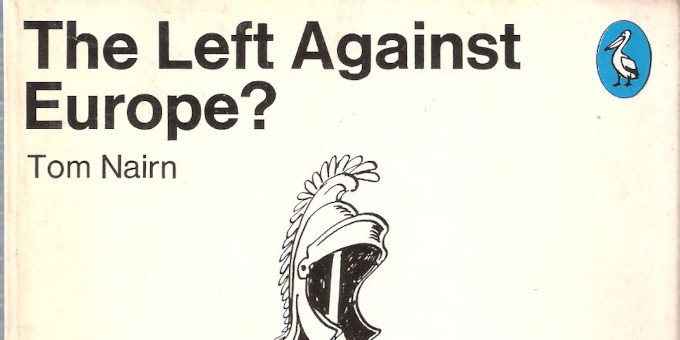
His critical disdain for Britain (as compared to Other Countries) was fruitful when in 1972 he wrote a brilliant special issue of NLR, The Left Against Europe, later republished as a Penguin book, flaying the activist left's adaptation to the nationalist campaign against Britain joining the EU, then EEC. (Workers' Fight, forerunner of Solidarity and Workers' Liberty, and two smaller groups, LSA and BICO, were the only dissidents in the activist left from the anti-EU consensus.)
Later Nairn's anti-Britishism mutated into Scottish nationalism. I suspect that there was more of leftists who wanted to go nationalist using Nairn's bravura denunciations of "Ukania" as a Marxist-seeming story for themselves, than of him convincing, but those polemics got a wider reach than anything else he wrote.
Nairn was a more engaged, more eloquent instructor than the more recent run of "academic Marxists", often as jargonistic as anything Thompson could satirise, but focused on exegesis rather than live politics. Even when wrong (in my view), his polemics always gave grist for critical thought.