
“You can’t have wage rises unless they are backed by improvements in productivity.” This is the bosses’ line on the growing number of pay disputes.
On the rail it means replacing 1,950 maintenance workers and 1,000 ticket office staff with machines, cutting routine maintenance by 50%. On the post, automated parcel sorting machines are part of a “modernisation agenda” that is putting 10,000 jobs at risk. The government has even suggested there are productivity gains to be squeezed from NHS workers.
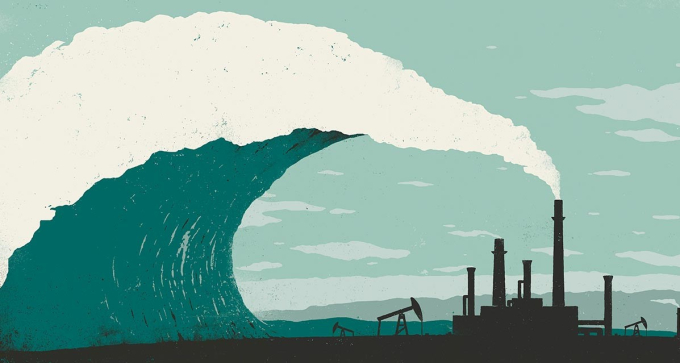
There are many good reasons to oppose these “modernisation” plans. One is that capitalism’s incessant drive for increased productivity is the main driver of multiple ecological crises.
As Paul Hampton explains in his book Workers and Trade Unions for Climate Solidarity, the incessant drive to chase profit has meant a constant acceleration and intensification of work since capitalism’s earliest days: “The application of machinery is imposed to speed up and simplify the production process. Individual capitalists recognise that by transforming the labour process they can appropriate higher-than-average returns... The process of replacing living labour with machinery — the product of other past labour — require[s] an enormous expansion of energy to power such labour processes...Increased throughput and substitution of energy for machines in place of labour mean ‘a more rapid depletion of high-quality energy sources and other natural resources, and a large amount of wastes dumped into the environment.’” (p.24-28).
Machines, unlike biologically limited human bodies, can concentrate potentially unlimited energy to propel the movement of matter. Human work directs this movement of matter which takes place on all scales from the molecular (chemical/agricultural), mechanical (extraction/manufacturing) and geographical (transport).
Work is designed to maximise the volume and speed of material transformations and get commodities to the consumer in as short a time possible, regardless of real world consequences.
Capitalist business is indifferent to what happens to the commodity after the point of sale (when it is consumed and reduced to useless waste). It is also indifferent to the waste that is produced in the production process itself. Waste only counts to the extent that society manages to impose environmental regulations or tax for clean up operations.
From an ecological perspective, capitalist growth is a constant and ultimately blind acceleration of physical matter. In the words of Marxist ecologists Paul Burkett and John Bellamy Foster: “the capitalist economy is arguably the most extreme example possible of a system that draws on a resource tap (at ever increasing rates) and dissipates waste into the environmental sink (also at ever increasing rates), in ways that accelerate entropic degradation.” (Marx and the Earth)
This constant speed up is the reason that capitalism has a seemingly insatiable appetite for ready sources of energy. Despite the rapid growth in renewable energy in recent years, fossil fuel emissions continue to rise. Renewable energy under capitalism is adding to the available energy inputs, not replacing fossil fuels. Analysis from Richard York finds “the average pattern across most nations of the world over the past fifty years is one where each unit of total national energy use from non-fossil-fuel sources displaced less than one-quarter of a unit of fossil-fuel energy use and, focusing specifically on electricity, each unit of electricity generated by non-fossil-fuel sources displaced less than one-tenth of a unit of fossil-fuel-generated electricity.”
Emissions (and the accumulation of all sorts of other waste) track GDP growth closely.
Of course computer technology may improve safety on the railway and parcel sorting machines may liberate postal workers of some drudgery. But these technologies are not being introduced for our benefit. New machinery has always been used as a weapon of class struggle. Likewise now, bosses are insisting on coupling this machine-led speed up with casualisation and job cuts.
Socialists and working-class militants have long insisted that the benefits of technological innovation should go to the working-class rather than our bosses. If machines can do the jobs that were once done by human workers, then this should means a shorter working week with no reduction in living standards. But the standard bargaining position across the trade union movement has become only one of opposing compulsory redundancies when new technologies come in.
This strategy and the general weakness of the trade union movement over the past few decades has meant that on a world scale almost all the productivity gains since 1979 have been captured by the boss-class, concentrating more power and wealth for further acceleration.
At a time of ecological breakdown, it is simply irrational to prioritise technological innovation that increases the volume of goods and people can be shifted at ever increasing speed. At various points in our history, the trade unions and broader workers movement have aspired to direct production according to rational workers’ plans using our technological know-how for human and ecological ends rather than simply to enrich our bosses.
Now more than ever we need the workers’ movement to set its own technological priorities based on meeting human needs, restoring degraded ecosystems and restabilising the climate. The current strike movement holds that potential within it.