
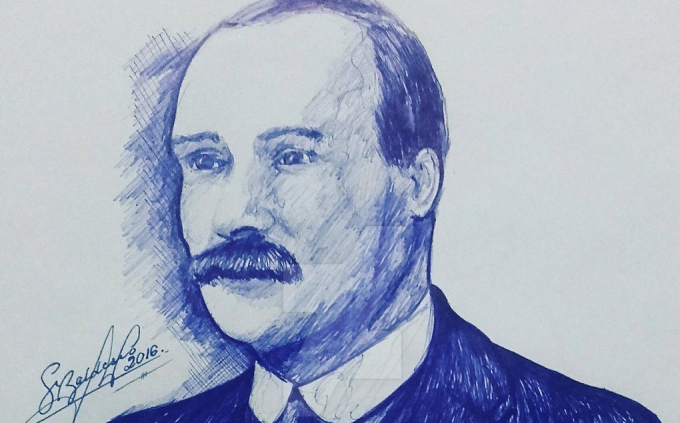
I’m not sure if I’ve read every serious biography or study of the great Irish socialist, James Connolly, but I think I have just read the best.
Whereas others have sought either to claim him for their own particular project or discredit him as a nationalist renegade, Liam McNulty’s recent book, James Connolly: Socialist, Nationalist and Internationalist does Connolly the honour of trying to properly understand his ideas and political development.
Connolly has too often been the victim of selective and partial readings, whether from nationalists who ignore his long record of activity as a working-class fighter, or from socialists who brush quickly over his full-throated involvement in the Easter Rising. McNulty’s book gives full recognition to the immense achievements of this towering, self-educated working-class leader while acknowledging the contradictions and limitations in his lifelong attempt to “carve out the future of which we speak”.
He locates those contradictions and limitations within the material circumstances Connolly faced; not to explain them away but to better understand them and assess the man fully. The result is a rounded work which treats James Connolly as a real (albeit exceptional) human being rather than an icon.
For good reason the life of James Connolly will forever be an inspiration to working-class militants. Born in extreme poverty in the slums of Edinburgh and never far above the breadline throughout his life, he equipped himself through self-education and political activity to grapple with the most complex and important issues facing humanity and debate them in a manner that ranks alongside some of the giants of our movement’s history.
McNulty’s book takes us from his youthful involvement in Scottish socialism, to his recruitment as an organiser of the Dublin Socialist Club and founder of Irish Marxism, through to his role as an organiser for socialist parties and the Industrial Workers of the World (IWW) in the US, his leadership of the Dublin Lockout and the Irish Transport Union (ITGWU) with Jim Larkin on his return to Ireland and finally to his fateful and contentious participation in the 1916 Rising. Throughout this account, however, the book places his ideas and their evolution at the centre.
This focus is vital. There are few leading figures in our history who so effectively combined the development and advocacy of ideas with a significant track record of activism and leadership in the day-to-day class struggle. It would be enough that Connolly established Ireland’s first Marxist party (the ISRP), launched the Irish Labour Party, and led the 1913 Dublin Lockout during which he formed a workers’ militia and built up the first big industrial union, the Irish Transport and General Workers Union.
While busy with all that, however, he developed the first materialist history of Ireland, created a radical critique of Irish nationalism, became a convert to, and then an advocate for, the ideas of industrial unionism and developed an understanding of the link between national and social emancipation ahead of his time.
Revolutionary unionism
Reading McNulty’s book, the contribution that stands out is Connolly’s introduction of revolutionary industrial unionism, not only to the Irish working class but to the debate in the wider British labour movement of the time. Impressed by what he saw during seven years in the US, in particular the development of the IWW, he became convinced the route to socialism went through the organisation of “one big union” in each industry which would prepare “within the framework of the capitalist society, the working form of the Socialist Republic”.
Yet the episode in this life which is most remembered and discussed is the final act — his involvement in, and execution following, the 1916 Easter Rising.
Those who reacted with shock and surprise at Connolly’s actions have a stronger case than those who, whether in praise or condemnation, see it as a simple surrender to physical force Irish nationalism. On the face it, his co-leadership of a doomed military adventure carried out by a small minority of a minority and organised with conspiratorial secrecy is hard to square with the resolutely independent class fighter of the Lockout and the “big union”. McNulty helps make sense of what was going on here in what is perhaps the best section of his book. It is the part that helps make his work stand out from others.
Without seeking to denounce or celebrate, he places Connolly’s actions and thought processes within the wholly unique and demoralising circumstances in which they developed. He was devastated by the defeat of the great Dublin lock-out and even more so by the collapse of the socialist parties of the Second International into support for “their” nations in the First World War. He saw these setbacks as linked in one important respect. In both cases the British trade union and socialist leaders had reneged on commitments to solidarity and internationalism in favour of social peace and patriotism.
Spirit
Possessed still of an indomitable spirit, Connolly convinced himself that independence for Ireland even more essential and a military revolt against British rule was winnable. “England’s misfortune”, as he famously said, “was Ireland’s opportunity”. He did this at a time when other forces, alien for the most part to his politics, were reaching the same conclusion and preparing to carry it out. McNulty makes it clear that Connolly developed this idea independently of the republican IRB and was prepared to carry it out with the tiny forces of the Irish Citizen Army alone if necessary.
His part in the Rising doesn’t, however, fit neatly into the rest of Connolly’s life. It is neither a straightforward continuation of his previous work nor a complete rupture or political collapse. The final section of the book explores with clarity and diligence how it came to such an end. In essence Connolly was attempting to keep a revolutionary, emancipatory spirit alive in the grimmest of times, in the hope that a courageous example would ignite a wider conflagration.
It was a quixotic end which even his good friends in the socialist movement struggled to understand. Whatever is made of McNulty’s attempt to make sense of and evaluate it, though, he gives no credence to any suggestion of dishonour, betrayal or simple political collapse. He quotes the Scottish socialist John Leslie, who first introduced Connolly to Marxism as a young man and who later developed differences with him and was mystified by (and opposed to) his participation in 1916. Despite that Leslie’s obituary, in the socialist journal Justice, remarked that:
“Of all the men whom I have ever known or could ever read of in tale or history there is not one who brought a cleaner soul, a more disinterested enthusiasm or a courage more undaunted to the service of working people than did James Connolly”.
In portraying him not as a sacred icon but as a living, thinking class fighter constantly trying to organise his class into a force that could make a world fit for all, McNulty reminds us why Connolly is a figure to emulate.