
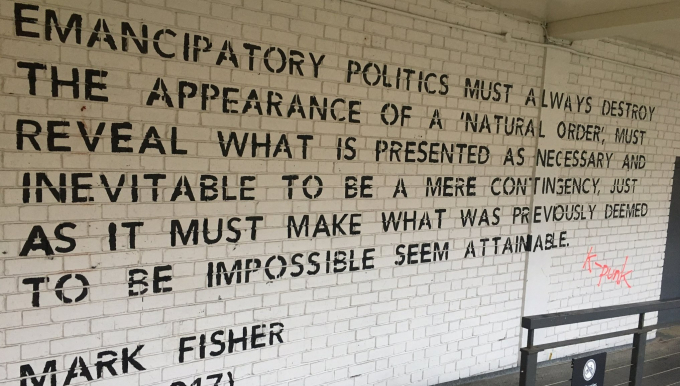
The Economist magazine in its 26 November issue recalled Mark Fisher’s Capitalist Realism, a book from 2009 which asserted (glumly, from the author’s viewpoint) that it had become “easier to imagine an end to the world than an end to capitalism”.
Even the crash of 2008, argued Fisher, had narrowed socialist imagination. According to the Economist’s columnist, the Tory crises and the Tories’ current offer — stable management of... a record drop in living standards and a near-collapse of public services — have had a similar paradoxical effect.
It has become, the column says, “easier to imagine the end of the world than the end of Tory rule”. The Tories will probably lose the next election, but that’s a way away. And “Keir Starmer won the Labour leadership promising to continue the programme of Jeremy Corbyn... But Sir Keir intends to win the next election on a platform of Conservative realism... within the Tory parameters of low immigration, tight spending and a distant relationship with the EU”.
All this in the midst of the biggest strike wave since 1989, which is still on the rise. Many of the strikes now or soon will come up more or less directly against the government: NHS workers, civil service workers, teachers, firefighters... All the strikes face parameters set by the Tories: anti-union laws, old, new, and threatened; public budget cuts; and a coming recession designed to stop “wage inflation” in the labour market. The big disputes need political action, to break the frame of “Conservative realism”. The political left needs to do much more to broaden the front for the strikes.
There have been some good, lively, strike support rallies. In the General Strike of 1926, between 400 and 500 local Councils of Action were formed and started activity in just nine days. Nearly nine months on in this strike wave, we are still short of strike support committees.
Such committees, connected with strike committees in workplaces and industries can help make connections, swell the picket lines, provide a space for formulating alternatives to “Conservative realism” of all varieties. They can develop capacity for demonstrations and other actions to push back the government on issues like the NHS, the coming new anti-union laws, and the Public Order Bill already in the works.
Mark Fisher concluded his 2009 book: “The tiniest event can tear a hole in the grey curtain of reaction which has marked the horizons of possibility under capitalist realism. From a situation in which nothing can happen, suddenly anything is possible again”.
The unexpected election of Jeremy Corbyn as Labour leader in 2015 was a “tiny event” which did tear a hole. The sequel showed that capitalist power is nothing so passive as a curtain, and that socialist imagination does not exist already full-formed to burst through as soon as a hole is torn.
Capitalists do not just erect curtains and barriers to what workers want. In fact, their curtains and barriers always have holes and gaps. People see through them. Mark Fisher’s book was a best-seller because its motto was false. Many people read it because they believe “another world is possible”. Only, they see no real way of getting there, and, partly because of that, their idea of that other world is blurred and flickering.
Capitalists gain a hegemony more like what Antonio Gramsci called a “molecular” (different from his better-known categories of consent and coercion) by constantly fractionalising our social awareness via new initiatives, via trying and often succeeding to set us onto the back foot. Every week, every day, they are discussing, strategising, training each other, drawing in new “cadres”. They learn through doing, “doing” their work of exploitation and class struggle every day.
Many of those capitalist “new initiatives” are botched and inept even from a capitalist point of view: the Financial Times (28 November) wearily hopes only that the Tories do no more “stupid stuff” in the next year. But even the “stupid stuff” like Brexit can sometimes faze our movement.
The working class has far greater intellectual and social capacities. Too often those capacities are dormant. They are dormant unless we too are discussing, strategising, educating each other; drawing in new activists every week; pushing against capitalist power every week. Unless we develop a dense enough mode of organising.
Almost three years after the crash of Corbynism, many have quit the Labour Party in despair; they are scattered in fragments of scant consequence. The left that remains in the Labour Party is usually quiet and intimidated. Much other left activism is sporadic.
The strikes spur us to reverse that slide. To win, and to prompt mobilisations which can restore the health service and civil liberties and union rights, they need us to reverse that slide.
We have to reactivate as many as we can of those who were active in the Corbyn years but have now gone quiet. We have to reach the young socialists whom the Corbyn surge never organised — Young Labour and Labour Students were weaker in 2019 than in 2015 — or who were only early-teens back then, and help them become active as socialists, not just as sporadic protesters. Workers’ Liberty works to help build strike committees and strike support committees. We produce weekly picket-line bulletins to enable the exchange of information and ideas between the picket lines of different disputes; we produce and circulate this paper to develop a less blurred vision of alternatives to capitalism, of ways to get there, and of links between those and every week’s issues. We organise leftists in our workplaces and union branches, and push leftists to raise their heads again in the Labour Party. We organise student solidarity groups to help the strikes.
All this work has to be done every week, and at a tempo and with an energy matching the dynamics of the strikes. Reader, it needs your help.