
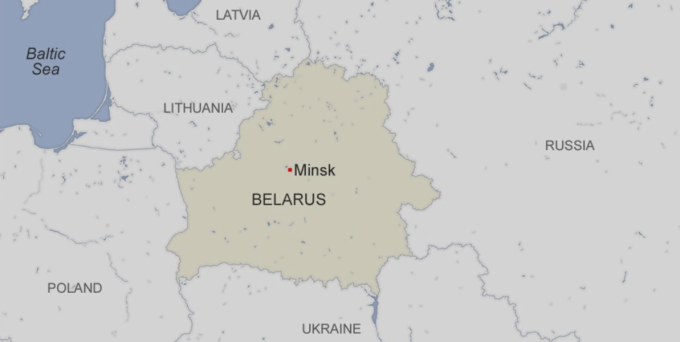
Sunday 27 November was the Global Day of Solidarity with Belarusian Political Prisoners. They currently number some 1,450 – but the number continues to increase.
Initiated by exiled opposition leader Svetlana Tikhanovskaya, the Day of Solidarity was backed by a range of Belarusian human rights organisations which have supported and campaigned for the release of the country’s political prisoners.
Exiled Belarusian communities and professional associations whose members in Belarus have been targeted for repression, such as the European Federation of Journalists and the Belarusian Association of Journalists, also staged events to highlight current levels of repression.
Like other post-Soviet states, Belarus declared its independence in the summer of 1991. Its first presidential elections, held in 1994, saw Aliaksandr Lukashenka elected to the post. He has remained President ever since, with each election less democratic than the preceding one.
Lukashenka’s claim to have won the most recent presidential election (August 2020) with over 80% of the vote triggered the biggest protests in the history of Belarus. Police violence and mass arrests were Lukashenka’s response to the nation-wide street protests.
A renewed and even more severe wave of repression followed Russia’s invasion of Ukraine in February of this year, when Lukashenka – a longstanding ally of Putin – allowed Russian forces to invade Ukraine from Belarusian territory.
By early April over 1,500 people had been detained for anti-war protests – over a thousand of them on the first weekend after the invasion – and subjected either to ‘administrative’ prosecution, usually resulting in a fine, or criminal proceedings.
The repression of civil society organisations has also intensified since February.
Their premises have been raised and activists arrested and imprisoned for make-believe offences such as involvement in extremist organisations, insulting public officials, treason, public order offences and tax evasion.
The most prominent victims of this crackdown are the human rights activist and co-winner of the 2022 Nobel Peace Prize Ales Bialiatski, detained since July 2021 and facing a 12 year prison sentence, and Marfa Rabkova, a coordinator of the Viasna human rights campaign, currently serving the longest sentence (15 years) ever imposed on a human rights defender.
In order to avoid the risk of criminal charges over 350 organisations ceased activities in Belarus between August of 2020 and the autumn of this year. Another 600 were shut down by the authorities. Many of them continue to campaign in exile.
The level of repression faced by the what remains of independent media in Belarus has been equally as intense since the invasion of Ukraine. Kafkaesque charges faced by journalists including membership of a terrorist group and/or extremist organisation, inciting hatred, and treason.
Almost all independent media have been labelled as "extremist", and either shut down completely or relocated abroad. Access to websites which carry regime-critical news coverage has been blocked and the number of individual social media channels and blogs which have been banned runs into hundreds.
Churches and religious activists have been included in Lukashenka’s crackdown, falling victim to fines, detention, dismissal from their jobs and prison sentences.
Since the summer of 2020 twelve religious leaders or activists are known to have been sentenced to a total of over a hundred years in prison, another 25 are awaiting trial, 25 have been sacked from their jobs, and fines of over 100,000 Belarusian rubles have been handed out.
The longest prison sentence was imposed on the Orthodox priest Siarhei Rezanovich in October of this year: sixteen years imprisonment, for participation in a criminal organisation, attempted seizure of state power, and miscellaneous explosives offences.
Over the summer of this year the country’s independent trade unions were added to the list of victims of Lukashenka’s onslaught on all forms of dissent and active opposition.
In April the Belarusian KGB raided the offices of the Belarusian Congress of Democratic Trade Unions (BKDP) and its affiliated unions, confiscating computers, files and union merchandise, on the pretext that they were extremist organisations.
More than twenty BKDP leaders and activists were detained for reason of their union activities. Further arrests followed in subsequent months. Most of those targeted for arrest remain in custody, with some already having been given lengthy prison sentences.
In July Belarusian courts "deregistered" (i.e. declared illegal) the BKDP, the Free Trade Union of Metalworkers (SPM), the Free Trade Unions of Belarus (SPB), the Trade Union of Workers of the Radio-Electronic Industry (REP) and the Belarusian Independent Trade Union (BNP).
By contrast, the Federation of Trade Unions of Belarus (FTUB) continues to work in partnership with the regime.
With a membership of over four millions and a real estate portfolio of sanitoria, health resorts and sports schools inherited from the Stalinist fake ‘trade union’ which spawned it, the FTUB has never condemned Lukashenka’s rigged elections nor his suppression of free trade unions.
Its main campaigning activity, for which it has received the Presidential Award for Spiritual Revival, is “promoting the patriotic education of citizens, including children, students and working youth.”
In practice, this means maintaining war memorials, refurbishing military museums, restoring military equipment from the Second World War, and raising funds for new war memorials. According to the FTUB: “The theme of the genocide of the Belarusian people during the Great Patriotic War is timely today as never before.”
Trade union activists continue to be sentenced to lengthy spells of imprisonment.
In November of this year Aliaksandr Mishuk (trade union leader of the now banned BNP in the Belruskali mining company) was sentenced to two and half years in prison for organising a strike and Yanina Malash of the now banned SPM was sentenced to eighteen months imprisonment.
The same month Andrei Khanevich of the outlawed BNP was sentenced to five years in prison for “discrediting Belarus” in a television interview and Yury Trapachou (an activist in the Homiel motor-power depot) was sentenced behind closed doors to four years for establishing an extremist organisation.
Prison sentences also continue to be handed out to the Railway Partisans – eleven Belarusians accused of sabotaging railways in order to delay Russian troop movements after the invasion of Ukraine.
In September Siarhei Hlebka was sentenced to eleven years in a medium-security penal colony and fined 9,600 Belarusian rubles, after having been found guilty of setting fire to logs on a rail track.
The following month Aliaksei Shyshkavets received the same prison sentence after having been found guilty of membership of an extremist formation and planning to sabotage rail tracks in order to prevent the movement of military equipment.
Recent amendments to Belarusian legislation have paved the way for more people to charged with offences, for more trials to be held which fail to meet legal norms, and for lengthier prison sentences to be imposed on those convicted.
Changes to the Law on Countering Extremism have massively expanded the concept of “extremism”. Between August 2020 and July of this year over 11,000 criminal cases involving extremism were opened, with potential prison sentences of up to ten years.
Closed hearings have become increasingly common, and recent changes to the Criminal Procedure Code allow trials to be held in absentia, thereby facilitating the prosecution of political dissidents and opposition leaders who have fled Belarus.
The range of crimes which can result in the death penalty has also been expanded to include terrorism, which has a particularly broad meaning in Belarus. It remains unclear whether this amendment will be applied retrospectively.
Although Belarusian judges need no encouragement to impose lengthy prison sentences, regime-loyal media in Belarus propagandise for exemplary punishments which supposedly fit the crime. According to the Belarus Today newspaper, official mouthpiece of the government:
“Four years for a flower from a flower bed thrown at the special police – yes. And you should be thankful for not getting more. A three-year prison term for kicking a police car a couple of times without damaging it. And if a little scratch had been left [on the car], [the sentence] would need to be at least an additional three years.”
For further information on Belarusian political prisoners and how to help them, see the (banned) Belarusian website Viasna. For information on the LabourStart campaign in support of Belarusian banned trade unions and imprisoned trade union activists, see LabourStart.