
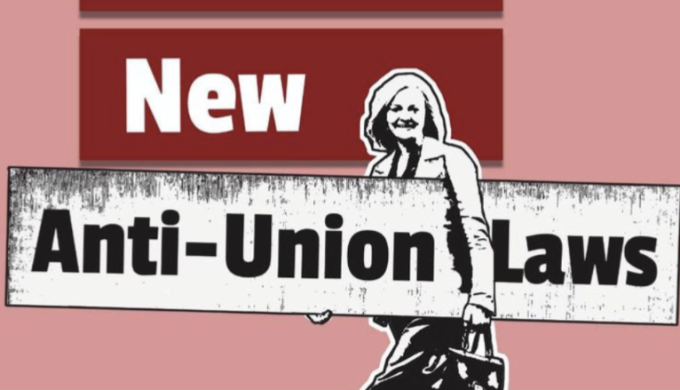
The Free Our Unions campaign, along with Earth Strike UK’s Empower the Unions initative, has called a protest at the Department for Business, Energy, and Industrial Strategy (BEIS) in central London, at 5:30pm on 10 October. BEIS will likely be one of the departments involved in drawing up new anti-union legislation, and is also a key department in terms of climate and energy policy. Earth Strike’s Empower the Unions initiative focuses on the ways in which anti-union laws constrain workers from taking action over the climate.
Free Our Unions also held a fringe meeting at the Labour Party conference (26 September). The platform speakers were Labour MP Bell Ribeiro-Addy, Fire Brigades Union National Officer Riccardo la Torre, and Unite Executive Committee member Jane Stewart. Tony Byrne, a striking train driver, RMT branch chair, and, until he was summarily excluded a few days before, Newark Labour Party’s delegate to conference, chaired the meeting.
Opening the meeting, la Torre emphasised how anti-strike laws constrain unions across a number of fronts, leaving them fighting with one hand tied behind their backs. He argued for workplace activists to make agitation against the anti-union laws part of their day-to-day organising activity
Attendees discussed the urgent need to press unions into action against proposed anti-union laws, as part of an effort to build up the confidence to defy them. The TUC has called a lobby of Parliament on 2 November over a number of demands, including defence of the right to strike. It will be frankly negligent if this is the only official action taken around the issue.
Union leaders including the RMT’s Mick Lynch and the CWU’s Dave Ward have spoken vaguely about the need for mass militant action in response to the imposition of new anti-union laws. But why wait until the laws are imposed? A visible, assertive campaign against them in advance will put the movement in a much stronger position to resist them once they are implemented.
RMT’s 2021 AGM passed a policy committing the union to “non-complicity” in setting minimum service levels during transport strikes. Lynch and other RMT officials never mention this, presumably out of reluctance to be seen to advocate breaking the proposed law in advance. But the policy was adopted unanimously, and now, against the backdrop of a rising strike wave and an unpopular and chaotic Tory government, is surely a time for attempting to push the envelope.
Multiple unions have AGM policies committing them to call demonstration against anti-union laws. Demos and others protests won’t stop the laws by themselves, but will contribute to laying the foundations for defiance. Union leaders would do better to enact those policies, and organise immediate campaigning, than make vague noises about radical action at some indeterminate point in the future.
• Free Our Unions has also produced a new briefing for activists on Truss’s proposed anti-union laws: here