
It’s time — two words that set the scene for Belgrade’s EuroPride in 2022.
“It is time for laws on same-sex unions, time for equality, solidarity, and much, much more,” said Goran Miletic, longtime coordinator of the country’s EuroPride. “It is time for Belgrade.”
It was also time for the community to come together against a backdrop of thousands who had gathered to march in the weekends leading up to Pride.
“There was a strange mix of different right-wing groups, extremists, right-wing political parties, and religious groups who held joint protests, twice,” Goran explained. “They are vocal, with a lot of Russian flags, Putin photos, and icons, with clear hate-speech towards the LGBT community.”
Anti-Pride protests aside, whether or not Pride was legally allowed to continue was up in the air right till the last moment. With the week-long series of activities meant to culminate in a march through Belgrade on Saturday, Sep 17, organisers on Sep 13 received news of a ban from the police — this came after three weeks of uncertainty following President Aleksandar Vucic saying EuroPride would be cancelled altogether. On Sep 14, organisers announced that they’d just received a formal rejection of the appeal they’d filed the day before. Then finally, Serbian Prime Minister Ana Brnabić, who is openly gay herself, announced that Pride could continue after all.
“I am not happy with the outcome,” Goran said after the event, “since the government confirmed the ban of the EuroPride several times, and it looks like the police in Serbia do not understand freedom of assembly.”
While restrictions wavered, the organisers were certain the event would continue. As stated on their social media platforms: Banning pride is a reason for pride.
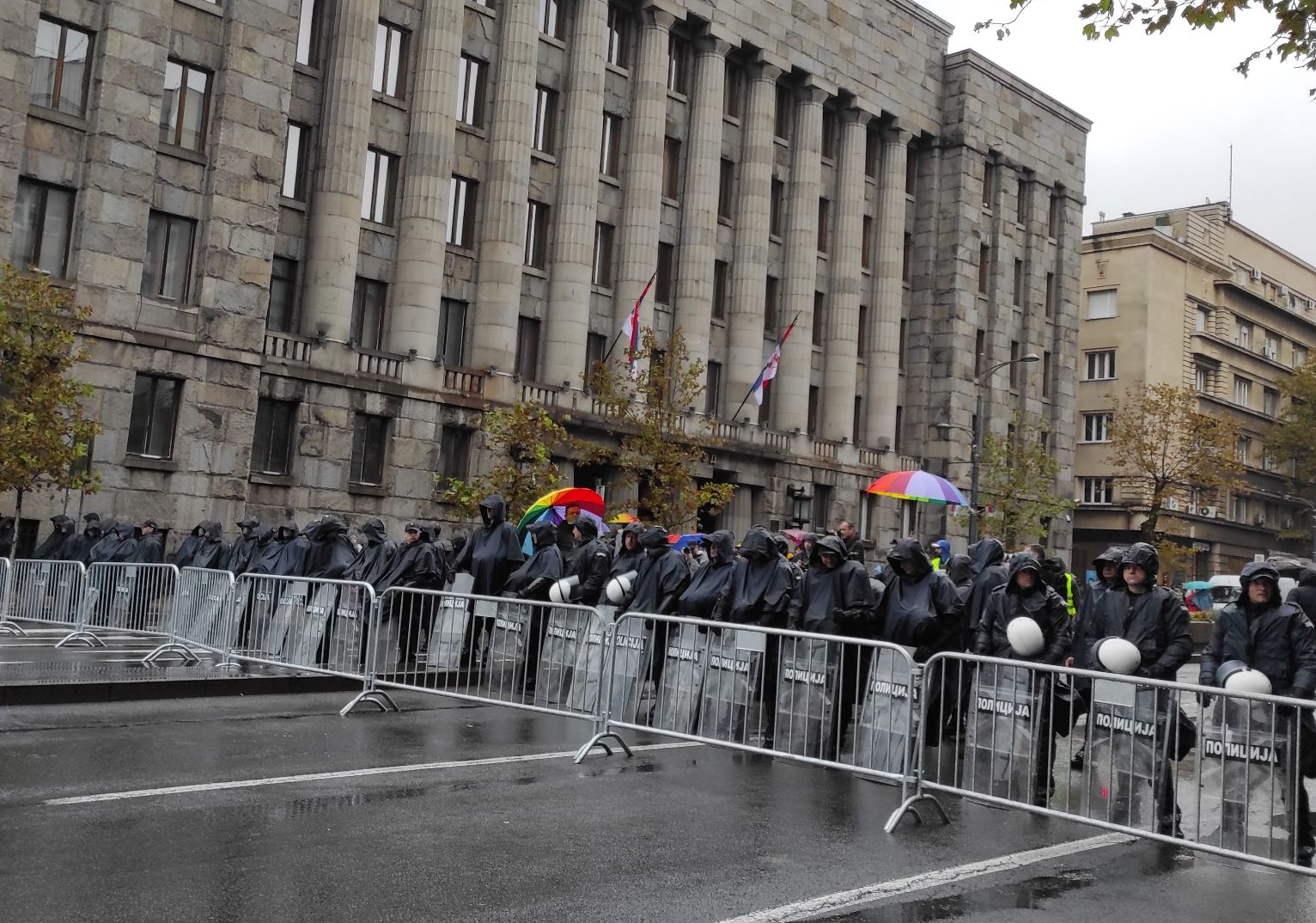
Heavily armed police kept pro- and anti-LGBT rights protesters apart
The tension felt
On the day of the event, organisers, volunteers, activists, groups from around the world gathered for what would turn out to be a far shorter version of the planned route.
Starting in front of the Constitutional Court building and continuing to a nearby stadium where concerts were held, an extremely high police presence was seen and felt. Screening every attendee at entry points around the area, heavily armed police formed a barrier around the event: batons ready and shields raised. Volunteers worked to make sure Pride attendees were allowed access, even as small groups of protestors lurked beyond police lines. Nearby, an Orthodox church continuously and ominously rang its bells as Pride attendees approached. Within church grounds, police held several dozen protesters away from the passing march, which continued through the rain, with spirits cautious but high.
Attendees would only later find out about other incidents of violence and damage around the city. Later in the evening, a crowd of several hundred marched through the city singing and chanting, holding banners adorned with images of Jesus as police guarded every corner, exit, and storefront.
Entenela Ndrevataj, who came in from Albania to attend the event both as a journalist and as an ally, was aware of both risk and security. “Some of my thoughts were that it would turn into a violent march, but on the other hand I kept saying to myself that all the security — thousands of policemen — and an international presence (including diplomatic representatives from the US, UK, Sweden, and France) indicated that the situation would not be allowed to escalate.”
“There was a huge amount of security, it’s like we were put in a box, surrounded by thousands of policemen,” said Entenela. “It was even difficult to walk, and it was also scary to march in those conditions — it’s uncomfortable to see so many police, while people were marching for love, acceptance and peace.”
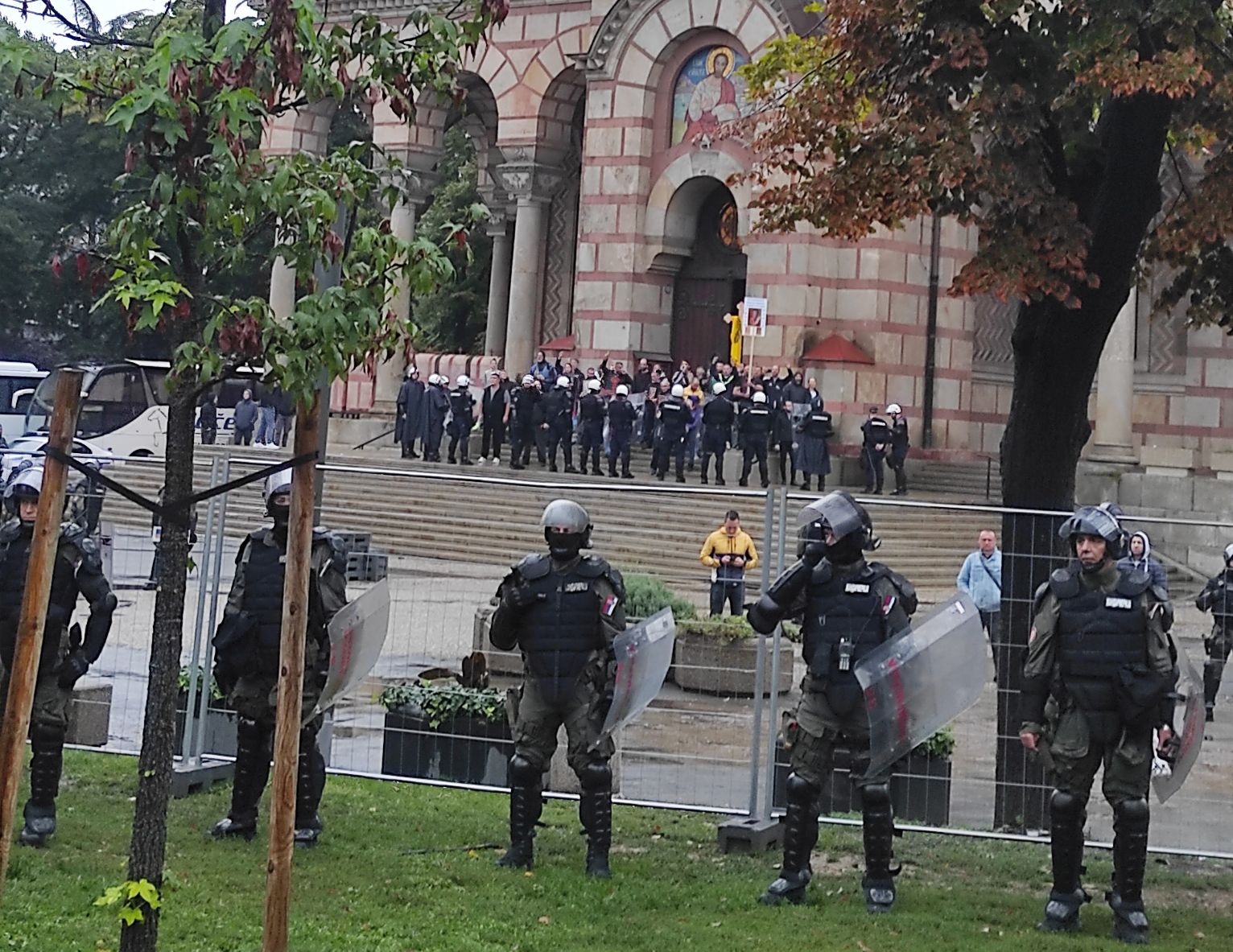
More than 5,000 police were on duty
The short march ultimately brought attendees to the stadium, where concerts continued through the heavy rain. It was there that, as the evening went on, reports of violence against the queer community began to come in — Entenela and her friends among those targeted.
“We decided to leave (the concert venue) around 8pm, because of safety, and because it was raining a lot,” she said. “Near our hotel, a group of boys showed up, singing loudly, and we knew that we had to leave immediately. But one of our group, a gay male, panicked and started to run. They caught him.”
“Me and another woman ran to get the police, just 30 metres away from us,” said Entenela. “But they were very slow to react. It took a lot of time for them to come and while we begged for help, there was zero expression on their faces. They hardly responded to us.”
By the time the police arrived, both the friend who had tried to escape and two women had been assaulted by the gang.
In a separate incident, at about 7:20 pm while on their way out of the stadium, two participants found themselves alone on a dark street after being blocked and redirected by police.
It was on this street that the pair were approached by a young man asking for the time. “And then he hit me in the face. I think twice. I fell to the ground. Then he hit my friend at least two times. She also fell to the ground,” said Nadine Lange, who lives in Berlin and had come in from Vienna for the event. “I lost my sense of orientation for a bit and thought the guy came at me again which made me put my hands up. That’s when my friend screamed — and the guy ran away.”
Nadine, an editor who works in the culture and LGBTIQ sections with Berlin newspaper Der Tagesspiegel, considers this a lucky escape. “We were extremely lucky not to be severely injured,” she said. “My friend had a bump on her forehead and swelling on her right cheek, as well as neck and back pain from the fall,” described Nadine, who sustained similar injuries.
While the pair reported the incident to Belgrade Pride organisers to warn others still at the stadium, they held back from alerting the police. “I don’t trust them at all,” Nadine said. “And I suppose there’s nothing much they could do, anyway.”
For organisers, it’s now time to get answers. “We invite anyone who was a victim in any incident to report it to us as soon as possible, so we can put pressure on the police and prosecutor’s office to conduct a proper investigation,” Goran said. “Reporting is an essential step if we want access to justice, and if we want to show that we were victims of violence.”
What’s next?
For Goran and his team, there are concrete next steps: To make Pride events in the region sustainable, so that no form of threats are faced and freedom of assembly is granted at all times. “Protests, concerts, and gatherings are happening every day, and the only community that is receiving threats because of freedom of assembly is the LGBT community.” he said, “For us, it is important that we are visible, that people can see that we exist, and that we face real problems.”
Violence and discrimination are two key problems faced by the LGBT community in Belgrade and the region. While some cases are reported, far more are not, with members of the trans community especially vulnerable to violence on the streets. Reports show 36% of LGBT individuals are subject to verbal harassment and other forms of violence in schools.
At the same time, lobbying for legalising same-sex unions is essential. “Only Montenegro has such a law at the moment, and we must have this legislation adopted in all (Balkan) countries,” Goran said.
“I am happy that we still had EuroPride in the format that was planned,” he continued. “It was the largest Pride ever in Belgrade with almost 10.000 participants, despite the ban. And two planned concerts were held despite the rain.”
Entenela said that she still would have attended the event knowing how it would end for her and her friends. “It is about love and freedom, and violence doesn’t scare me,” she said. “If Pride would have been cancelled, that would mean a huge regression not only for the LGBTI+ community in Serbia, but for many other countries where existence is a daily fight.”
Comments?We welcome replies, corrections and debate pieces. Contact us