
William Burns, director of the CIA, estimates that Russian casualties in Ukraine have reached around 15,000 killed and perhaps 45,000 wounded. Russia has suffered the same number of military fatalities in a few months of war in Ukraine as the USSR in the decade it fought in Afghanistan.
A growing number of Russian troops are refusing to fight. For example, Corporal Ilya Kaminsky and 77 other troops from Russia’s 11th Air Assault Brigade have refused to return to the front after four and a half months without leave during which, according to Kaminsky, around 1,000 troops — or half his battalion — had either been killed or injured.
Since Russia has not declared a war, but only a “special military operation”, Russian soldiers are able to refuse to fight, but face dismissal if they do. Nevertheless, refuseniks are being illegally detained. Maxim Grebenyuk, a lawyer from the Moscow-based advocacy organisation, Military Ombudsman, says he knows of 140 troops who have been locked up for refusing to fight. The Guardian has seen testimony from one soldier, who stated: “As a result of what I believe were tactical and strategic mistakes made by my commanders … and their total disregard for human life … I made the decision not to continue in the military operation.” This soldier was then jailed for more than a week in different cells in the Russian-controlled Luhansk.
Russia also seems to be assembling a new army corps of 10-15,000 personnel but finding it difficult to get new recruits.
Some young Russian men who have signed short contracts have found themselves on the battlefield after one week’s training. According to Mediazona, for example, Yevgeny Chubarin, 24, was killed near Kharkiv after signing a three-month contract with the Russian army. He was killed after just four days. His mother, Nina Chubarina, said: “There was no training. They arrived, got a uniform and a machine gun — and that’s it, go ahead.”
Russia’s war in Ukraine has damaged or destroyed 105,200 cars, 43,700 agricultural machines, 764 kindergartens, 1,991 shops and 634 cultural facilities, according to the researchers at the Kyiv School of Economics.
Ukraine’s Health ministry reports that least 18 personnel have been killed and nearly 900 medical facilities damaged or destroyed during Russia’s invasion of Ukraine. (Guardian 25 July).
Ukraine’s Defence ministry estimated on 2 August that the war had damaged at least 140,000 residential buildings. The war has caused $47.7bn of damage to apartment buildings and private homes.
Damages to transport infrastructure, including roads and airports, stands at $31.6bn. The cost of repairing Ukraine’s infrastructure is estimated at $185bn.
Rebuilding the country as a whole may cost $1tn.
Workers’ Liberty demands that the Western powers cancel Ukraine’s debts.
More than 12 million Ukrainians from a population of 42mn have now been forced from their homes. 6.3mn are internally displaced, and another 6.2mn are refugees have been dispersed, mainly across Europe.
By the end of July, 104,000 refugees from Ukraine had arrived in the UK, from 200,000 visa applications. As a proportion of the UK’s population that is one of the lowest figures in Europe, a monument to our Tory’s government’s xenophobia. Workers’ Liberty demands the right of refuges from the war in Ukraine be allowed to freely enter the UK and be supported generously, by the state, when they get here.
In addition, on 10 June a Ukrainian presidential adviser estimated that 10,000 Ukrainian troops had already died; President Volodymyr Zelensky reported that during most of June 100-200 Ukrainian troops were dying each day.
This imperialist Russian war is an affront to civilisation and is peppered with individual incidents of brutality: a Ukrainian prisoner of war castrated and murdered; scores of Ukrainian prisoners of war held in Olenivka killed by Russia after a faked Ukrainian missile attack; Ukrainian civilians abducted and tortured in the occupied south.
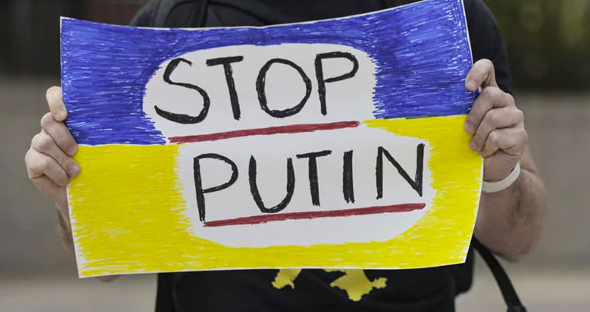
The war must end. And the only democratic peace can be one in which Russia withdraws from Ukrainian territory. Since Putin’s stated war aims are to overthrow the Ukrainian government and abolish the entity of Ukraine, Putin must be forced to withdraw. That’s why Workers’ Liberty demands the West arms Ukraine, and donates military equipment which is adequate to force Russia out.
In the last weeks of July Ukraine began to use effectively the limited amounts of high quality artillery provided by the US. They have destroyed numerous arms dumps, rail hubs and Russian control centres, especially in the south, around Kherson. A Ukrainian counter-offensive is underway with the stated intention of liberating occupied Kherson city. Whether they can, in fact, retake the town is difficult to assess; it is very heavily defended and the Russians have moved large amounts of equipment and thousands of troops to the south of Ukraine, from Donbas.
So far the Ukrainians claim to have taken 60 villages and small towns on their way towards Kherson and have destroyed bridges that the Russians use to resupply their occupying army. This has also weakened the Russian offensive in the East of Ukraine. The Ukrainians also seem to be pushing forward around Izyum in the country’s North East.
This appears to be a moment of danger for Putin. He cannot afford to be defeated in Kherson Oblast. If the war turns, and Putin does begin to lose, perhaps putting his political position in Russia in doubt, it will also become a time of danger for us all. Putin has a lot in reserve, including chemical weapons, many more human resources, and the ability to widen the war across Europe.
• Moldova: ex-president Igor Dodon, leader of the pro-Russian opposition, and currently under house arrest facing corruption and treason charges, has demanded the pro-EU Moldovan government goes to Moscow to beg for a better energy deal from Russia.
Putin is using energy costs as a political weapon against Moldova. Gas prices will rise 47% in August and have risen 220% since January.
Moldova is a poor ex-Soviet state with a population of 2.6m. It has applied for EU membership and was granted candidate status in June.
Transnistria, the sliver of Moldovia Russia has effectively ruled for 30 years, could be the base for action against Moldova’s government. Inside Moldova some local authorities are Russia-loyal, in areas such as Gagauzia, and could be the basis for Russian destabilisation. Moldova has 3,000 troops, poorly equipped.
• Bulgaria: On 31 July an arms warehouse in Karnobat owned by Emilian Gebrev exploded following a break-in. This is the fifth explosion and fire at facilities owned by Gebrev since 2011. In 2015 Gebrev nearly died in a nerve agent attack attributed to the Russian state. Recently Gebrev admitted to supplying arms to Ukraine.
President Rumen Radev has set 2 October to hold Bulgaria’s fourth parliamentary election in less than two years. Prime Minister Kiril Petkov’s pro-EU coalition government collapsed in June. Opinion polls show some shift in opinion towards nationalist and pro-Moscow parties. Inflation stands at 17% and the country is unsure of its energy supply, much of which comes from Russia.
• Kazakhstan has significantly increased its military spending, from the equivalent of $1.7bn last year to $2.6bn. Alarmed by the invasion of Ukraine President Kassym-Jomart Tokayev is looking to strengthen links with China and with the West.
Despite a close political relationship with Putin’s Russia, Tokayev has refused to officially recognise the so-called People’s Republics of Luhansk and Donetsk. 20 percent of Kazakh citizens are ethnic Russians, largely living along the long northern border with Russia. Russian nationalists claim that these areas belong to Russia. Kazakhstan has banned demonstrations against the Russian invasion of Ukraine, but also made it illegal to display the pro-Russian “Z” symbol.
• Georgia: former President, and current deputy chair of Russia’s Security Council, Dmitry Medvedev, has called for Russia to “restore the borders of our Motherland” by retaking the now independent state of Georgia. He also believes Ukraine should “disappear from the world map”.
In a social media post that has now been deleted Medvedev also described Kazakhstan as an “artificial state” and stated that Kazakh government policy “can be classified as the genocide of Russians.”
• Kosova, largely ethnically Albanian, was formerly ruled as a province of Serbia and has an eight per cent Serb minority, mainly in the north of the country. Following the Kosova war of 1998-99, in which NATO intervened, Kosova declared independence from Serbia in 2008, and is now recognised by around one hundred countries. There is a 3,800-strong NATO-led force in Kosova, KFor, deployed to Kosova in 1999.
On Sunday 31 July, ethnic Serbs blocked roads in the north of Kosova in protest against new regulations that would require Serb drivers to display Kosovan number plates. About 50,000 Serbs living in northern Kosovo use licence plates and identity cards issued by Serbian authorities. A significant part of the conflict is the malign influence of Serbian President Aleksandar Vucic, an unpleasant Serb nationalist. Vucic has close relations with Putin’s regime in Moscow, which has enthusiastically been backing the Serb minority in Kosova.
Serbia, which is completely dependent on Russian gas, refuses to join sanctions against Moscow.
The Ukraine Solidarity Campaign is appealing for funds to help the mineworkers’ unions in Ukraine here