
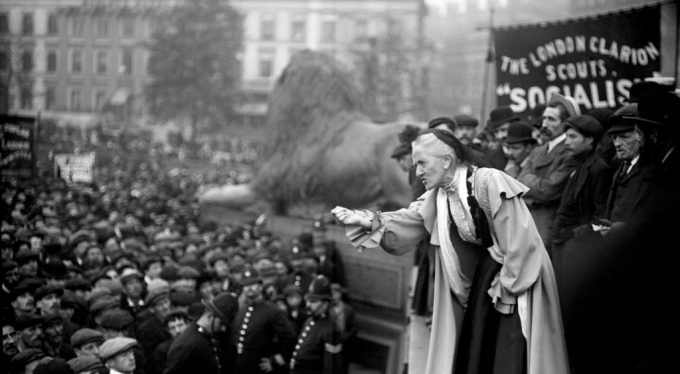
Part one of a series on the feminist and socialist Charlotte Despard (1844-1939). Part two is here.
At her 89th birthday party, in 1933, Charlotte Despard made a speech urging her friends to fight fascism, and she quoted Lenin as she put the case for revolution.
Days earlier she was making a speech in Trafalgar Square, bent with old age and shaking her arthritic fist as she made the case for anti-fascist mobilisation just as she had made countless other speeches in the previous four decades in support of socialist, feminist, anti-imperialist and republican causes. Charlotte was also a vociferous advocate for vegetarianism, an anti-vivisectionist, a Roman Catholic, and a Theosophist. She would die in Belfast aged 95.
Charlotte Despard is a familiar name to anyone who has paid much attention to the magnificent struggle for votes for women. Less known than the publicity-seeking, autocratic leadership of the Women’s Social and Political Union (WSPU), Despard should spark curiosity, inspire and be much admired for her fight for democracy and against the dictatorial leadership in the WSPU of Emmeline and Christabel Pankhurst. Despard, Theresa Billington-Greig and Edith How-Martyn organised a 70-strong split in the WSPU in 1907 at the height of the battle for votes for women.
For a couple of months both sides of the split feuded over who should keep the WSPU name. The group around Despard argued that they were the real WSPU because they upheld its constitution and therefore the name was theirs.
After a couple of months of that argument, Despard, Billington-Greig and How-Martyn, along with others, launched a new organisation, the Women’s Freedom League (WFL). Their motto was “Dare to be Free”, and they eventually produced a newspaper called The Vote.
With hindsight, it seems highly unlikely Emmeline and Christabel Pankhurst would ever give up the name of the organisation they founded in 1903, and, just four years on, were running like a private army.
Both sides of the split were formidable. One side was relying heavily on loyalty and their personal charisma, and the other on rational argument about democracy and the kind of organisation the movement needed.
The WFL wasted no time in getting a caravan together to tour the country drumming up support for women’s suffrage and recruiting members to the WFL. Like all women’s suffrage meetings, the WFL’s attracted opposition. At open-air meetings angry youths would often throw things. Annie Barnes, an East End suffragette and close friend of Sylvia Pankhurst, recalled Sylvia and others being pelted with urine-soaked newspapers by youths in the East End.
On one such occasion in 1908 Charlotte was hit by a stone lobbed by youths. She battled on, her forehead bleeding, standing on a chair and continuing to addressing the crowd. The youths, undeterred, eventually forced Charlotte to retreat. Equally undeterred, the WFL returned to the same spot the next day to address a more engaged crowd.
The WFL debated tactics and what it was to be a militant organisation. The WFL recognised that if women relied on paid employment or had family responsibilities, that is, the vast majority of women, then the sort of militant direct action which Emmeline and Christabel focused on, almost certain to lead to arrest and imprisonment, was not an option.
Along with other women, the WFL began a campaign of tax resistance: no taxation without Representation. Despard helped found the Women’s Tax Resistance League. Tax resistance was a creative tactic with a long history but limited in its scope as so few women earned sufficient income to pay tax. Over a five year period, 220 women got involved in tax resistance. A well known tax resister was Dora Montefiore, a member of the WFL and later a founding member of the CPGB, who had become politically active only when she was 40.
Charlotte was 64 when those stones were lobbed at her, and had been active in politics for less than twenty years herself.
She was in her 40s when she took up “good causes” as “something to do” after she was widowed at 46. That was what benevolent wealthy widows did.
And she had been left incredibly wealthy. In 1890 trusts and dividends made her annual income the equivalent of a little under £500,000 in today’s money, and she inherited three properties. She could have taken a very comfortable route for the rest of her long life, satisfied with charity work, being wealthy and very well connected.
Her brother, John French, was a high ranking British army officer, at one point Chief of the Imperialist General Staff (head of the British Army), and Lord Lieutenant of Ireland during the Irish War of Independence while Charlotte supported Sinn Fein.
But Charlotte took up work among a big poor Irish community in Lambeth, feeling an affinity with the Irish through ancestry and marriage. Within months she was living at number 2 Currie Street, Nine Elms, among some of the poorest migrant workers in London.
Her home doubled as a youth club for local boys, a nursery for small children, a welfare clinic and soup kitchen. It was open and active seven days a week. Sunday was set aside for a Bible class “run lightly”. Taking on the cause of children was the fundamental fire burning inside her.
She became a Poor Law Guardian. This was an elected position in local government, open only to propertied women from 1869, and to all women from 1894. Being a Poor Law Guardian was an extension of the charity work of middle and upper class women. But Charlotte wanted to affect the law and how it was interpreted for the greater good of men, women and children living in poverty imposed on them. She set about exposing the corrupt and unjust nature of the poor law and those who administered it. After 1894 being a Poor Law Guardian was a common route by which many socialist-leaning women got involved in politics and the women’s suffrage movement. For Despard, it was her “apprenticeship”.
In 1895 Despard joined the Social Democratic Federation (SDF), Britain’s first Marxist group. In five short years since her husband’s death Despard had gone from being a rather bored wealthy Victorian woman writing romantic novels to being an active member of the SDF. She gave over the use of a property she owned in Wandsworth Road to become a meeting place, renamed The Social Hall, where meetings, political education and fund-raising concerts were held for the SDF.
She became close friends with Eleanor Marx and Edward Aveling and fell out of love with the SDF in 1898 when Eleanor Marx killed herself after being betrayed by Aveling. Through her friendship with Margaret Bondfield Charlotte Despard joined the ILP and became active in getting workers to join trade unions.
In 1911 Despard and Marion Coates Hanson, a trade union activist in Middlesbrough, attended the Trades Union Congress, arguing that the labour movement needed to take women’s equality more seriously and that there should be campaigns to get women to join trade unions. In 1912 Charlotte addressed strike meetings around London, including the London tailors’, machinists’ and dressers’ strike, where she put the case for working women and the vote.
Over the years she was active in the Social Democratic Federation (SDF) Independent Labour Party (ILP), the Labour Party, and (in the 1930s) the Communist Party of Great Britain (CPGB). In the early 1920s she was a member of Sinn Fein. She remained politically active beyond her 90th birthday.
Writer Gifford Lewis calculates that in 1916-17, when she was already 72, Despard held positions on more than ten committees including the National Campaign for Civil Liberties, the Home Rule for India Committee, the Women’s Labour League and the Theosophical Society, alongside being president of the Women’s Freedom League.
Was she catching up on lost time? or driven by knowing she was already “old” when life expectancy for women was 60? Who knows? Her thirst for involvement, action, organising and inspiring others seemed unquenchable.
Whatever her shortcomings in political clarity, she lived by the idea that once injustice and inequality were identified, they had to be to be fought. They could not be ignored, dismissed or forgotten.
In 1918, as women over 30 who met a property qualification were granted the right to vote, and after decades of work in Lambeth, she was selected to stand as the Labour Party candidate in Battersea North. This was John Burns country. Once a Labour leader in Battersea, Burns defected to the Liberals to further his career. Of him, Despard wrote: “Just for a handful of silver he left. Just for a medal to hang on his chest”. Her agent in 1918 was John Archer, who had been the first man of colour to be elected as a mayor in London, in 1913.
Despard did not win the seat. Out of the 17 women who stood in this significant election only one was elected, Constance Markievicz for Sinn Fein. (It was Sinn Fein policy not to take up a seat in the British Parliament, and Markievicz was in Holloway Prison at the time).
Many women who stood lost simply because they were women. Some, like Charlotte, had been consistent and vociferous anti-war activists throughout World War One, and that added to their unpopularity among some of the electorate. It has forever been acceptable to be an old man in politics just how acceptable was it, or is it, to be an old woman? The Liberal who won the seat got almost double Charlotte’s vote, with 11,231.
In her election publicity Despard stood for equal rights for men and women; equal pay for equal work; the child as the most important factor in the state; children to have the first consideration in all food schemes; boys and girls should go to work at a later age; rigorous inspection of shops and factories where boys and girls work; adequate provision for disabled men and women; abolition of Defence of the Realm Act, especially 40D; free speech, free press and liberty of action; and for a League of Free Nations. Regardless of her years she campaigned vigorously and made many public speeches.
In the 1922 general election Shapurji Saklatvala stood in Battersea North and was elected as Labour’s first black or minority-ethnic MP. Charlotte supported his campaign, but she had already begun a new phase of her life, living in Dublin and focusing her energies on the Irish Free State - though in the civil war that followed its creation she supported the anti-Treaty (pro-Irish Republic) IRA. A second article will cover this period of Charlotte Despard’s remarkable life.