
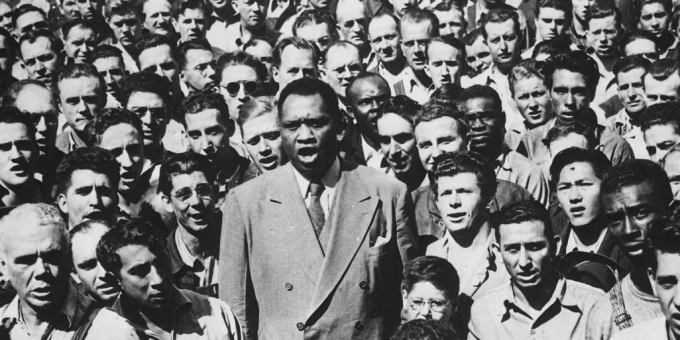
The question of who black American actor, singer and activist Paul Robeson was in anything beyond general outline hovered at the edge of my mind for several years. Earlier this year I googled for a book and found Australian journalist Jeff Sparrow’s No Way But This: In Search of Paul Robeson. I recommend it.
It’s not a straight biography. Sparrow travelled to various parts of the US, Spain, London, South Wales and Moscow to engage with episodes and aspects of Robeson’s life (1898-1976), and a lot of No Way But This consists of his conversations with experts and activists in those places. At first I found this slightly irritating, with a sense that Sparrow was making the book too much about himself. But the way it is constructed actually brings out a lot of interest.
A left-wing political campaigner widely known and respected among oppressed and exploited people in many different parts of the world, Robeson was – and is – also globally admired as an actor, in film and theatre, a singer, and before that as an athlete. All this was achieved in the face of vicious discrimination and persecution, despite his in many ways middle-class background (though his father had been enslaved) and amassing of significant wealth. Sparrow’s book gives a fascinating overview of this remarkable life.
Partly through his own experiences, but to a large extent through the impression made on him by the struggles of working people, Robeson travelled a long way politically from fairly conservative roots, reaching not only left-wing politics in a general sense but “communism”. Not only the black working class of the US but, through a chance encounter which generated a deep life-long connection, the overwhelmingly white miners of South Wales played a central role in that journey.
This is a great story, of an incredibly talented person inspired to devote his life to socialism and working-class struggle – but also a sordid and depressing tragedy. For the "communism" Robeson preached was Stalinism; he became a fellow traveller of the Communist Party USA and a regular visitor to Moscow.
As our American contributor Barry Finger put it in a 1998 article for the centenary of Robeson’s birth:
“Here was a black performer still deep in the age of minstrelsy who comported himself with an implacable dignity and stature, both in film and in public, offering a seditious countervision to the prevailing racist stereotypes and in so doing undoubtedly providing a momentary sigh of relief to the oppressed.
“But Robeson aspired to more than artistic excellence, seeing in his talents and growing prestige an instrument of social and racial liberation. It is the political ends to which that instrument was applied, however, that measures the true tragedy of the man and his generation.”
As Barry explains in detail, the humanist rebel Robeson was also a hardcore Stalinist, breathlessly praising Stalin’s 1936 constitution, supporting US state repression against Trotskyists and comparing the latter to the KKK, the 1956 Hungarian revolutionaries to Franco’s fascists – and all the rest of it. In case this kind of stuff seems somehow peripheral – which of course it is not – consider that, in deference to the CP/“Soviet” line, he opposed war-time campaigning for black equality in the US and, having previously criticised racism against Japanese Americans, said nothing when the government put them in concentration campaigns.
(The CPUSA actively supported Japanese internment – and expelled its interned members! For the importance of the party in black liberation struggles in the 1930s, and how it then betrayed these struggles, see this article by Communist and then Trotskyist leader James P Cannon.)
Another very important Communist of colour (whom Robeson met in London), the Indian nationalist and UK MP Shapurji Saklatvala, became a Stalinist too. Many such prominent figures, and millions of workers, in many countries were part of the wider political tragedy. However a comparison of the dates underlines the depths of Robeson’s descent. Saklatvala was an active revolutionary socialist from 1907 and a Communist activist in the heroic days of the Russian revolution; he died in 1936, before the Moscow Trials (which Robeson militantly defended) heralded the full ascendancy of Stalinism. Robeson’s political awakening began in 1928; he became a “Communist” in the 1930s and remained Stalinist, publicly unyielding, through the horrors of the 40s and 50s all the way to his death in 1976.
Even among the many who have embodied the contradictions of Stalinist movements in the capitalist world, Robeson's case is striking.
I thought at first that Sparrow’s book would be a hagiography. In fact it combines enthusiastic appreciation of Robeson with some determination to consider these violent contradictions.
This was not a given, given the mostly uncritical praise for Robeson – ideologically Stalinist, motivated by artistic appreciation or sympathy, or plain opportunist – which seems pretty widespread on the left. To take a case of what I suspect is opportunism, the brief comment about Robeson and Stalinism in Socialist Review’s review of No Way But This made me wonder if we'd read the same book! ("It has become popular to paint anyone who looked to the Soviet Union in the 1930s as either dupes or accomplices of the crimes of Stalin. Sparrow ably demonstrates here that Paul Robeson was neither of these things"...)
Robeson’s career and mental health were badly damaged by years of aggressive racist hostility, escalating with Cold War witch-hunting (in the context of which more conservative African American leaders also denounced him for his “Communism”). Sparrow speculates that he was also battered by psychological crises stemming from the growing realisation of the contradictions between his professed socialist ideals and the reality of the USSR – while simultaneously remaining unwilling to speaking out about them.
In particular, he centres the persecution of Jewish people by Stalin’s regime after the Second World War – which Robeson was intimately aware of, seemingly shaken by, but denied publicly, even after Stalin’s death.
It’s worth knowing who Paul Robeson was, for good and ill. Jeff Sparrow’s book (together with Barry Finger’s article) is a good starting point. It concludes with an insistence of the need, despite and in fact because of the horrors of Stalinism, for a movement to radically transform society.
• Barry Finger very kindly sent us a second article he wrote, also for New Politics, in 1999, when the US Public Broadcasting Service released a documentary on Robeson. You can read it here.