
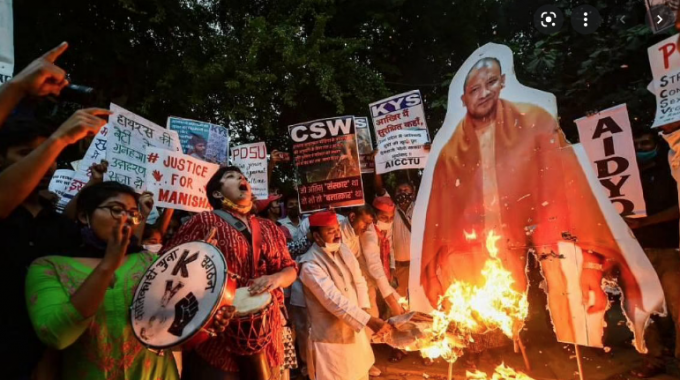
Protesters burn an effigy of Uttar Pradesh's chief minister, fundamentalist monk Yogi Adityanath, after the gang rape of a Dalit woman, October 2021. Effigies of Adityanath were also burnt during last year's farmers' struggle
During the year-long farmers’ movement which humbled India’s far-right government in 2021, forcing repeal of its pro-corporate agricultural reforms, many farmers’ leaders were vocal about their desire to drive that government from power. In March 2021 much of the movement’s leadership went to West Bengal, target of a huge campaign by prime minister Narendra Modi’s Bharatiya Janata Party (Indian People’s Party, BJP), and helped block its takeover attempt in India’s fourth most populous state.
Barring an even more dramatic upheaval, India will not have national elections until 2024. But five more state elections take place this month, with over one hundred million people likely to take part. At least two of the polls could have significant wider consequences.
Elections in Uttar Pradesh and Punjab were surely an important part of why Modi’s government retreated on the farm laws in November. In different ways both will be major tests of how the farmers’ struggle and victory has impacted Indian politics. (The other three states voting, Uttarakhand, Manipur and Goa, may also be telling, but are relatively small.)
In the unlikely event the BJP and its allies can break through in Punjab, the epicentre of the 2021 uprising, their ability to launch an aggressive counter-offensive against the farmers’ movement (and other resistance) will be greatly strengthened. If the BJP loses control of its current stronghold in the giant state of Uttar Pradesh, its position will be much weakened. There will likely be a better environment for the farmers’ movement, workers’ movement and other struggles to push forward with demands.
Pay attention!
The UK media extensively covers elections in countries big and small, and in US states. California has under 40 million inhabitants. Uttar Pradesh has over 230 million: if independent it would be the fifth largest country, bigger than Pakistan and Brazil. Yet there is very little coverage of its election in the British media, mainstream or left.
The British left’s lack of attention is in the teeth of India’s multiple connections with the UK; and the fact that Modi’s government, and the wider Hindu-nationalist political regime and movement it is part of, constitute an important pillar of the global far right. If they fall back that will have enormous positive consequences far beyond India.
Despite failing to suppress the farmers’ movement, the regime has not been defanged. Every day brings fresh atrocities and outrages by the Indian state and Hindu nationalist activists.
Despite last year’s revolt against neoliberalism, and widespread discontent at deepening inequality during the pandemic, the government has just promulgated a neoliberal, privatising budget which the left group CPI-ML describes as “a betrayal of youth, farmers, workers and common people, even as it panders to India’s billionaires”.
But the other side of the coin is this: the farmers’ revolt, the remarkable culture of solidarity and chain of social changes it generated, and its victory over Modi and his corporate backers represent one of the most important “people’s” movements in the world for many years.
We should try to keep learning more and find ways to make solidarity.
Uttar Pradesh
Different parts of Uttar Pradesh (“Northern Province”, UP), in the middle of northern India, will vote in seven phases: the first on 10 February and the last on 7 March, with the votes counted on 10 March.
UP, currently controlled by the BJP with a very big majority, is important for a range of reasons in addition to its massive size – though its size certainly makes it important for winning power nationally. 80 of 543 seats in the Lok Sabha (People’s Assembly – the lower house of India’s parliament) are in UP. In 2019 the BJP won 62.
The state plays a very important role in India’s agriculture, eg accounting for 19% of the country’s food grain production. Its western areas played a very important role in last year's farmers' movement.
UP has a long tradition of “radical” – though generally not anti-capitalist – farmer politics, emblematised by peasant-background, land-reforming late 60s chief minister and later briefly Indian prime minister Chaudhary Charan Singh. Such politics cut across and weakened communal divisions, uniting Hindus and Muslims. Today just under 20% of UP’s people are Muslim or of Muslim background, significantly more than across India, and just under 80% Hindu.
In the late 1980s, as the small-to-middle farmer-oriented political movement Charan Singh had led weakened, farmers’ unions became increasingly important. The Bharatiya Kisan Union (Indian Farmers’ Union, BKU), which was central in the recent struggle, led many mobilisations over issues including higher prices for crops and the cost of electricity. It involved not only farmers of different sizes but landless labourers, and for a period strengthened Hindu-Muslim cooperation.
Hindu nationalism, rising from the 80s, has worked to destroy this political culture. The BJP surged in the 1991 state election; and in 1992 UP became the centre of nationwide communal clashes in which thousands died, after far-right Hindu activists tore down a 16th century mosque, the Babri Masjid, in the city of Ayodhya. (The destruction was illegal, but Hindu organisations, including those who initiated the destruction, have since been granted the land by the courts.)
That was UP Hindutva’s first big wave. Lower-caste political assertion, partly as a result of farm unions’ struggles, helped create a different dynamic, and in the early 21st century UP politics was dominated by two leftish or left-talking parties – the Samajwadi Party (Socialist Party, SP), which is now very mildly social democratic, politically corrupt and socially conservative; and the Bahujan Samaj Party (Majority Society Party, BSP) claiming to represent the state’s Dalits (the lowest, most oppressed caste) in particular. The BSP won the 2007 state elections; the SP won in 2012. In 2012, the SP got over 29% of the vote, the BSP almost 26% and the BJP 15%, falling for the fifth election in a row.
From 2013, the year before Modi first won power nationally, new Hindu nationalist mobilisations to create communal division and polarisation changed the dynamic again.
In August-September 2013, Muzaffarnagar, in the western heartland of the farmers’ movement, saw communal violence – supposedly sparked either by a traffic incident or an episode of sexual harassment – which left 62 dead, 42 Muslim and 20 Hindu, injured close to a hundred and displaced 50,000. Many poor Muslim farmers, artisans and labourers fled.
The Hindu right reaped the harvest. In the 2017 state elections the BJP surged, leaping from 47 to 312 seats out of 403. Several lower-to-middle-caste Hindu groups prominently represented among farmers swung heavily to it. However it is worth noting that, while the BJP vote increased from 15% to just under 40%, the combined SP-BSP total was still over 44% (with Congress and left parties, well over 50%). As nationally in 2014 and '19, the BJP benefited hugely from first-past-the-post.
The state’s chief minister since then has been a monstrous figure, a Hindu fundamentalist monk born Ajay Mohan Bisht but styling himself Yogi Adityanath. Adityanath has repeatedly found himself in conflict with the national BJP leadership, essentially because he regards them as insufficiently zealous and right-wing. His regime has been in the vanguard of both Hindu nationalism’s religious fundamentalist and sectarian drives – including campaigns and laws to discourage inter-religious marriages and special police “anti-Romeo squads” to harass young couples – and its neoliberal ones – including using the pandemic to exempt employers from almost all labour laws.
A flavour of the situation in Uttar Pradesh is given by the 12 journalists killed, 48 assaulted and 66 arrested since the BJP came to power, most of them in the last two years.
Adityanath and the BJP have been knocked by issues including their government’s disastrous handling of the pandemic; high crimes rates including rising attacks against Dalits and non-Hindus; lack of safety for women “despite” the Hindu right’s moralistic and communalist campaigns; and a dire social and economic situation including desperate youth unemployment. India's youth unemployment rate is 25%.
In 2019-20 UP was one of the centres of youth-driven protests against the Modi government's anti-Muslim changes to citizenship law, as well unemployment, inequality and other issues.
The BJP has appealed strongly to Hindu chauvinist and anti-Muslim narratives to shore up its support. Adityanath has led agitation presenting the 2013 clashes as primarily persecution of Hindus, alongside all manner of other anti-Muslim themes used by the BJP nationwide. He has said those who oppose the BJP "love Pakistan" and openly called it an “80 vs 20” election (ie Hindu vs Muslim).
Campaigning in UP, Modi's home minister Amit Shah spoke about “Mughal invaders”, strongly suggesting Muslims are an alien presence in India that should be driven out.
Naturally none of the BJP’s candidates are Muslim (quite a lot of the SP's and BSP's are). With the BJP takeover of the state assembly in 2017 the proportion of Muslim members fell from 17% to 6%. This in a state - and a country - in which Muslim-background people suffer systematic discrimination and disadvantage.
Coming in the midst of the wider social crisis, the farmers’ struggle has disrupted the BJP's communalist strategy and put it on the back foot. In the west of UP in particular the movement organised many mass meetings in which both Hindu and Muslim farmers and labourers participated, and as well as denouncing the BJP farm union leaders used slogans from both religions to encourage cross-communal unity. It is widely reported that the social and political “atmosphere” in villages in the west of the state has changed significantly from five years ago.
UP was also the site of a possibly decisive turning point in the farm laws struggle. In October four farmers and a journalist were killed and ten injured when a convoy of cars rammed into a protest in the northern district of Lakhimpur Kheri. Two of the cars belonged to local MP and national home affairs minister Ajay Mishra Teni, and his son was in one of them.
The farmers’ movement made Mishra’s resignation a central demand; this is the only point on which Modi has made no concessions. However these events were a propaganda disaster for the BJP, sharpening the bitterness generated by hundreds of protesters’ deaths and the nationalist propaganda offensive against the farmers’ movement. By the time of the Lakhimpur Kheri incident the farmers had been in struggle for over ten months; Modi announced the withdrawal of the farm laws six weeks later.
Probably the most prominent national leader of the farmers’ movement is Muzaffarnagar-born Rakesh Tikait, national spokesperson for the BKU. A politically ambiguous figure who before 2020 aided the BJP, he now denounces its treatment of the farmers virulently, its neo-liberal economic policies strongly and its communal agitation more hesitantly. He is popular among the middling farmer social groups that previously swung strongly to the BJP, and now much more widely too.
Leaders of the BKU and the Samyukt Kisan Morcha (United Farmers’ Front, SKM: the national coalition of over forty farmers’ organisations that led last year’s struggle) have flipflopped on what if anything they are calling for in the UP vote. But on 4 February Tikait issued social media posts using the slogan #novotetobjp and appealing to farmers in UP and the neighbouring much smaller state of Uttarakhand: “We need your support to teach the BJP which insults the farmers”.
Tikait said the SKM would be holding pre-election events across UP. His intervention is regarded by many as an important last-minute setback for the BJP.
The polls suggest that the main rival to the BJP is a coalition of the Samajwadi Party with seven smaller organisations including Rashtriya Lok Dal (National People’s Battalion), the political descendant of Charan Singh’s farmer-based political movement. The Bahujan Samaj Party is standing by itself; there is also a more radical Dalit-based party emerging out of recent Dalit mobilisations, Azad Samaj (Free Society). The liberal / neo-liberal Indian National Congress, the main national opposition party but weak in UP (Indian politics is highly regionalised), is also standing by itself. There is a “Left Front” coalition of four Stalinist / social-democratic parties, unlikely to make much of an impact.
If the SP’s coalition wins, 2012-2017 chief minister Akhilesh Yadav will return. This is not in itself cause for celebration; the “socialist” SP is a conservative political machine. However it would be a sharp blow for the Hindu right and give heart to those fighting it.
The polls suggest the BJP will probably lose seats but hold on, though they had tightened considerably even before Tikait’s intervention. What exactly Marxists in Uttar Pradesh should advocate in the election I don’t know – but I am keeping everything crossed!
Punjab
The state election in Punjab, in north-west India, takes place on 20 February and the count on 10 March.
The minority of historic Punjab that became part of India in the partition of 1947 has a population of 31 million. It is in important respects very different from Uttar Pradesh, but also a centre of the 2020-21 farmers’ movement. In fact the centre: the struggle against the farm laws began in Punjab, and Punjabi farmers, farm labourers and supporters made up a core contingent of the activists who massed on the Haryana-Delhi border. About 600 of the 700 who died during the protests were Punjabis.
Punjab plays a massively disproportionate role in Indian agriculture. With less than 2% of the country’s land area and just over 2% of its population, in 2019-20 it contributed 37% of India’s “central pool” of wheat production. In the past its role was even greater.
The background to Punjabi farmers and labourers’ role in 2020-21 is a very long history of struggles in the state, stronger farm unions and a stronger left influence within them than in other states.
Punjab’s politics are in flux. They were previously dominated by Congress and the Sikh-based conservative party Shiromani Akali Dal (Supreme Eternal-Ones Battalion, SAD – the name is a Sikh religious reference). SAD was part of the BJP’s “National Democratic Alliance” but left in 2020 over the farm laws: although it is right-wing, its leaders were aware how unpopular the laws were among Punjabi Sikhs, who make up a substantial majority of the state’s farmers.
About 57% of Punjab’s population is Sikh; although about 38% is Hindu, the BJP only managed 5.4% last time, in 2017.
During the farmers’ struggle it looked like the Hindu right was gearing up for a campaign against India’s Sikhs, perhaps even hoping to unleash the kind of massacres which followed the assassination of prime minister Indira Gandhi in 1984, in retaliation for military action against Sikh fundamentalists occupying Sikhism's most important shrine, the Golden Temple in Amritsar. With essentially no basis in reality, BJP politicians and right-wing activists and commentators accused Sikh farmer activists of being “Khalistanis” – supporters of an independent Sikh state in Punjab. The powerful cross-communal solidarity of the farmers’ movement stymied the anti-Sikh agitation.
This is not to say the Sikh religion and culture of most Punjabi farmers played no role in the farm laws struggle: eg see the arguments about political ethos, forms of organising and logistics here.
In this year’s election in Punjab, the BJP is in alliance with right-wing defectors from Congress, one of them recent chief minister Amarinder Singh. If they are able to win a state government allied to Modi’s regime, that could put Punjab’s farmers’ and farm labourers’ organisations in severe danger. However this looks unlikely.
The BJP's alliance is doing worse in the polls than the BJP itself did last time. When Modi tried to campaign in Punjab last month protesters blocked his way; the turnout at the rally he didn't make was embarrassing.
In the 2017 election the Aam Admi Party (Common Man Party, AAP), a leftish, populist, anti-corruption party that runs the government of Delhi, surged from nowhere into third place. Every poll in the last year has the AAP first, narrowly ahead of Congress, and likely to be the largest party in a hung assembly. Since Amarinder Singh resigned as CM and announced his alliance with the BJP, both the AAP and Congress have risen in the polls. The BJP has declined, as has SAD (in an alliance, for reasons I don't really understand, with the Bahujan Samaj Party discussed above). The Stalinist / social democratic parties, once strong in Punjab, are as in UP unlikely to get many votes.
Adding some unpredictability, a section of the farmers’ movement is contesting the elections under the banner Sanyukt Samaj Morcha (United Society Front, SSM), in alliance with the farmer-based Sanyukt Sangharsh Party (United Struggle Party, SSP).
The SSM is led by, and is promoting as its CM candidate, Balbiar Singh Rajewal, head of the BKU (Rajewal), another farm union that was very important in the protests. (If I’ve understood rightly, there are multiple unions called BKU, often distinguished by the name of their most senior leader.) The idea of standing candidates is controversial among farm unions, and BKU (Rajewal) and others have been excluded from the SKM coalition as a result of their electoral campaign in Punjab. Punjab's farm unions, including the more left-wing ones, are also divided on the question.
At one point a farmers’ movement-Aam Admi Party electoral alliance was touted, but it fell through. The SSM has made left-wing criticisms of the AAP that seem plausible – including that its government in Delhi did little to help the farmers’ protest encampments on the capital’s borders. However, from the English language sources I have read, it is hard to assess the overall political character of the SSM / SSP campaign. It also seems hard to tell how well it is likely to do.
Whatever the main outcome, if the BJP and its friends are crushed that will be very good news. If some strong anti-farm law activists are elected – particularly if any are farm labourers – even better.
The results in Uttar Pradesh and Punjab will have an important impact on the debates and struggles around how to confront the BJP and remove it from power in 2024 or sooner, what role the left can and should play in this, and what comes afterwards.