
We know less about the future of the Omicron variant of the virus behind Covid than do the scientists who insist that it will be weeks before a clear picture.
But from what the scientists are reasonably sure of, already some political conclusions follow.
The months for which governments have stalled demands to requisition Big Pharma assets — at least the patents and the technical know-how which would allow ultra-fast worldwide expansion of vaccine production and distribution — will now take a toll in Africa.
The world jab rate has been more or less static, around 0.4 doses per 100 people per day, since May. Big Pharma’s profit drive has ruled supreme. When richer countries have dispatched vaccines to poorer countries, it has often been as an afterthought — at short notice, and of doses near expiry date, so it is difficult to use them efficiently.
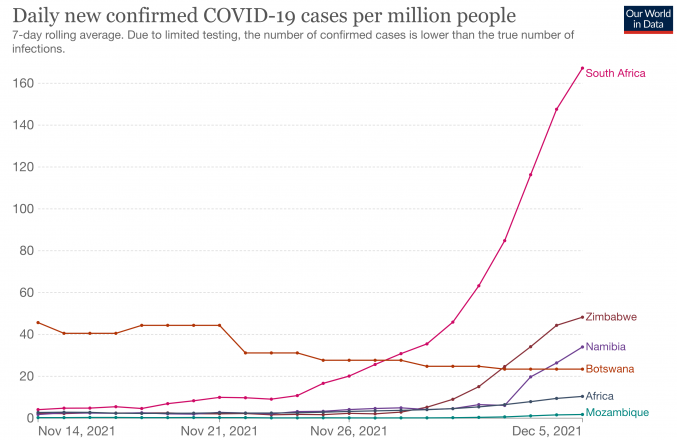
Now, probably thanks to Omicron, Covid is spreading rapidly in South Africa and in the neighbouring countries (except, inexplicably, Botswana, where Omicron was first detected). South Africa has only 25% fully vaccinated, and the neighbouring countries many fewer.
Africa’s official (though surely underestimated) Covid death count so far is 16 per 100,000 population, much lower than Europe’s 192. Even a more comparable estimate of excess deaths (by the Economist magazine) shows Africa at 65-190 per 100,000, while Europe is 320-340.
A younger population helps. Yet Omicron will hit harder in unvaccinated populations than vaccinated. Even a late effort for vaccine justice will give at least some protection against Omicron.
Scientists say that Omicron evades vaccine and previous-infection immunity sizeably, but those immunities will probably reduce severe infection. They don’t know whether Omicron brings fiercer (or milder) symptoms than other variants.
Omicron has already spread to dozens of countries, and it will spread in Britain.
In Britain and other European countries, vax rates are already high. So the Covid death rate in Britain is one-tenth what it was when case counts were similar in early 2021. But Israel, in August-September, and Chile, in early summer, have shown that even relatively high-vax countries can have Covid surges big enough to bring high death counts.
Britain’s Covid count has been increasing and, even without Omicron, would be likely to increase faster as winter proper sets in (December-February), with more indoors crowding. And NHS hospitals are already overstretched, even before winter gets going.
Countries across Europe have responded to the recent new Delta surges, and the probability of bigger Omicron surges, with tighter mask and covid-distancing rules, with drives to get vax rates up from levels like Germany’s 68% (the same as the UK) to Portugal’s 88%, and with booster jabs. The Tories in Britain differ, relying almost exclusively on booster jabs.
Masks have limited effect; covid-distancing rules are clumsy and have many downsides, and they only delay the virus; but they do delay it, and delay can make a big difference here.
The labour movement can make a difference too. Many bosses are still pushing to get workers back into offices, though risk assessments made with earlier variants of the virus were already out of date with Delta, probably more so with Omicron. Unions should push the other way.
Demand workers’ control of workplace safety, and full isolation pay for all! Demand the reintroduction of furlough payments to facilitate a quick shutdown of high-risk workplaces if Covid rates soar. And demand immediate requisitioning of extra resources for the NHS and social care!
Graph: John Hopkins University CSSE Covid-19 data