

You can buy Sacha Ismail's pamphlet telling the full story of Shapurji Saklatvala here.
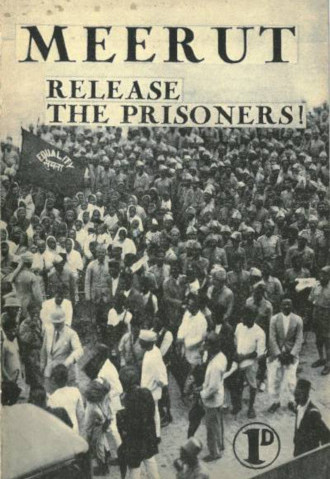
Image above: 25 of the accused in the Meerut conspiracy case
This is part five of a series. For the other articles, see here.
“Mr Saklatvala… has great influence in India. Irrespective of his Communist views, the Indian people are proud of him… They, a subject race… are naturally proud of the courage with which Saklatvala, one of themselves, denounces the British domination of India in unmeasured terms in the very House of Commons itself. He is a rebel by proxy for them all… When he speaks to them, therefore, they listen, and he speaks to them frequently.”
– “India’s lost faith in Labour”, Socialist Review, 1928
Now let us look at Saklatvala’s relationship to the struggle in India itself. His starting point was opposition to British rule. In 1927, when Parliament discussed the creation of an all-British “commission” on the future of India, he protested in the Commons, denouncing the whole idea of people being ruled by another country:
“May I ask the House just to review the historical position from 1910 to 1914? There was the Kaiser in Europe. He also felt the same thing [as the Tories argued about India], that... there was such a welter and chaos that one strong man was required to rule the whole of Europe. He failed. You succeeded. That is the only difference, but the claim of the Kaiser and the British Kaisers is equally preposterous from the ethical standpoint and the point of view of national rights.”
His speech repeatedly assailed the idea that British rule was somehow intended to bolster the rights of minorities or any working people in India:
“Who are the majority of the Indian people? Never mind the Hindus and Mohammedans, because religious differences exist in all nations of the world. The majority of the people of India are peasants and agriculturalists. The majority of the people in the large cities are industrial workers. What rights have you given to them? … What is the purpose of this country’s rule in India? To keep talking of minorities and to trample on the rights and progress of the majority.”
“It is not your fault”, added Saklatvala. “The Romans did the same thing once when they were ruling your country. My ancestors, the Persians, did the same thing when they were ruling the Jews, the Assyrians and the Turks.”
In 1923, during his first year in Parliament, he had intervened in a debate about the role of Britain’s Viceroy by denouncing “the right of this country to send a Viceroy at all”. Although he perhaps shifted towards a more aggressively anti-colonial stance during the 1920s, he had held the same basic position for decades.
India’s rising tide
Saklatvala’s rise to prominence coincided with a rising tide of India’s national liberation movement – not coincidentally, since the Russian Revolution and its ripples set the context for many rising anti-colonial struggles as well as the working-class upsurge in Europe.
Also important was the upheaval of the war, in which Allied leaders proclaimed a principle of self-determination but did not apply it to colonies of the victorious powers. So was British repression: in 1919 the government suspended the rights of defendants in sedition trials and the army killed hundreds in the Jallianwala Bagh massacre in Amritsar. This in the middle of a “Spanish flu” pandemic in which perhaps 18 million Indians died. In 1919 the Indian National Congress moved away from cooperation with the British authorities and launched a more militant struggle for complete independence.
India also saw a growth of specifically working-class and socialist struggles. As the 1931 Royal Commission on Labour in India expressed it, from the early 20s there was a “realisation of the potentialities of the strike” and “industrial strife became almost general”. Groups of socialist workers, labour organisers and intellectuals organised and intervened in this ferment. The Communist Party of India was founded as a solid organisation in 1925.
In 1927 Saklatvala toured India for three months, pledging – as he put it in his appeal in the Daily Herald for solidarity messages – “a great effort from the Indian end to pull the two working-class brotherhoods [Indian and British] together”. He got an overwhelming reception, speaking to thousands wherever he went. The authorities of nine cities formally welcomed him, despite the undemocratic nature of local government in India and opposition from British officials.
Saklatvala used his “megaphone” to encourage working-class and peasant organisation, and to urge young nationalists to help workers assert themselves, including by taking jobs in industry. Behind the scenes he helped build and organise the CPI in the areas he visited.
Respected well beyond the limits of the Communist movement, Saklatvala was close politically and personally to many more mainstream nationalists, including future prime minister Jawaharlal Nehru. As you might expect, however, he did not shy away from hashing out his political disagreements.
While India in 1927 he engaged in polemics with Mohandas Gandhi, in written exchanges and on one occasion in person. He criticised Gandhi’s limited and in many ways backward-looking perspective, counterposing the organisation of workers and peasants to struggle for their rights against capitalism:
“The acuteness with which the class war operates upon the wage-earners of India is more than in most of the advanced European countries... The class war in India is murderous... to throw dust in the eyes of the world that class war is not operating in India is inhuman and monstrous... Class war is there and will continue to be there until... Communism abolishes it. But in the meantime, not to struggle against its evil effects day to day is a doctrine which cannot appeal to any genuine humanitarianism...”
He demanded an end to the “moral plague” of cult-like devotion which surrounded the nationalist leader, including his use of the honorific “Mahatma” (“Great Soul” – venerable or holy man). Gandhi’s replies praised Saklatvala but, unsurprisingly, firmly disagreed.
How the British government viewed all this can be judged by the fact that, on Saklatvala’s return to the UK, it announced his passport would no longer be valid for travel to India. This ban remained in place for the rest of his life, including under the 1929-31 Labour government.
Six months after Saklatvala arrived back, the government appointed its commission on India. Chaired by right-wing Liberal MP John Simon, it was made up entirely of white British politicians – including two Labour MPs, one of them Clement Attlee. Despite claiming to support Indian self-determination, the Labour leadership backed the commission. Indian nationalists were outraged and called for the party to withdraw its support and representatives.
When the commissioners arrived in India in 1928, they met a very different reception to Saklatvala’s, with mass protests and strikes (“Simon, go back”). After police attacked demonstrators to clear the way for the commission in Lahore, nationalist leader Lala Lajpat Rai died of his injuries. Saklatvala helped organise the fight against the commission, in the name of full independence, in Britain.
Anti-imperialist organising
The Communist International’s work in the colonies was organised primarily by a network led by Manabendra Nath (MN) Roy; he and Saklatvala had important differences, including on how Communists should relate to India’s bourgeois nationalists, and Saklatvala was increasingly distrustful of and hostile to Roy. As a result he was often excluded (or self-excluded) from the International’s colonial work.
He did nonetheless play a significant part, due to his position in the CPGB and as an MP. The British party was responsible for work in India until the CPI was firmly established in 1925; Saklatvala pushed to ensure it took this work, and anti-imperialism more generally, seriously. He himself undertook various roles, from establishing CI connections while travelling as an MP; to liaising with and helping set up unions in India; to interviewing Indian students in Britain who could help build the CPI when they returned home. Even after the CPI’s establishment, his status made him an important international liaison and propagandist, as his 1927 tour demonstrated.
He played a high-profile role in the League Against Imperialism – an international network of organisations and activists founded on the CI’s initiative in 1927, drawing in prominent anti-colonial leaders in many countries and colonies. The LAI was named as an attack on the League of Nations, which had perpetuated colonialism by handing territories over to European control as “mandates”. Through it Saklatvala supported anti-colonial struggles in other parts of the world, for instance in Nigeria.
The LAI was an early venture by Willi Münzenberg, a Stalinist who – after leading the international campaign for Sacco and Vanzetti – managed to put together a number of Popular Front-type show events even in the depths of the CI’s “ultra-left” Third Period. Trotsky described the venture as a “masquerade”, and one of the leading groups featured in the first LAI congress was Chiang Kai-shek’s Guomindang, which only two months later would massacre the Communist-led workers in Shanghai. By the time the organisation folded in 1937, the Stalinists were minimising their opposition to the imperialism of the Western “democracies” in search of military alliances against Nazi Germany.
In 1927 the Communist Parties were as yet far from completely Stalinised, and for Saklatvala and many others in the British labour movement, the LAI meant militant opposition to colonialism.
Communism on trial
In 1928-9 over 31 million worker-days were lost to strikes in India, and the depression further energised workers’ and peasants’ struggles. The growth of working-class militancy and Communist activism alarmed the British authorities, who intensified their repression. In 1929 this came to a head with the Meerut conspiracy case, named after the small town near Delhi where the trial took place. 32 left-wing labour organisers, 29 Indian (of diverse religious and ethnic origins) and three British, were charged with attempting to “deprive the King Emperor of his Sovereignty of British India” and “incitement of antagonism between Capital and Labour”.
Naturally many of the accused were Communists. The charges referred extensively to Communists and their International. Britain’s Viceroy wrote of his hopes of dealing a “severe blow to the Indian Communist movement”.
As word of the arrests spread, there were big protests, including strikes in Bombay’s textile industry. It was the beginning of a major struggle.
The international campaign was led by organisations in which Saklatvala was central, including the League Against Imperialism and the Workers’ Welfare League of India. Before and after losing his parliamentary seat in 1929, he spoke and campaigned prolifically for the liberation of the prisoners, who he pointed out were guilty of “no more heinous a crime than openly and legally organising workers and peasants in India” (London May Day, 1929).
After four years in India’s brutal prison system – in 1930 holding something like 23,000 political prisoners – sixteen were sentenced to transportation to a penal colony for between five years and life, and eleven to “rigorous imprisonment” for three to four years.
The Meerut trials took place mainly under a Labour government. The arrests occurred just before the 1929 general election in which Ramsay MacDonald returned to office; it was his Secretary of State for the Colonies, Fabian leader Sidney Webb, who allowed the process to go forward. The Labour leadership continued and deepened the awful record of its 1924 government.
Left-wingers such as George Lansbury, while critical of what was happening in India, remained in the MacDonald government while this scandal was taking place and as a result were relatively muted. Nonetheless, there was serious unrest in the British labour movement about the trials, including in the Labour Party.
Later in 1933, in the midst of great agitation and protest, with a realisation that the affair was actually strengthening Communism in India, eight of the convicts were released and the remaining sentences greatly reduced – but no thanks to the Labour leadership.
The analysis Saklatvala made in the House of Commons in 1928 had been shamefully confirmed:
“The workers in Great Britain should realise that God has not created man to be ruled dictatorially and autocratically by another man. Through self-determination and mutual consent we should elect somebody to rule who is not a socialist boss, but a helper and adviser. If that is our essential belief, how can the people of this country believe that God has created the British Labour Party to rule the Indians and the Chinese? ‘We are ruling you; we are sending Commissions to your countries because you are less experienced and we are more experienced, and we want to be kind to you and tell you how you should live your lives.’ That is exactly what the capitalist masters and bosses are saying to the workers in this country. They say to them, ‘We are more experienced in directing industry than you are, and we keep an Army, a Navy, and an Air Force to protect you...’ Socialism believes that that sort of incapacity is not inherent in human nature. How can the Labour Party say that they are preaching socialism and collecting the majority of voices in favour of socialism when they are pursuing such a policy as I have described?”
• Part six here
• Part four, also about Saklatvala, India and colonialism, here
Comments?We welcome replies, corrections and debate pieces. Contact us