
by Alex Wilson
Last week, I showed two year 7 classes the following picture in their French lessons:
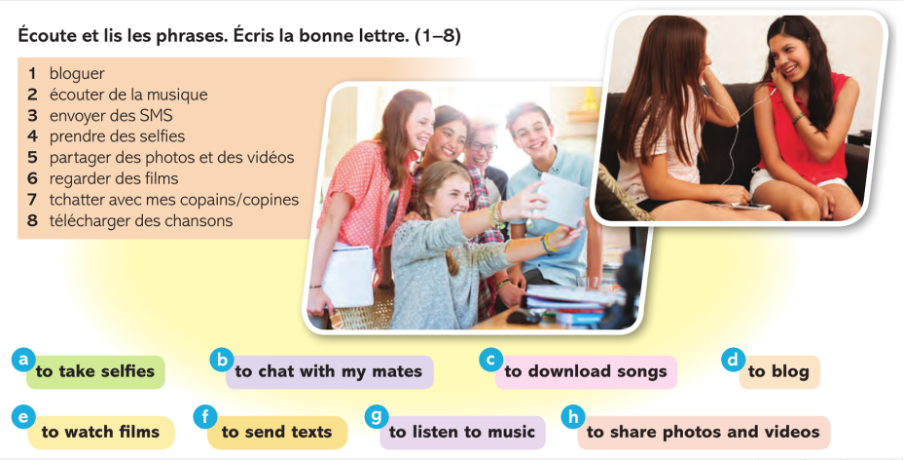
To introduce new vocabulary on the topic of likes and dislikes, the students had to match the French and the English. The top set (32 students), who I asked to match the words with no further explanation, had finished in a few minutes. Some had completed before I even gave any instructions. We talked about the answers, and I deviated to talk about infinitives. I made up a story about how infinitives are verbs that grow on a tree called verbus treeonicus in an orchard outside Paris, and that there are three kinds of French verb apples: -er verb apples, -re verb apples, and -ir verb apples. They picked out the -er and -re verbs in the exercise, and changed the infinitives into present participles. One student said they didn’t understand what an infinitive was, and was confident enough to put up their hand and seek confirmation. I then encouraged them to make new phrases from the language on the board, and the whole room was in stitches as students offered ‘j’aime regarder mes copains et écouter des selfies’. I like watching my friends and listening to selfies. One student suggested he liked downloading friends as he didn’t have any (more hilarity ensued). Friendship is an incredibly sensitive topic in school children: this one had the esteem to make jokes about it at his own expense, but many wouldn’t.
The bottom set has 16 students. I introduced the activity slightly differently, doing a couple of examples, pointing out the cognates and discussing together how to use a process of elimination. One student completed it. The rest did anything they could not to: get up and walk around, talk to each other, claim not to understand, claim not knowing what to do. Not pick up pens. Get into confrontation about uniform expectations, exploding pens … all the usual things! Well, why should they? They know their place. They are intelligent humans. But it wasn’t always like this. In term one, all 16 were trying. But by term two, word had got around: are we in the bottom set sir? Four or five of the students started to disengage. Now by term three, only one student is regularly trying to complete activities. On Monday, I will be trying a different approach, and we will be using a set of videos and activities to try and open a discussion about growth mindset, and what it means to try, even if something is difficult. It is my job to continually seek to engage the minds of young people, I must continue to reflect on and seek to improve my practise; I hope that I can help them to recover some of the esteem that they seem to have lost in French lessons since they started secondary school.
Of course, addressing mindset with individual groups is just an attempt to paper over cracks created by an unfair system, one which judges children on ability and limits their mental mobility by putting them in a rigid box marked bottom set, and one that, in my view, harms their esteem. As socialists, what should we be doing so that we no longer have to paper over cracks for future generations, so that all children who are learning in our care are free to explore new information without judgement and in a way that their brains allow?
We must advocate at work for an education system that lights a fire in our students, not one which leaves them feeling judged and deflated. In our conversations with colleagues, we must advocate for classes which treat children as human equals, all with the right to learn in the same surroundings to their ability. We must recognise that students learn in different ways, that they are neurodiverse, and welcome this diversity in our classrooms. We must work together in our unions and demand set-free schools, and an end to the exam factory approach. Above all, we must show unending belief in the potential that children have to become free thinkers and uphold them at every opportunity.
Comments?We welcome replies, corrections and debate pieces. Contact us