

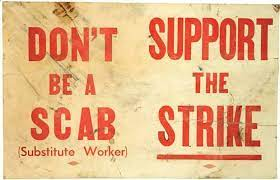
Following RMT general secretary Mick Lynch's retirement announcement (on which, more on this blog soon), there was a fair bit of chat in mess rooms, and a flurry of posts in union WhatsApp groups, recounting some of his greatest hits from the period in 2022-3 when he became a media celebrity.
Particularly highlighted was his pithy question to Sky News' Kay Burley: "Do you not know how a picket line works?"
(You can watch the interview here.)
Lynch was responding to Burley's efforts to draw him into suggesting that intimidatory or even violent tactics would be used to stop "agency workers" from breaking strikes. Lynch quite rightly responded by saying that RMT members would picket their workplaces, and ask agency workers not to cross the picket lines.
At one point in the interview, Lynch stepped aside to indicate the picket line behind him, very visibly not engaged in anything remotely violent or in any way disruptive, to further demonstrate that Burley's implications of potential violence were nonsensical.
It was certainly satisfying to see Lynch cut through an obviously bad-faith line of questioning. And he was right to affirm the basic purpose of a picket line: to persuade workers to join the strike rather than break it. But the vignette also highlighted something less encouraging about the state of industrial struggle in Britain, even at the generational high-point represented by the 2022-3 strike wave.
Most picket lines, including the one behind Lynch during this interview, are more like static demonstrations. Many take place away from the actual entrances to workplaces, in locations where strike breakers don't have to cross them in order to get into work. In short, most picket lines do not perform the function Lynch said they should: of confronting potential strike-breakers and persuading them not to go into work.
In workplaces with multiple entrance points, where workers can arrive via a variety of modes of transport, it is logistically difficult to organise picketing in such a way that ensures anyone coming into work will have to physically cross one to do so. But the diminution of picketing from mass forms of direct action, aimed at shutting down production in a workplace, to the current model of small static demonstrations, is ultimately not a logistical issue. It is substantially a product of a generation of labour-movement defeat, and the restrictive anti-strike laws triumphant Tory governments imposed in the wake of their victories. We instinctively assume that employers will simply call the police, or private security, to move picket lines on if we mount them in locations considered to be overly obstructive. Many of us are also understandably reticent about conduct on a picket line being made the subject of disciplinary proceedings at work once the strike is over.
Static-demonstration picket lines serve a purpose too, as a visible expression of a strike and a place where striking workers can gather to show solidarity and discuss issues and next steps. They also serve as focal points for the public and allow us to explain the demands of the strike to passersby, rallying potential support. But to maximise the impact of strikes, we — that is, the entire trade union movement — need to find a way to get back to more "old school" forms of picketing.
This does not mean intimidation or violence. The first method of the picket line should always be persuasion rather than obstruction. But ultimately, we do need to see our picket lines as aiming to stop the job.
We can't rebuild the cultures of mass picketing seen at the high-points of class struggle in the 1970s and 80s, seen during heroic class battles such as Saltley Gate, Grunwick, and the 84-5 miners' strike, at will. Nor will every picket line in every strike, even at high points, be a mass event. But if we want to level up the combativeness and confidence of our movement towards such a rebuilding, we can surely start by finding ways to push the envelope a little bit. How about setting up the picket line at the actual entrance to the workplace to start with, and daring management to move us on? If they do so, we can always take a collective decision about whether to move.
The 2022-3 strike wave, for which Mick Lynch became a de facto spokesperson, was the most significant period of workers' action since the late 1980s. To make those strikes the first phase of a more sustained revival, rather than a blip in an ongoing period of stagnation, we must find ways to energise and radicalise our movement, including in how we organise direct action such as picketing.
Comments?We welcome replies, corrections and debate pieces. Contact us