

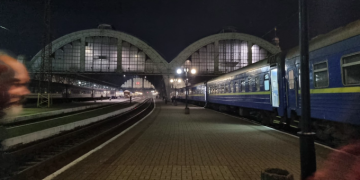
During a solidarity trip to Ukraine, railway writer and trainer Janine Booth spoke with a Ukrainian train driver.
On Saturday morning, we met with Volodymyr, a train driver on the state-owned railway, based in Lviv.
Working in war conditions
He told us that for him and his workmates, working conditions have not changed much since the invasion, although wages have fallen twice and some bonus payments have stopped. However, the situation for rail workers in the occupied territories is different, and is generally very bad.
Railway workers can be conscripted to the armed forces, but have mostly not been so far.
Male and stale?
The rail workforce is old, and Volodymyr feels that they accept poor working conditions more readily than younger workers would. New workers get the worst working conditions, and starting wages are so low that young workers are not attracted to railway work. There are seniority benefits – the longer you work on the railway, the better your conditions.
The normal retirement age is 55 for drivers, but up to 65 for other grades. Volodymyr believes that around ten percent of drivers are still working on the railway when they should really be retired.
There are no women drivers on mainline railway services. There are women ticket sellers, platform staff and ticket-checking staff on trains (there are no ticket barriers at stations), and a very small number of women engineers.
Two trade unions
Volodymyr is a member of the Free Trade Union of Railway Workers of Ukraine (VZU), which is part of the Confederation of Free Trade Unions of Ukraine (KVTU).
The established union is the Trade Union of Railwaymen and Transport Builders of Ukraine (ZALP). I had contacted this union to arrange a meeting during our trip, but they were unable to do so. Volodymyr’s union, VZU, was set up 1994 by a minority of members who felt that ZALP was not doing its job to maintain workers’ pay, terms and conditions.
VZU has a thousand members in Lviv and ten thousand across Ukraine, representing about a third of drivers and about one-tenth of the railway workforce as a whole. VZU’s membership fell because of the loss of members in occupied territories Donetsk and Luhansk. All train drivers are members of one of the unions, but this varies in other grades.
The union helps workers with their problems. As strikes are banned, all the union can do is negotiate with the employer and the government.
Volodymyr told us that ZALP has more resources for campaigning than VZU, but is seen by workers as a friend of the government, which does not make important demands, such as higher pay or recruiting more young people to work on the railway.
Asked about ZALP’s opposition to new ‘minimum service’ laws brought in by the government, Volodymyr was unaware of this, saying that “New laws come in so frequently, it is hard to keep up!” It seems like this issue is one that ZALP’s leaders are more concerned about than railway workers are.
Long hours, low pay
Drivers work 180-190 hours a month (around 43 hours per week), but many work overtime, taking their hours to over two hundred per month. Overtime is voluntary, and while there is no direct pressure from managers to do it, drivers feel compelled to by low wages.
The railway is short-staffed, particularly in non-driving grades.
There are also safety issues: accidents, crashes, falls, some assaults by (drunk) passengers, and dangers from electricity. Although Ukraine’s railway runs both diesel and electric trains, the majority – including all long-distance trains – are electric.
How we can support
Asked how UK rail workers can support our Ukrainian colleagues, Volodymyr emphasised the need to put pressure on the government to improve working conditions and to recruit more young people.
His union holds a national union conference once a year, and we could come as visitors.
When railway workers are killed in the war, the union supports their families. We could maybe raise some money for the support fund, especially as UK rail unions have a long tradition of supporting the families of members killed at work.
Comments?We welcome replies, corrections and debate pieces. Contact us